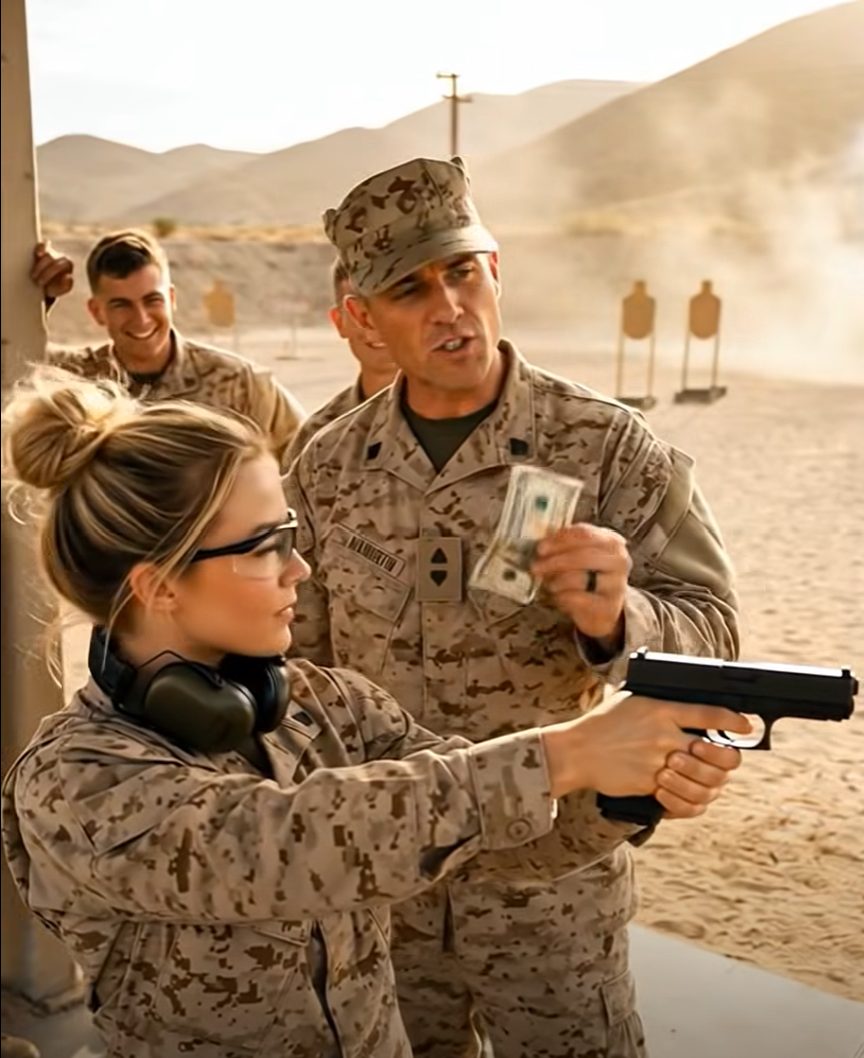
“You really thought I was just some girl holding a gun for fun?” – I chambered a round beneath the Marines’ mocking laughter, right before my six shots turned their little bet into a nightmare no one at the range would ever forget.
“Shooter down! Somebody call 911!”
That scream cut through the range before the first body even hit the concrete.
My name is Rachel Voss, and the moment Sergeant Michael Ducker turned from mocking me to reaching for his pistol, I knew this afternoon had stopped being a stupid ego contest and become something far worse.
One second, the Marines behind him were grinning, waiting for me to embarrass myself. The next, two sharp cracks came from somewhere beyond the parking lot wall – not from the firing line, but behind us, wrong angle, wrong rhythm, wrong sound. Real incoming. Not range fire.
The gray-mustached range officer folded like somebody had yanked his strings. Blood sprayed across bay six. A woman near the vending machine dropped screaming. Everyone else did what civilians always do when violence shows up uninvited: they froze half a beat too long.
“Down!” I shouted.
Ducker stared at me like he hadn’t processed the change yet. Then a third shot snapped over our heads and punched sparks off the steel frame behind lane eight. His training kicked in. He went low fast, barking at his Marines to cover the line.
I was already moving.
The Glock rental felt cheap in my hand, but weight is weight and sights are sights. I slid behind the concrete divider, grabbed the injured woman by her wrist, and dragged her flat. She was bleeding from the shoulder, panicked, trying to crawl the wrong way.
“Look at me,” I said. “You move when I move. That’s how you live.”
Ducker landed beside me, breathing hard now, pride gone clean out of his face. “You military?”
“Was.”
Another round cracked through the signboard over the check-in desk. Too controlled to be random. Too patient to be panic. Whoever was out there had elevation on the lot and eyes on the exits.
One of the younger Marines – Lance Corporal Ethan Kim, if I remembered Ducker introducing them right – pointed toward the far berm. “Top of the maintenance shed!”
I risked one glance and saw it: a figure in sun-faded work coveralls, rifle braced, face hidden behind dark eye protection.
Then he shifted just enough for me to catch the tattoo climbing his neck.
My stomach dropped.
I knew that tattoo.
I had watched the man wearing it d*e seven years ago in Helmand.
And now he was aiming straight at me.
What the Dead Look Like
The tattoo was a black scorpion, tail curling up behind the left ear. The artist had done it freehand, which meant the claws were uneven, the tail too thick at the base. I’d teased him about it once. He’d laughed and said symmetry was overrated.
His name was Dale Pruitt. Staff Sergeant, 75th Ranger Regiment, attached to our forward element for a week-long joint op near Sangin. He’d been funny. Loud. The kind of guy who made friends out of strangers in under ten minutes. I’d liked him immediately, which made what happened to him worse.
An IED on a dirt road that had no business being a road. The blast had been big enough that there wasn’t much to recover. We’d been told he was gone. There’d been a memorial. I’d written a letter to his mother in Decatur, Georgia. She’d written back.
And yet.
The figure on the shed shifted again, tracking something, and I caught the profile clean for just under a second. Square jaw. Big through the shoulders. The way he held the rifle, stock seated deep, elbow tucked, not how most people hold a gun, the way someone holds it when they’ve done it so many times the form is just breathing.
That was Dale Pruitt.
Or it was someone wearing his tattoo and his muscle memory, which seemed like a longer explanation.
Ducker was three feet to my left, pressed against the divider. He had his service weapon out now, a Beretta M9, and he was doing the math on angles the same way I was.
“You know him?” he said. Not accusing. Reading my face.
“I might.”
“Might.”
“Seven years ago I watched him get killed.”
Ducker looked at me for a long second. Then he looked back at the shed. “Well. He seems fine.”
The Geometry of Getting Out Alive
Ethan Kim had moved the other two Marines, Corporals Briggs and Santos, toward the back hallway that connected the range to the equipment storage area. Smart kid. He’d done it without being told, which meant Ducker had trained him right regardless of whatever else I thought of the man.
The injured woman, her name was Carol, she’d managed to tell me that much between gasps, had stopped trying to crawl. She was pressing her own hand against her shoulder, which was good. She was still with me.
“Can you walk?” I asked.
“I think so.”
“Then in about thirty seconds, you’re going to walk fast and low toward that door, and you’re not going to look at the windows. Understand?”
She nodded. Tears running sideways down her face because she was still lying flat. She didn’t make a sound about it.
The geometry was bad but not hopeless. The shooter had elevation and distance, maybe sixty yards to the top of the shed. But the shed was off to the northwest, which meant the back hallway door was in his blind spot if we moved right. The problem was the twenty feet of open floor between the divider and that door. Twenty feet of nothing but fluorescent light and air.
“Ducker,” I said. “I need thirty seconds of his attention on you.”
He looked at me like he was about to argue, then didn’t. “Where are you going?”
“To ask him a question.”
“That’s insane.”
“I know.”
He thought about it for maybe four seconds. “What do you need?”
Running Toward It
I gave Carol to Ducker. He took her arm without me having to explain why. He understood the math too.
I went low along the far wall, past the wrecked signboard, past the vending machine with its cracked glass front, past a paper target someone had left on the floor with a tight cluster of holes in the center mass. The range was quiet now except for a distant car alarm that had started up somewhere in the lot, probably from a round clipping something parked outside.
The side door to the maintenance corridor was propped open with a rubber wedge. I went through it without stopping.
The corridor smelled like gun solvent and old concrete. Tool racks on one wall, a utility sink, a folding table with a coffee maker that had been on too long. The back exit was a steel door with a push bar. I hit it slow, eased it open an inch, looked out.
The maintenance shed was maybe forty feet across a gravel strip. One window on the near side, boarded. A rusted ladder on the exterior wall going up to the roof access.
He was up there. I could hear him now, boots shifting on the corrugated metal.
I took a breath. Stepped out.
“Dale.”
Nothing.
“Dale Pruitt. I know it’s you. I wrote your mother a letter.”
The boots stopped moving.
“Her name is Connie. She has a garden in the backyard. She told me she plants marigolds every spring because you used to pick them for her when you were little. She told me that in the letter she wrote back.”
Silence. Long enough that I counted it. Six seconds. Seven.
Then a voice from up top, rough and low, said: “Rachel Voss.”
Not a question.
What Helmand Left Behind
He came down the ladder slow. Rifle still in hand but barrel angled down, not pointed at anything. I kept the Glock on him the whole time because I didn’t know what this was yet and knowing his name didn’t change that.
He looked older. Obviously. Seven years does that. There was gray at his temples and a scar along his jaw that hadn’t been there before. His eyes were the same, dark brown, the kind that looked like they were always doing math.
“You’re supposed to be dead,” I said.
“Yeah.” He stopped at the base of the ladder. “I know.”
“Who’s shooting?”
He glanced back toward the range building. “Two men. They followed me here. I came here because it was the only place I could think of that had cover and people who might actually shoot back.” He looked at the Glock in my hand. “I wasn’t expecting you specifically.”
“Who are they?”
“People who want something I took from them.”
“What did you take?”
He looked at me for a long time. “Proof. That what happened in Helmand wasn’t an IED.”
My chest did something I didn’t have a name for.
“Dale.”
“I’ve been trying to get it to the right people for three years. Every time I get close, they find me.” He wiped the back of his hand across his mouth. “The range officer. Is he – “
“I don’t know yet.”
He closed his eyes for one second. Opened them. “I’m sorry. He wasn’t supposed to be part of this.”
Six Shots
Ducker came through the back door at a run, Carol still with him, Kim and Briggs right behind. He pulled up short when he saw Dale standing there, rifle down.
“The hell is this?” Ducker said.
“It’s complicated,” I said.
“Shooter’s still out there,” Kim said. He was pointing toward the northeast corner of the lot. A sedan, dark gray, engine running, two figures moving along the far fence line.
They were trying to flank.
What happened next took maybe forty seconds. Ducker and his Marines moved the way Marines move when someone stops explaining things to them and just does the job. Kim went right. Briggs went wide left. Ducker took Carol behind the concrete barrier at the back of the lot.
I had six rounds in the rental Glock and I knew it.
Dale was behind me with a rifle he’d clearly been using all afternoon.
The first figure made it to the gap in the fence. I put a round in the ground six inches in front of his foot and he stopped. That’s not a real shot. That’s a conversation starter.
He didn’t want to have that conversation. He raised his weapon.
Dale fired once, from the right, and the man’s gun skidded across the asphalt.
The second figure turned and ran.
Kim had him on the ground before he made the street.
It was quiet again. The car alarm was still going. Somewhere a siren had started up, finally, coming from the direction of the main road.
I lowered the Glock and realized my hands were completely steady.
What Came After
The paramedics got to the range officer first. His name was Gary Whitfield, 58 years old, 22 years running that range. He made it. The bullet had clipped his side and cracked two ribs but missed everything that mattered. He was out of surgery by eight that evening.
Carol’s shoulder was a through-and-through. She’d be sore for months but she’d be fine.
The two men in the parking lot were taken into federal custody by people who arrived in unmarked vehicles and showed credentials that Ducker looked at very carefully before he let them inside the tape. He told me later he’d never seen that particular agency code before. I told him I had.
Dale sat in the back of a black SUV for four hours. I sat next to him for two of them because no one told me not to and I wasn’t leaving until I understood what I’d watched happen seven years ago.
He told me. All of it.
I’m not going to write what he told me here. Not yet. Some of it is still moving through channels I don’t fully trust, and Dale has spent three years staying alive by being careful about what goes where and when.
What I’ll say is this: the IED wasn’t an IED. And the people who needed everyone to believe it was had been very patient and very thorough, right up until they weren’t.
Ducker found me standing by my truck in the lot around nine o’clock. The range was still taped off. Floodlights everywhere.
He stood there for a second, not saying anything.
“You were Army,” he said finally.
“Military Police. Then a few years doing other things.”
He nodded slowly. He looked like a man recalibrating something he’d thought was settled.
“For what it’s worth,” he said, “I was out of line earlier.”
“Yeah,” I said. “You were.”
He almost smiled. “You didn’t have to drag Carol out from under fire.”
“Yes I did.”
He looked at the building, the broken signboard still visible through the taped-off door.
“Buy you a coffee sometime?” he said.
I thought about it.
“Maybe,” I said. “Ask me again when this stops being a crime scene.”
He walked back toward his Marines. I got in my truck.
I sat there for a minute before I started the engine. The parking lot lights buzzed. Somewhere a radio crackled. Normal sounds. The kind that mean things are over, at least for tonight.
I started the truck and drove home.
—
If this story got into your head, pass it along to someone else who needs it.
If you’re looking for more stories about surprising moments and challenging expectations, you might enjoy reading about what happened when she walked into the cage alone, or the time two thousand sailors went completely silent. We also have a great piece about the “Karate Secretary” who stepped on the mat.