“Fight us!”
The challenge echoed across the mat, loud, confident, and dripping with the kind of arrogance that only came from men who had never truly been tested.
By then, most of Ironclad had gathered.
Word had spread quickly.
The “karate secretary” had shown up.
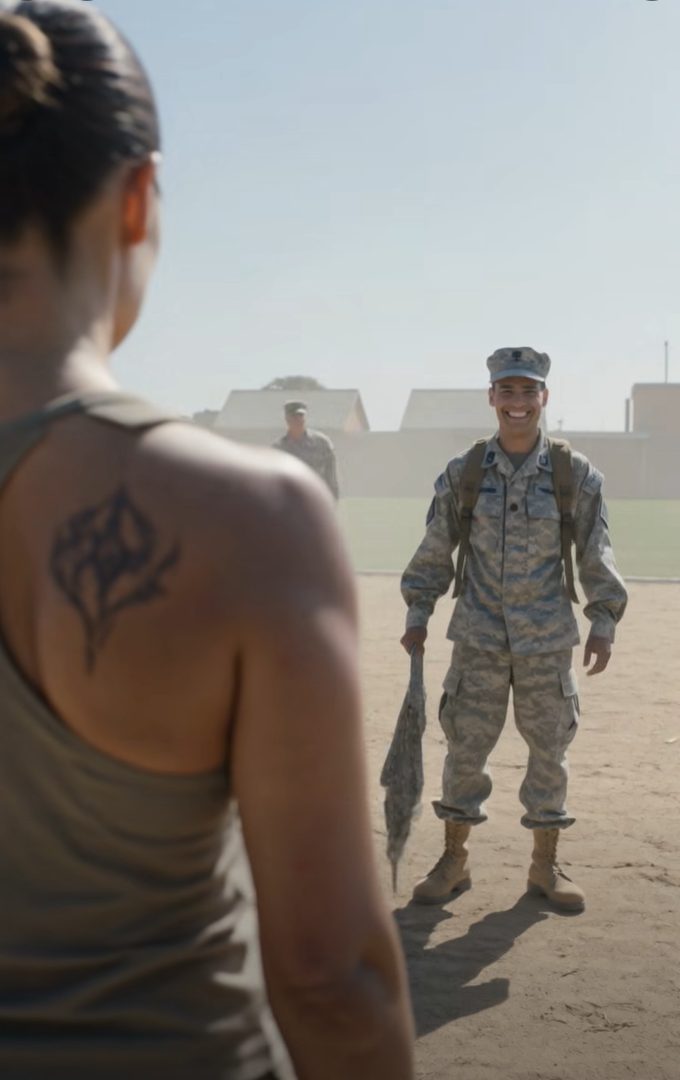
Chief Petty Officer Rachel Whitmore stepped onto the mat without ceremony – no stretching routine, no dramatic buildup. Just quiet movement. Controlled breathing. Focus.
Around her, Marines circled loosely, some leaning against the walls, others sitting cross-legged, waiting for what they expected to be entertainment.
At the center stood Staff Sergeant Kyle Braddock, arms folded, expression unreadable but clearly amused. To his right, Corporal Dean Holt rolled his shoulders, already bouncing lightly on the balls of his feet. To the left, Lance Corporal Evan Pike cracked his knuckles, barely containing his eagerness.
“Last chance,” Braddock said. “You sure you want this?”
Rachel met his gaze.
“I’m not here to fight,” she replied calmly.
A few snickers rippled through the room.
“Then walk away,” Pike shot back.
Rachel didn’t move.
“I’m here to evaluate,” she said. “This is part of that now.”
That answer only made them laugh harder.
Braddock gave a small nod. “Fine. Holt, you’re up first. Keep it clean… if you can.”
Holt stepped forward, confident, relaxed – like this was already decided.
Rachel didn’t raise her hands immediately.
She just watched him.
Measured distance.
Timing.
Breathing.
Holt moved first – fast, aggressive, throwing a sharp combination meant to overwhelm.
Rachel moved.
Not backward.
Not into him.
Around.
A slight pivot.
A minimal shift.
His strike passed through empty space.
Before he could recover, she stepped inside his range – one precise motion – and redirected his balance with a controlled sweep.
Holt hit the mat.
Hard.
The room went quiet for a fraction of a second.
Then – “Lucky,” someone muttered.
Holt pushed himself up, a little less relaxed now.
He came in again.
Faster.
More force.
This time with intent.
Rachel didn’t rush.
Didn’t escalate.
She absorbed the movement, deflected the strike, and rotated her body with mechanical precision – her elbow locking his arm at just the right angle.
Control.
Not damage.
Holt froze.
Because he understood exactly what would happen if she applied pressure.
She released him.
Stepped back.
Silence spread.
Braddock’s expression shifted – slightly.
“Pike,” he said.
The younger Marine didn’t hesitate.
He rushed in, reckless speed replacing strategy.
Rachel adjusted instantly.
This time, she didn’t just redirect – she intercepted.
A sharp, controlled strike to his centerline stopped his momentum cold – not enough to injure, but enough to shut his body down for a split second.
Then she moved.
A fluid transition.
Hip rotation.
Balance broken.
Pike hit the mat even harder than Holt had.
A low murmur spread through the room.
Phones came out.
No one was laughing now.
Pike stayed down for a second longer than expected, staring up at the ceiling like he was trying to understand what had just happened.
Rachel stepped back again.
No celebration.
No expression.
Just readiness.
Braddock unfolded his arms slowly.
Now he was paying attention.
“You’ve trained,” he said.
Rachel didn’t answer.
Because it wasn’t a question.
He stepped onto the mat.
The atmosphere shifted instantly.
This wasn’t a sparring match anymore.
This was a test.
Braddock circled her, slower than the others, eyes locked in, searching for weaknesses.
“You’ve been holding back,” he said.
“Yes,” Rachel replied.
No hesitation.
No denial.
That answer alone changed everything.
He attacked without warning.
Precise.
Disciplined.
Unlike the others, he wasn’t reckless.
But Rachel met him at the same level.
And then – Beyond it.
Her movements sharpened.
Angles tighter.
Timing faster.
Every exchange lasted less than a second – but within those seconds, she dictated everything.
Control of distance.
Control of balance.
Control of outcome.
Braddock pushed harder.
So did she.
Until finally – He overcommitted.
Just slightly.
That was all she needed.
A pivot.
A redirection.
A controlled takedown that used his own momentum against him.
Braddock hit the mat.
Not violently.
But decisively.
The room went completely still.
Rachel stepped back, giving him space to rise.
He didn’t immediately.
He stayed there for a moment, breathing, processing.
Then he stood.
Slowly.
The arrogance was gone.
“What style?” he asked.
Rachel picked up her clipboard from the edge of the mat.
“Several,” she said.
Then paused.
“But I started with karate.”
A few Marines exchanged looks.
Confusion.
Respect.
Realization.
Braddock nodded once.
Not casually.
Acknowledging.
“SEAL?” he asked.
Rachel met his eyes.
“Yes.”
That answer settled over the room like weight.
Because now it made sense.
The control.
The restraint.
The difference.
She wasn’t fighting to win.
She was fighting to finish – if she had to.
And choosing not to.
Rachel flipped open her notebook, pen already moving.
“Your program emphasizes dominance over control,” she said calmly, as if nothing unusual had just happened. “That creates unnecessary risk. You’re training ego, not survivability.”
No one interrupted.
No one laughed.
Because now – They were listening.
And as Rachel Whitmore stepped off the mat, leaving behind three Marines who had walked in expecting a fight – And walked out understanding something far more important – One truth lingered in the silence:
They hadn’t just challenged a black belt.
How She Got Here
Rachel had been at Ironclad for eleven days before the nickname started.
Eleven days of sign-in sheets, readiness assessments, cross-branch coordination paperwork. Eleven days of sitting across conference tables from men who answered her questions with the particular brand of polite dismissal that meant we’re cooperating because we have to, not because we think you matter.
She’d heard the name for the first time through a wall. Two junior enlisted, not bothering to keep their voices down. The karate secretary is back. Then laughter. Then footsteps moving away.
She’d kept writing.
The assignment came down from the Joint Readiness Evaluation Office, Washington, D.C., mid-October. Rachel’s name on the order because she was three things simultaneously: qualified evaluator, combat-trained, and the person available. She’d done two of these before. One at a base in Virginia, one at a facility outside Stuttgart that she still wasn’t allowed to discuss in specifics.
Ironclad was different.
The unit had a reputation. Not the bad kind, exactly. More like the kind that builds up when a group of men performs well for long enough that they start to believe performance is the same thing as correctness. They’d deployed four times. They’d come back four times. Their numbers were good. Their methods were aggressive, efficient, effective – by the metrics that got written down.
Rachel’s job was to look at the metrics that didn’t.
She’d been doing that quietly. Taking notes. Watching training sessions from the back of the room. Sitting in on briefings where her presence was technically acknowledged and practically ignored.
The clipboard was real. So was the evaluation.
The nickname, though. That one had legs.
The Morning It Escalated
It started, as these things usually do, with something small.
Tuesday. 0630. Rachel was in the auxiliary gym running through her own morning routine, which she did alone, early, specifically because she didn’t want an audience. Forty-five minutes. Nothing spectacular. Katas she’d been doing since she was nine years old, mixed with the kind of conditioning work that doesn’t look impressive until someone tries to move you and can’t.
Holt walked in at 0648.
Then Pike.
Then three others she recognized from the motor pool.
They weren’t scheduled for the auxiliary gym. She knew their training block. She’d read the schedule twice.
They’d come to look.
She kept moving. Finished the sequence she was in. Took a breath.
“You do that every morning?” Holt asked. He wasn’t being hostile yet. Just that particular tone, the one that’s technically a question but is really an assessment.
“Most mornings,” she said.
“Karate?”
“Among other things.”
Pike made a sound. Not quite a laugh. “My little sister does karate.”
Rachel picked up her water bottle.
“Good for her,” she said.
That should have been the end of it. Would have been, with a different group. But Pike was twenty-three and Holt was twenty-six and neither of them had ever been in a room with someone quieter and more dangerous than they were, so they didn’t know what that looked like yet.
By 0800, the story had mutated. By 0900, Braddock had heard it. By 1100, when Rachel walked into the main training facility to observe the afternoon combatives session, the room was already arranged the way rooms arrange themselves when something is about to happen.
She’d seen it before.
She set her clipboard on the folding table by the door and pulled out her pen.
What They Didn’t Know
Rachel had started karate at nine because her mother, Donna, signed her up for it the same week her father left, for reasons that were probably practical and probably also not. The dojo was three blocks from their apartment in Tacoma. Twenty-two dollars a month. The instructor, a retired postal worker named Gary Stubbs who went by Sensei Gary without a trace of irony, ran a tight program with bad fluorescent lighting and a mat that smelled permanently of rubber and old sweat.
She’d trained there for six years.
Then wrestling in high school, because the girls’ team needed a body and she needed somewhere to put the energy that had nowhere else to go.
Then two years of Muay Thai at a gym in Bremerton run by a former WBC contender named Dennis Park who charged forty dollars a month and didn’t care who you were as long as you showed up and didn’t quit.
Then the Navy.
Then BUD/S, which she wasn’t supposed to talk about in certain contexts, so she generally didn’t.
Then eight years of operational work that had taken her to places that don’t get named in polite conversation, doing things that required a very specific combination of skills: technical expertise, physical capability, and the ability to make decisions in compressed time with incomplete information.
The clipboard wasn’t a prop.
She was genuinely good at the administrative work. Always had been. Numbers, patterns, systemic analysis. She could read a training program and see its failure points the way other people read weather. It was the job she’d been assigned and she took it seriously.
But the body was still the body.
Twenty-two years of training doesn’t go anywhere. It just gets quieter. Waits.
After the Mat
The afternoon session was supposed to run until 1700.
It ran until 1730, because after Rachel stepped off the mat, nobody moved for about ninety seconds, and then everyone started talking at once.
She let them. Sat down at the folding table, opened her notebook, and wrote for ten minutes while the room gradually remembered how to function.
Braddock came over at 1715. He pulled a chair up across from her, sat down without asking, which she didn’t mind.
“How long have you been watching us?” he asked.
“Eleven days.”
“And?”
She looked up from the notebook. “You want the real answer or the report answer?”
He thought about that. “Real.”
“Your guys are tough,” she said. “Genuinely. They’ve got good instincts and they work hard and they’ve been through enough that they don’t rattle easy.” She paused. “But you’ve been training them to dominate, and domination is a strategy that only works when you’re bigger, faster, or have more resources than the other person. The moment any of those conditions flip, you’ve got nothing to fall back on.”
Braddock was quiet for a moment.
“And control is different.”
“Control works in more conditions,” she said. “It scales. Dominance doesn’t.”
He looked at the mat. Holt and Pike were on the far side of the room. Holt was rotating his shoulder in slow circles, not because it was injured, but because he was still processing what had happened to it. Pike was pretending to look at his phone.
“They’re going to be insufferable about this for a week,” Braddock said.
“Probably,” Rachel agreed.
“Then they’ll want to know how you did it.”
“That’s usually what happens.”
He looked back at her. The expression on his face was different from the one he’d walked in with that morning. Not softer, exactly. More accurate. Like he’d recalibrated something and was still adjusting to the new reading.
“The evaluation,” he said. “What are we looking at?”
Rachel tapped her pen against the notebook.
“A few structural changes to the combatives curriculum. Some reframing around threat assessment. Nothing that guts what you’ve built.” She met his eyes. “You built something real here. It just needs better edges.”
Braddock nodded. Slow.
“We can work with that,” he said.
Rachel went back to her notes.
Across the room, Pike had put his phone down. He was watching her. Not with the same look as before. Something different now. The beginning of a question he didn’t know how to ask yet.
She’d answer it when he figured out the words.
She had eleven more days.
—
If this one got you, pass it along to someone who needs it.
If you loved this story of unexpected strength, you’ll definitely want to read about the time she hadn’t touched a rifle in three years, but still didn’t miss and when they thought the old janitor was nobody, until someone recognized her. We also think you’ll find inspiration in the tale of how they called her the daughter who quit, then the Admiral saluted her.