
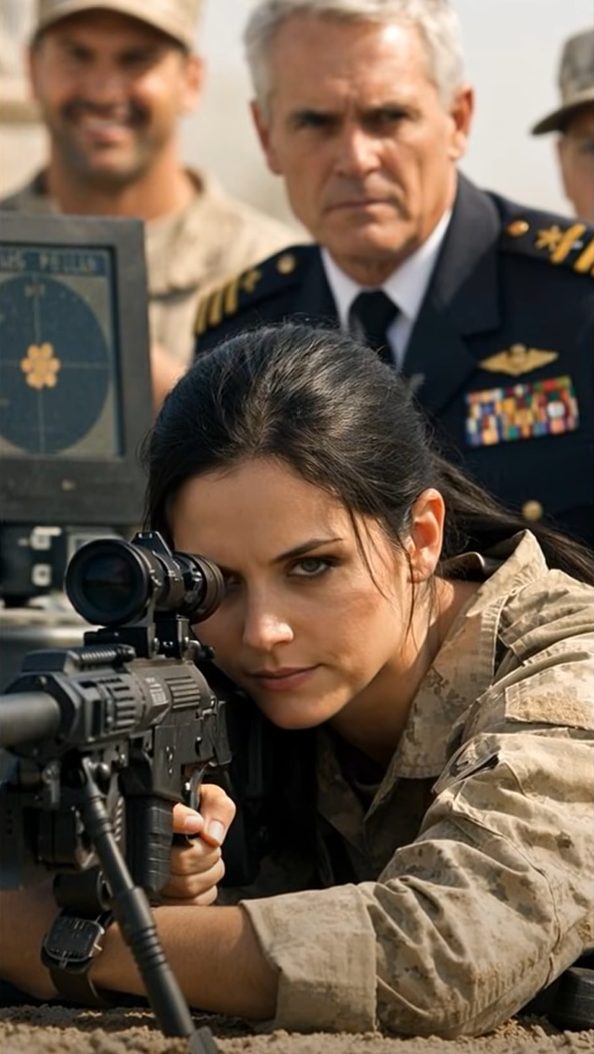
They erased her name, buried her alive… and three years later, she walked back onto their range with a rifle – and a secret that could destroy them all.
No rank. No insignia. No record.
Just a woman sitting in the shade on a scorching desert range, quietly assembling a sniper rifle like the world around her didn’t exist.
At first, they laughed.
An admiral mocked her. Officers smirked. Someone called her lost.
Then she stepped onto the firing line.
800 meters.
Five shots.
One hole.
And just like that… the laughter died.
But Admiral Kane didn’t believe in miracles – only mistakes waiting to be exposed. So he pushed her further.
1,000 meters.
Unstable wind.
Standard rifle.
“Let’s see you fail now.”
She didn’t.
Five shots.
Perfect center.
Again.
Silence fell across the entire range… because what they were witnessing wasn’t skill anymore.
It was something else.
Something trained.
Something buried.
And then everything changed.
A single moment. A single mistake.
A lieutenant grabbed her arm – – and exposed the tattoo.
A sniper reticle.
A number.
847.
Under it, two words that made the admiral go pale:
DEATH ANGEL.
A name that was supposed to be dead.
A mission that was supposed to be erased.
A ghost… standing right in front of them.
She didn’t raise her voice.
She didn’t need to.
Because when she looked at the admiral, there was no fear in her eyes – only something colder.
Recognition.
And something far more dangerous.
Memory.
“You declared me dead,” she said quietly.
The air shifted.
Officers stopped breathing.
Because suddenly this wasn’t a training exercise anymore.
It was a reckoning.
And when she reached into her pocket and pulled out a black data drive…
…everyone understood.
This wasn’t about proving she could shoot.
This was about proving what really happened the day they buried her.
And why she came back.
Before the Range
Her name was Vera Cobb.
Or it had been, once. Before the program. Before the desert. Before whatever they’d done to her file that turned three years of service into a blank page with a death date stamped across it like a library card past due.
She’d driven from Tucson in a rented Civic with no AC, a bag of gas station almonds on the passenger seat, and the drive in her jacket pocket. Twelve hours. She didn’t stop except for gas, and even then she kept the engine running.
The base at Yuma sat low against the flats, heat coming off the tarmac in sheets. She’d known this place before. She knew where the cameras pointed and where they didn’t. She knew the guard rotation. She knew which gate the civilian contractors used.
She used that one.
Nobody stopped her. Nobody asked. She had a contractor badge with a name on it that wasn’t hers, and she sat down in the shade beside the eastern range like she was waiting for a ride.
The rifle case was already there.
She’d placed it the night before.
The Laugh That Started It
She’d been there maybe forty minutes when Captain Doyle spotted her. Doyle was mid-thirties, square jaw, the kind of guy who’d been good-looking in his twenties and had started to notice it fading. He walked over with two junior officers trailing him like ducklings.
“Ma’am.” He said it the way people say it when they mean what the hell. “This is a live-fire range.”
She looked up. Kept her hands moving. The rifle was almost assembled. “I know.”
“This isn’t a public facility.”
“I know that too.”
He looked at the rifle. Then at her. Then at the rifle again. “Where’s your credentials?”
She reached into her jacket. Handed him the contractor badge.
He looked at it. Frowned. “This doesn’t authorize weapons access.”
“No,” she agreed. “It doesn’t.”
One of the ducklings laughed. Quiet, under his breath, the way you laugh at something you think is about to be handled for you.
That was when Admiral Kane walked out.
Kane was sixty-one years old, built like a man who’d been athletic at thirty and had let it calcify into something harder and less useful. Silver hair, regulation cut, hands that never quite stopped moving. He ran the Special Operations Training Command out of Yuma. He had for six years.
He’d been the one who signed the paperwork.
He looked at Vera the way you look at a stray dog that’s gotten into the building. Puzzled. Not yet concerned.
“What’s the situation, Doyle?”
“Civilian on the range, sir. Contractor badge, no weapons authorization. She’s got a rifle.”
Kane looked at her. She looked at him.
Something crossed his face. Fast. Gone before anyone else could catch it.
“Ma’am, I’m going to need you to step off this range.”
She stood up. The rifle was fully assembled now. She picked it up and walked to the firing line.
“I’d like to shoot first,” she said.
Someone behind Kane actually laughed out loud. Not Doyle. One of the others. She didn’t look to see who.
800 Meters
The target was already set. Standard silhouette at 800 meters. The wind was doing about 12 miles an hour out of the northwest, gusting to maybe 18. The sun was directly overhead and the heat shimmer off the desert floor turned the target into something that breathed.
She lay prone. Adjusted her position twice. Put her cheek against the stock.
Five shots. Took her maybe ninety seconds.
She stood up, cleared the rifle, and set it down.
Kane had his binoculars up. He didn’t say anything for a long moment.
One hole. Dead center. The kind of group that shouldn’t be physically possible from a standing start, on an unfamiliar range, with a rifle nobody had zeroed for her.
The laughing had stopped.
Kane lowered the binoculars. His face had gone still in the way faces go still when someone is doing math they don’t like.
“Who are you?” he said.
She didn’t answer.
He pushed her to 1,000. She knew he would. It’s what you do when something doesn’t fit your model: you stress-test it until it breaks. He had someone bring out a standard-issue M24. No adjustments. The wind had picked up. She could see the flags at the edge of the range snapping back and forth, inconsistent, the kind of condition that makes even good shooters pull shots.
She lay down again.
Five shots.
Perfect center.
Again.
She stood up and the range was silent the way a room gets silent when something has happened that nobody has language for yet. One of the junior officers had his hand over his mouth. Doyle was staring at the target through his own binoculars and not moving.
Kane was looking at her.
Not at the target anymore.
At her.
847
She’d known someone would grab her arm eventually. She’d counted on it, actually. People who’ve just seen something they can’t explain always reach out and touch the thing that confused them. Basic human response. You try to make it real by making it physical.
It was a lieutenant she didn’t recognize. Young, maybe twenty-six, the kind of kid who still moved fast because he hadn’t learned yet that speed gets you into trouble. He grabbed her left arm just above the wrist, pulling her back as she started to walk away from the line.
The sleeve rode up.
She let it.
The tattoo was small. Black ink, faded slightly at the edges from three years of sun. The reticle. The number. The words underneath.
DEATH ANGEL.
She watched Kane’s face when he read it.
He’d gone pale the way people go pale when the blood actually leaves. Not a figure of speech. His face did the thing. His hands stopped moving.
“Where did you get that,” he said. Not a question. More like something he was saying to himself.
“You know where,” she said.
The lieutenant had let go of her arm. He was looking at Kane, then at her, then back at Kane, trying to figure out what he’d just touched.
What Got Buried
Three years ago, Vera Cobb had been Operator 847 in a program that didn’t have an official name. It had a budget line buried inside a defense contractor’s contract, a small facility outside of Kandahar, and six people who knew it existed. Kane had been one of them.
The program’s job was simple on paper. Impossible in practice. Long-range target elimination in denied areas, no footprint, no signature, no attribution. The kind of work that requires someone who can get close, stay invisible, and hit a target at distance under conditions that would make most trained snipers walk away.
Vera had been good at it. Better than good. She’d run eleven operations in fourteen months.
The twelfth had gone wrong.
Or it had been made to go wrong. She’d spent three years figuring out which one it was, and by the time she drove to Yuma she knew.
The mission had been a setup. The target had been wrong. Not wrong in the way targets sometimes are, where intelligence is bad and you’re working with what you have. Wrong in the deliberate sense. The kind of wrong that requires someone on the inside to make a specific call at a specific time.
Someone had needed the twelfth operation to fail. Someone had needed her to be in that building, in that position, at that moment. And when it had gone sideways and she’d barely gotten out, the easiest solution was to close the file.
Declare her dead.
Erase the program.
Burn everything.
She’d spent eight months in a hospital in Ramstein that officially didn’t treat her, using a name that wasn’t hers, recovering from injuries that weren’t on any record. The other eight months after that she’d spent in a rented room in Flagstaff, going through every document she’d been able to pull before they’d locked her out. And the year after that she’d spent building what was on the drive.
The Drive
She pulled it out of her jacket pocket and held it where Kane could see it.
It was about the size of a thumb. Black plastic casing, no markings. She’d made two copies. One was in a safe deposit box in Phoenix. The other had already been emailed to a journalist at the Post she’d vetted over six months, set to deliver in seventy-two hours unless she sent a specific cancellation code.
She hadn’t decided yet whether she’d send it.
“That’s everything,” she said. “Budget authorizations. Comms logs. The targeting package for Operation Twelve, including the modification that was made to it forty-eight hours before I deployed. The name of the person who made it.”
Kane looked at the drive. Then at her.
“You’ve been out three years,” he said. “No one will believe – “
“They’ll believe the intercepts,” she said. “The ones from the Kandahar facility. The ones that were supposed to be destroyed.” She paused. “Turns out the contractor who ran the destruction protocol had a backup procedure. He was careful like that. He’s in Tucson now. Retired. We had coffee.”
Nobody on the range was moving. Doyle was standing six feet away with his arms at his sides and his face doing nothing, which she recognized as the expression of a man who has realized he’s standing too close to something and can’t figure out how to back away without drawing attention to the backing away.
One of the junior officers had his radio out. She looked at him.
“Go ahead,” she said. “Call it in. That’s actually fine with me.”
He looked at Kane. Kane said nothing.
“Here’s what I want,” Vera said. She was still holding the drive. “I want my record corrected. I want my name back. I want the file on Operation Twelve reopened with the actual targeting documentation, not the version that was filed after. And I want the person who modified that package to answer for it on the record.”
Kane’s jaw had gone tight. “You’re making accusations you can’t – “
“I’m not making accusations.” She held up the drive. “I’m showing you what I found. There’s a difference.” She looked at him steadily. “You know there’s a difference. You’ve known it for three years.”
The wind came across the range. A flag snapped.
“You declared me dead,” she said. “You signed the paperwork. I have the copy.”
Kane said nothing.
“I don’t think you modified the targeting package,” she said. “I’ve spent a long time on this. I don’t think it was you.” She watched his face. “But you knew. Afterward. And you signed the paperwork anyway.”
The silence stretched out long enough that a hawk somewhere above the range made a sound and it carried.
“So here’s what happens now,” she said. “Either you pick up your phone and start making the calls that fix this. Or in seventy-two hours, a reporter in Washington does it for you.”
She set the drive down on the table beside the rifle.
Then she picked up the rifle case, packed it, and walked back toward the gate she’d come through.
Nobody stopped her.
She didn’t look back.
But she heard Kane behind her, finally, after she’d gone maybe thirty feet.
She heard him pick up his radio.
—
If this one stayed with you, send it to someone who needs to read it.
For more tales of unexpected victories and hidden strengths, check out I Brought My Dead Father’s Rifle to a Competition Nobody Thought I Could Win, discover what happened when My Commanding General Ordered Me to Prove My Kill Shot – Then Started Asking Questions I Wasn’t Supposed to Answer, and see why everyone underestimated The Tiny Female Soldier Everyone Mocked… Until Her Sleeve Ripped Open.



