
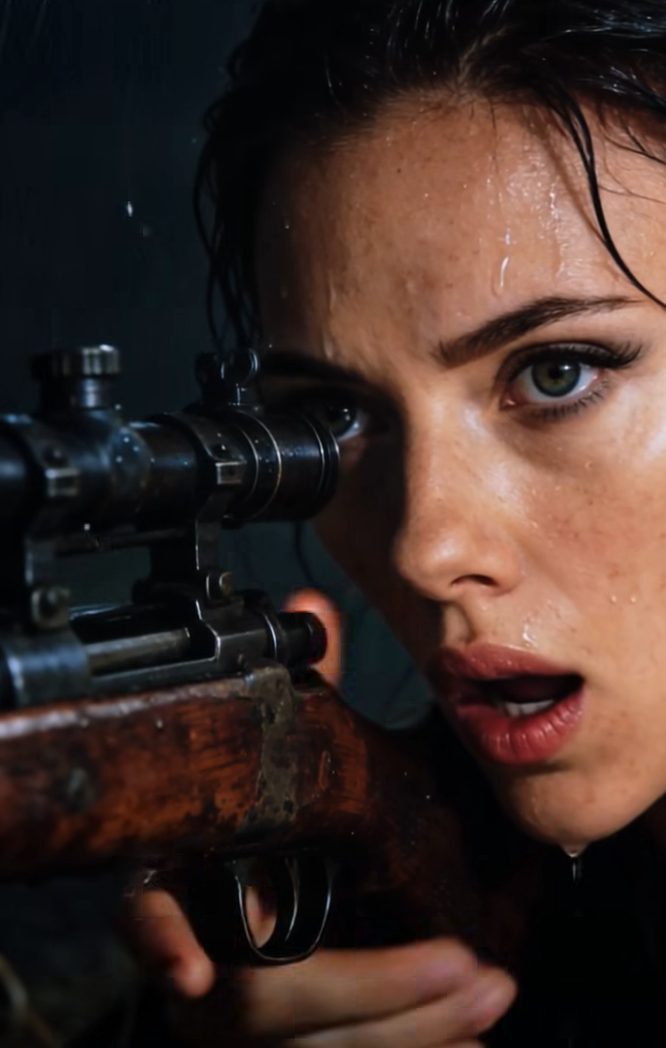
“They gave her that rifle as a joke.”
That was what people said the moment Hannah Mercer stepped onto the range. She was the first woman ever cleared to compete in the Advanced Precision Warfare Trials – a competition known for breaking egos and building legends. The best marksmen in the country had arrived with rifles that looked like they belonged in a laboratory: precision-machined platforms fitted with ballistic computers, thermal optics, laser rangefinders, and scopes worth more than most vehicles. Hannah arrived with a worn canvas rifle bag. And silence. The kind of silence that made people uncomfortable.
Inside that bag was an old M14 – her father’s rifle.
Daniel Mercer. A name that barely lived anywhere except in old paperwork and fading family memory. The rifle showed its age. The walnut stock was scarred. The finish dulled by time. And the mounted scope? Useless. When Hannah tested it on the practice line, the image flickered, drifted, then died completely.
A few competitors noticed. One of them laughed.
She didn’t respond. She simply removed the scope, set it aside, and locked the rifle back into position – iron sights only.
To everyone else, it looked like defeat. To her, it felt like truth.
What Her Father Built Into Her
Her father had taught her differently.
No shortcuts. No reliance on gear. Just fundamentals – breathing, control, patience, reading the wind before it spoke. He used to say that tools could assist, but they could never replace the person behind them. “A rifle only tells the truth,” he had told her once. “It’s the shooter who decides what to do with it.”
Hannah was eleven when she fired her first shot on a gravel road outside Dillon, Montana. December. Cold enough that her fingers went stiff inside the gloves. Daniel had set a steel plate at two hundred yards and told her to take her time. She rushed it. Missed.
He didn’t say anything. Just handed her another round.
She took three breaths this time. Slow. Let the last one half-out and held there. Squeezed.
The plate rang out across the frozen field like a bell.
Daniel put one hand on her shoulder. That was the whole celebration. One hand. Brief. And then he said, “Again.”
She fired six hundred rounds that winter. Every weekend. Every school holiday she could get. She learned to read grass movement before she could reliably parallel park. She learned to hold position through discomfort, through cold, through the specific kind of boredom that the range produces when the target is far away and the wind is lying to you.
By the time she was sixteen, she was shooting better than most of the men her father trained with.
He never once told her she was exceptional. He told her she was consistent. He said that like it was the better compliment.
She understood that now. She hadn’t always.
The First Stage
The first event was a six-hundred-yard static course. Clean conditions. Predictable wind. The kind of stage designed to favor advanced optics.
Hannah took her time. She blocked out the noise – the radio chatter, the competitors adjusting their setups, someone two lanes down running a zeroing check with a crack that echoed off the berm. She blocked all of it out and looked through the iron sights at the target downrange.
One shot at a time.
When the targets were checked, her grouping sat tighter than several competitors running full systems.
The laughter stopped.
The range didn’t get loud. It got quiet. That particular kind of quiet that happens when something doesn’t go according to the script people had already written.
She packed her brass. Moved to the staging area. Drank half a bottle of water and ate a granola bar that had been in her jacket pocket since Tuesday. Someone nearby was on a phone call, keeping his voice down. She didn’t try to hear it. She didn’t need to.
She already knew what kind of room she was in.
What Started Going Missing
She realized later that she had missed a scheduled practice window – one that everyone else had somehow known about.
The notice had gone out by text. To a group thread she hadn’t been added to. An oversight, someone said. Probably. She nodded and said it was fine.
Then her ammunition count came up short. Two full boxes gone from her staging bag. No explanation. No witnesses. No one said anything. No one offered help.
She sat with that for about ninety seconds.
Then she recalculated. Adjusted. Figured out which stages she could afford to limit her warm-up on and which ones she couldn’t. She moved forward.
This was the thing about Daniel Mercer’s training that nobody talked about, because nobody had been there to see it: he had built problems into her practice on purpose. He’d change the target distance without telling her. He’d put a piece of tape over part of her sight picture. Once he’d handed her a rifle with a deliberately loosened stock screw and told her to figure out what was wrong before the third shot. She hadn’t figured it out until the fifth. He’d marked it down in a small notebook he kept. Not to shame her. To show her the gap.
She’d found that notebook after the funeral. Forty pages. Her name on every one.
She’d read it three times and then put it in a drawer she didn’t open often.
Nine Out of Ten
The moving-target stage separated shooters from pretenders.
Targets appeared briefly – running silhouettes, sliding figures, narrow exposure windows that required more than just skill. They required timing. Prediction. Instinct. The competitors with the best systems were using tracking software that calculated lead distance automatically. Expensive stuff. Effective stuff.
Hannah didn’t chase targets. She anticipated them.
She picked the point where each target would be. Not where it was. Where it was going. Then she was already there, waiting.
Nine hits out of ten. Clean. No hesitation. No wasted motion.
The one she missed – a silhouette that stuttered mid-run, a mechanical hitch in its track she hadn’t seen in the walk-through – she noted it, accepted it, and moved on. No adjustment in her expression. No visible frustration.
By then, people weren’t laughing anymore. They were watching.
She could feel it. The shift in the attention. The way the ambient noise of a range changes when the crowd reorients. She didn’t look around to confirm it. She kept her eyes on what was in front of her.
When the Storm Erased the Playing Field
Then the storm hit.
Fast. Hard.
Wind tore across the range – gusts coming in off the ridge to the northwest, the kind that hit thirty miles per hour and then spike to forty-five without warning. Electronic systems faltered. Ballistic computers threw error readings. Laser rangefinders couldn’t hold a return in the crosswind. One competitor’s scope fogged from the temperature drop. Another’s bipod blew off a sandbag rest.
The advantage vanished. All of it. Every dollar spent on precision equipment became weight.
But Hannah didn’t lose anything. She had never depended on it.
She settled lower against the stock. Read the grass at the two-hundred-yard line. Read the flag at four hundred. Felt what the air was doing against her left cheek. She’d learned to use her face as an instrument before she’d learned to drive.
Breath. Sight. Control. Shot.
She worked through the stage at the same pace she’d worked through every other stage. The storm was just a condition. Conditions were information. You read them, you adjusted, you fired.
By the final stage, the narrative had changed.
She wasn’t an outsider anymore. She was the variable no one could account for. The one problem no one had built a solution for, because no one had thought she needed to be solved.
The Man Who Recognized the Rifle
And then something else happened.
The man overseeing the competition – a retired colonel named Walt Pruitt, thick through the shoulders, gray at the temples, a guy who had been running trials like this for eleven years and had seen every configuration of weapon and shooter that existed – stepped closer as Hannah prepared for her final stage.
His eyes weren’t on her.
They were on the rifle.
On the worn stock. On a small, nearly invisible marking carved into the wood near the pistol grip. A set of initials and a number. The kind of thing you’d miss unless you already knew to look for it.
His face changed. Completely.
He went still in the way that people go still when they’re trying to keep their face from doing something.
Hannah noticed. She kept her position. She didn’t ask.
After a moment, Walt Pruitt said, quietly, “Where did you get this rifle?”
“It was my father’s,” she said.
He didn’t say anything for a long moment. He looked at the marking again. His jaw moved once, like he was working out what to say.
“Daniel Mercer,” he said. It wasn’t a question.
“Yes.”
Walt Pruitt had known her father. That much was immediately clear. But the way he said the name – low, careful, like a word you say in a place where you’re not sure who’s listening – told her it was more than that. Daniel Mercer wasn’t just a name Walt Pruitt recognized. It was a name Walt Pruitt had been careful around. For a long time.
“He disappeared,” Hannah said. She’d said this sentence before. To insurance people, to Army liaisons, to a VA grief counselor who hadn’t known what to do with her. She’d gotten good at saying it flat.
“I know,” Walt said.
“Do you know why?”
He looked at her then. Really looked. The kind of look that measures something.
“Finish your stage,” he said. “Then come find me.”
What Was Still Unfinished
Hannah fired the final stage.
She didn’t think about what Walt Pruitt knew. She didn’t let herself. She filed it somewhere behind everything else and kept her attention on the target, on the wind, on the iron sights that had been her father’s iron sights on a rifle that had been in her family’s closet for six years wrapped in an old Army blanket.
She fired. She hit. She was consistent.
When the scores were tallied, she’d placed second overall – behind a Special Forces sergeant named Greg Hatch who had thirty pounds on her and fifteen more years of trigger time. She shook his hand. He nodded at the M14 and said, “That’s a hell of a rifle.” She said, “I know.”
She found Walt Pruitt near the range office, standing outside with a paper cup of coffee he wasn’t drinking.
He told her that Daniel Mercer had been involved in a program that officially didn’t exist anymore. That his disappearance hadn’t been an accident. That there were people who had known that and said nothing. That there were files – some still sealed, some not – that had her father’s name in them in ways that the family had never been told.
He told her he’d been waiting for someone to bring that rifle back into the open.
He hadn’t expected it to be her.
Hannah looked down at the worn walnut stock. At the scarred finish. At the initials carved near the grip.
Her father’s hands had held this. Every day for years. He’d taught her with it. He’d told her that a rifle only tells the truth.
She believed that now in a different way than she had before.
She picked up the rifle. Slung it over her shoulder. And told Walt Pruitt she wanted to see everything he had.
—
If this one hit you, pass it on to someone who needs it today.
If you enjoyed Hannah’s incredible story, you might also be interested in other tales of unexpected strength, like when My Commanding General Ordered Me to Prove My Kill Shot, or the time The Tiny Female Soldier Everyone Mocked… Until Her Sleeve Ripped Open. And don’t miss the powerful moment She Hit the Ground and Nobody Moved – Until the Sergeant Saw Her Arm.



