
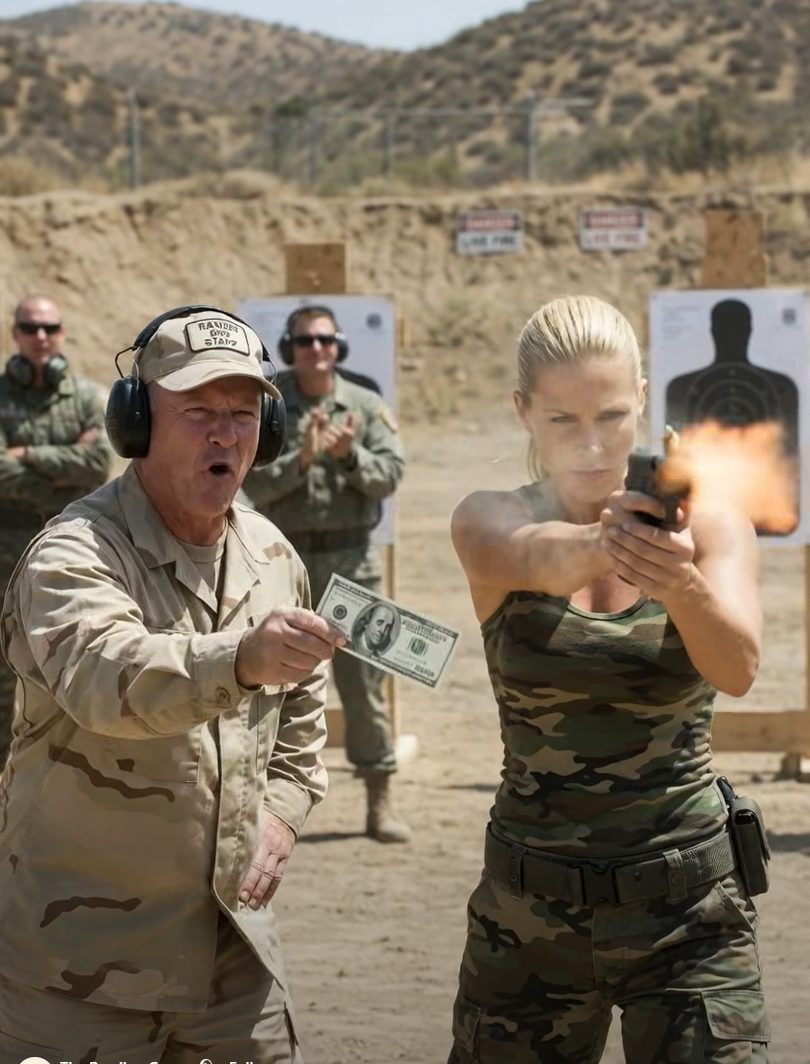
“Go Home Before You Embarrass Yourself, Sweetheart,” the Marine Sergeant sneered as he kicked my ammunition across the dirt with the toe of his boot. He thought I was just another nervous civilian woman playing dress-up at the range – until I calmly loaded five rounds, sent them all through the exact same hole at fifty yards, and then walked onto his base the next morning in uniform as the Senior Chief Petty Officer whose name was buried so deep in classified war files that most admirals didn’t even know I existed.
The first mistake Michael Ducker made was laughing.
The second was making damn sure everyone else laughed with him.
By the time the hard plastic rifle case thudded against the concrete at Lennox Harrow’s feet, the entire line at the Oceanside range had fallen into that heavy, unnatural silence crowds get when they sense a situation sliding toward something ugly. Not obviously dangerous yet – just charged. The yellow safety lines, the range officers with their radios, the sun-faded warning signs, and the paper targets snapping in the dry Santa Ana wind were all still in place. The range was built to keep things controlled.
But humiliation has a temperature, and that morning it was climbing fast.
Staff Sergeant Michael Ducker loomed over her, chest puffed out, wearing a wide, ugly grin. Four younger Marines flanked him, grinning too, waiting for his cue to keep laughing. He had taken one look at the woman in the faded red windbreaker, blonde ponytail threaded through the back of a Padres cap, worn jeans, and battered rifle case, and written her off: weekend warrior. Nervous civilian. A woman who’d stumbled into the wrong world and needed to be put in her place.
“You’ll miss, sweetheart,” he announced loud enough for half the range to hear. “Go home before you embarrass yourself.”
Then he casually kicked her ammunition box with his boot, sending loose rounds scattering across the concrete like loose change.
Someone behind him snorted. Another muttered, “Barbie brought her daddy’s hunting rifle.”
Lennox stared down at the rolling brass for a long second. She didn’t flinch. She didn’t speak. She didn’t immediately reach for her rifle case. She simply stood there in the bright morning sun, one hand relaxed at her side, the other resting against the seam of her jeans, breathing slow and steady – making Ducker’s loud cruelty sound even louder by comparison.
That stillness was the first thing Ray noticed.
Ray had run the Oceanside range for twenty-two years. He’d seen every type of pretender: drunks acting sober, cowards acting brave, dangerous men acting harmless. But this woman in bay four was pretending to be nothing – and in Ray’s experience, people who worked that hard to look like nothing were almost always the ones you didn’t want to underestimate.
Ducker had no idea.
He didn’t know that Lennox Harrow had once spent fourteen straight hours motionless on a rooftop in Kunar Province, dust in her teeth, watching a Marine patrol walk blindly through a valley full of enemy rifles. He didn’t know she’d carried bleeding men out of kill zones, watched friends lowered into the ground under folded flags, and done work so classified that even the people she saved would never learn her name. He didn’t know the woman he’d just called “sweetheart” was listed in sealed Navy files as one of the most lethal precision shooters her command had ever produced.
All he knew was that she was smaller than him.
What Happens When You Let Them Laugh
Lennox crouched and picked up the rounds. One by one. No rushing. She set each one back in the box with a small, deliberate click.
Ducker watched, still grinning, and said something to the Marine on his left. She didn’t catch it and didn’t try to. She’d learned a long time ago that men like Ducker needed an audience more than they needed a target. Take away the reaction and you take away half the power. She’d sat still through worse than this. She’d sat still through things that would make this man’s blood go cold if she described them.
She snapped the ammunition box shut.
Then she unlatched her rifle case, opened it on the bench, and began the slow, methodical process of assembly. The rifle was a Remington 700, bone-stock to look at, but the barrel had been replaced and the trigger was set so light it could’ve startled itself. She’d had it for eleven years. She’d put somewhere north of forty thousand rounds through it. She knew its tendencies the way you know a person’s moods.
Ducker had drifted back to his own bay, bored now that she wasn’t crying, but he kept looking over. So did his guys.
Ray had moved closer. Quietly, the way he moved when he was watching something he didn’t want to interrupt.
She put on her ear protection, settled into her stance, and looked downrange at the fifty-yard target. Clean silhouette on white paper. She took one breath in, let it halfway out, and held it.
The first round went center mass.
She worked the bolt.
The second round went through the same hole.
She didn’t check. She already knew.
The third, fourth, fifth – same. Same. Same.
When she set the rifle down and pulled off her ear protection, the range had gone quiet again. Different kind of quiet this time. She walked the fifty yards to the target and brought it back. Five holes in the paper, all of them stacked so tight they looked like one. She set it on the bench without comment and began breaking her rifle down.
Ducker was staring.
His guys weren’t laughing anymore.
Ray was smiling at the ground, pretending to check something on his clipboard.
Lennox packed her case, latched it, picked up her ammunition box, and turned to leave. She walked past Ducker’s bay without looking at him. He said nothing. She hadn’t expected him to. Men like that go very quiet when they realize they’ve misjudged something badly, and they stay quiet until they can find a way to reframe it where they come out fine.
She drove back to her hotel, ordered room service, and went to sleep early.
She had to be on base by oh-seven-hundred.
The Uniform
There is a specific kind of silence that happens when someone walks into a room and the room recalibrates.
It’s not the silence of surprise exactly. It’s slower than that. It’s the silence of people doing math in their heads and not liking the answer.
Lennox had worn her uniform maybe a dozen times in the last three years. Most of her work didn’t require it. Most of her work required the opposite – the Padres cap, the worn jeans, the battered case, the woman nobody looks at twice. But today was different. Today was a formal coordination meeting between two commands, and she was attending as herself.
She signed in at the gate at 0648. The MP checked her ID, looked at it once, looked at it again, handed it back with a small nod, and waved her through without a word.
She found the building, found the room, and set her cover on the table.
She was the only woman in the room. She was also the highest-ranking person in it by a margin wide enough to be slightly uncomfortable for everyone else, which she understood and which she had long ago stopped trying to smooth over. Rank was rank. It meant something or it didn’t.
The briefing started. She listened. She asked two questions. She got answers that told her the people running this particular operation had a gap in their thinking around one specific problem, and she explained the gap, and the room absorbed it, and they moved on.
It was a normal morning.
Until the door opened at 0920 and Staff Sergeant Michael Ducker walked in.
Same Room, Different World
He was in service uniform, cover tucked under his arm, a folder of something in his other hand. He was halfway to the table before he looked up and saw her.
She watched the math happen on his face.
The Padres cap. The windbreaker. The scattered brass on the concrete. The five holes in one piece of paper. And now this: the anchors on the collar, the ribbons on the chest, the name tape over the pocket that said Harrow, and the way every other person in the room was orienting toward her slightly the way people do around someone they’re taking seriously.
He stopped walking.
She didn’t look away from him. She didn’t smile. She didn’t do anything with her face at all. She just looked at him the way she’d looked at that target – steady, neutral, already knowing the outcome.
He found a seat at the far end of the table.
She went back to her notes.
The briefing continued for another forty minutes. She spoke three more times. He said nothing. When it broke up and people started gathering their things, she snapped her folder shut and stood.
Ducker was moving toward the door. He wasn’t going to say anything. She could see that clearly. He was going to walk out and spend the next few days reconstructing this in his head until it was a story he could live with.
“Staff Sergeant.”
He stopped. Turned around.
She kept her voice level. Not warm, not cold. Just a register that said: this is information, not punishment.
“The brass you kicked yesterday. Two of those rounds got scratched on the concrete. I had to pull them before I shot.” She paused. “On a range, that’s a headspace problem waiting to happen. On a job, it’s something worse.”
He stood very still.
“Yes, Senior Chief,” he said.
She nodded once. “Good morning.”
She picked up her cover, put it on, and walked out.
What Ray Saw
Ray Kowalski had been running the Oceanside range since 1999 and he’d watched a lot of things happen in those bays. He’d watched a retired colonel put every round into the dirt because his hands shook too bad to hold the line anymore, and he’d watched a sixteen-year-old girl come in with her uncle and shoot clean enough to make the uncle look at the ceiling. He’d watched men show off and women hold back and vice versa and every combination in between.
He’d been watching the woman in bay four since she walked in.
He’d clocked her the way he clocked everyone: the way she carried the case (easy, one hand, no white-knuckle), the way she set up (no wasted motion, everything in the same place twice), the way she breathed before she shot (like she was going to sleep, not like she was about to fire a rifle).
When Ducker kicked the box, Ray had started walking over. Not fast. He’d learned not to move fast in situations like that. Fast movement changes the shape of a thing. But he’d been ready.
He hadn’t needed to get there.
After she left, he walked down to bay four and looked at the target she’d left on the bench. He picked it up and held it to the light. Five shots. One hole. At fifty yards with a bolt-action she’d assembled in front of him in under three minutes.
He pinned it to the board in his office, next to a photo of his father in Korea and a cracked scoring card from 1987 that he’d never explained to anyone.
He didn’t write her name on it. He didn’t know her name.
He figured that was probably the point.
What She Never Said
Lennox drove back to the hotel after the base visit, changed out of uniform, and sat on the edge of the bed for a while. Not thinking about Ducker. He wasn’t worth a lot of thinking. She’d met fifty versions of him. Some of them had eventually become decent. Some hadn’t. That wasn’t her problem.
She was thinking about Kunar. She did that sometimes, in the quiet after a long day, when the adrenaline that wasn’t really adrenaline anymore – just her baseline, just the hum she’d learned to run on – finally dropped a little.
Fourteen hours on that roof. Dust in her teeth. The patrol below moving in a loose column, completely exposed, and her watching the ridgeline for the rifles she’d been briefed about. She’d found them. She’d handled it. The patrol had walked out of that valley not knowing what had happened, not knowing anyone had been watching, not knowing her name.
They still didn’t know her name.
She was fine with that. She’d been fine with that for a long time. The work wasn’t about being known. The work was about the outcome. The patrol walked out. That was the whole thing. That was all of it.
She ordered coffee from the front desk, sat by the window, and watched the sun drop behind the hills west of Oceanside.
Tomorrow she’d be on a plane. Different city, different briefing room, different problem to solve. The Padres cap was already packed. The rifle case was already locked.
She drank her coffee.
Outside, the Santa Ana wind was still moving through the dry grass, pushing it flat, the way it always did out here – like the land itself was trying to stay low, stay quiet, stay out of the way.
She understood that.
—
If this story hit the way it should, pass it to someone who needs to see it today.
If you’re hungry for more stories of unexpected comebacks and fierce determination, you’ll love how She Told Him Not to Touch the Rifle. He Did It Anyway. and when She Walked Back Onto the Range Three Years After They Declared Her Dead. And for another tale of poignant returns, check out I Stood at the Gate with My Dead Friend’s Ashes and Someone on Base Was Already Waiting.



