
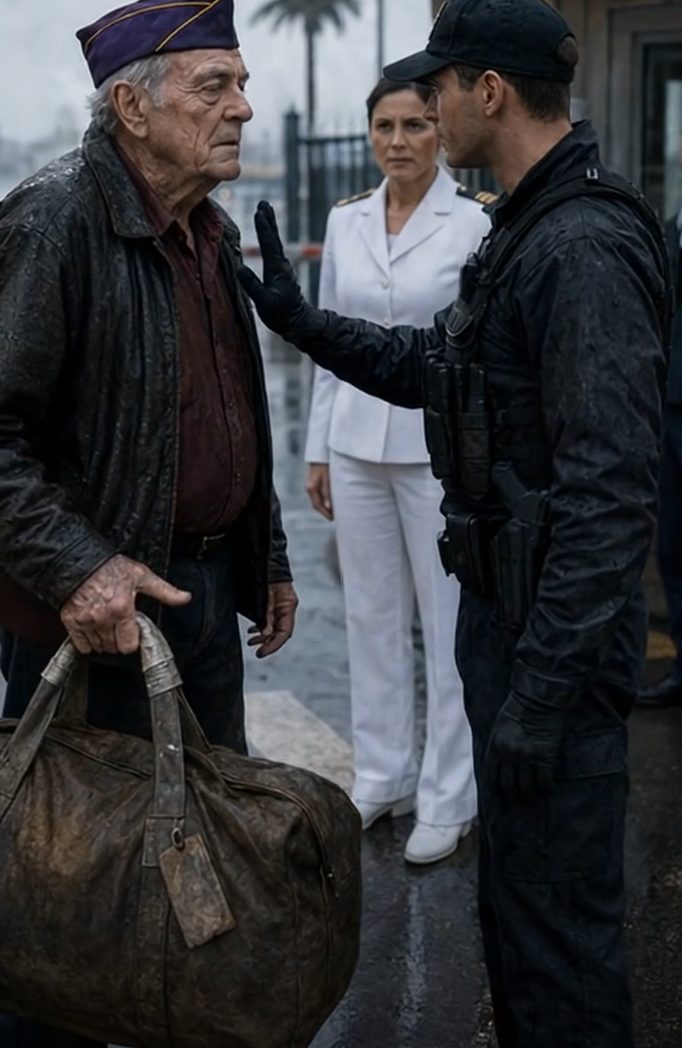
The bus doors hissed shut before Nicholas Adams had both boots on the curb. He stood still, one hand on the rail, the other locked around the taped handle of his old duffel. Rain slipped from the brim of his purple veteran cap and ran down his face. The driver watched him through the mirror for half a second, deciding something. Nicholas gave the smallest shake of his head. The doors closed. The bus pulled away, tires throwing up water from the gutter, and he was left at the edge of the road with the naval base still a quarter mile ahead. The gate lights burned pale through the rain.
He hadn’t expected it to be this hard to stand. That irritated him more than the weather. There’d been years when he could sleep four hours, climb a ladder in rough water, carry another man’s weight across steel decking, and keep moving because stopping was worse. He’d never once thought about his knees back then. They were just knees. They worked. Now a bus step and a wet curb made them argue with him. His right hand had stiffened around the duffel handle during the ride, and when he tried to loosen his fingers, they opened one at a time, slow and reluctant. The duffel sagged against his leg.
It wasn’t full the way luggage is full. It didn’t have the rounded shape of clothes packed for travel or gifts packed for a visit. It hung unevenly, heavy on one end, the canvas soaked dark. The handle had been wrapped years ago with black tape that’d split along the seam and curled at the edges. Near the zipper, almost hidden by water and age, a faded cloth tag showed the ghost of a ship’s name. Most people wouldn’t read it. Most people wouldn’t look long enough.
Nicholas looked. Then he lowered his eyes.
“Still with me, George,” he murmured.
The rain answered on the road.
Across from the bus stop, the base fence ran along the coast in gray-green lines, broken up by cameras, lights, and signs telling people what not to do. Beyond it, palm trees leaned in the wind and the harbor churned black beneath the low sky, the kind of water that swallowed sound. He could smell salt through the diesel the bus had left behind. He’d stood on that water. He’d dragged men through it. He wasn’t sure, standing here now with his knees burning and his fingers barely working, that any of it had counted for what he’d believed it would.
Somewhere inside the fence, a loudspeaker crackled once. Then a voice cut through the rain, sharp and close, saying his name.
The Voice That Knew Him
He turned toward it before he’d decided to.
A young petty officer was jogging toward the gate from the guard post, one hand on his cover to keep the wind from taking it. He was maybe twenty-three. Square jaw, boots so clean they looked wrong in the wet. He stopped at the gate barrier and looked at Nicholas through the chain link with the particular kind of attention that means someone told you who to look for.
“Chief Adams?”
Nicholas hadn’t been called that in eleven years. It didn’t feel wrong, exactly. Just old. Like a coat he’d left in storage.
“Just Nicholas,” he said.
The petty officer nodded once, quick, like he’d been briefed on that too. He keyed something at the post and the gate clicked. “Commander Reyes asked me to meet you, sir. She said you’d be on the 11:40 bus.” He glanced at the duffel, then back up. “Can I carry that for you?”
“No.”
One syllable. The kid didn’t push. Good instincts.
They walked the quarter mile in near silence, the petty officer matching Nicholas’s pace without making a show of it. The rain had eased to something between mist and intention. The base smelled the way it always had – diesel, cut grass, something metallic underneath that Nicholas had never been able to name but could identify blind. He’d been gone eleven years and the smell was exactly the same. That bothered him more than he’d expected.
He kept the duffel at his side. His shoulder was going to pay for it later.
What George Had Asked For
The request had come in a letter. Actual paper, handwritten, the kind George Pulaski had always preferred because he said typing was for people who didn’t mean what they wrote. Nicholas had gotten it in February, forwarded twice, the envelope soft at the corners from handling. George had mailed it in November, which meant he’d known in November. He hadn’t called. Hadn’t said a word when they’d talked at Christmas, and they had talked at Christmas, same as every year, same forty-minute conversation that covered nothing important and meant everything.
The letter was three pages. The first page was jokes. George always opened with jokes because he said bad news needed a runway. The second page was the real thing: Stage four. Pancreatic. Moving fast. He’d decided on no treatment because treatment would’ve meant six months of being sick instead of three months of being himself, and George had always been particular about who he was.
The third page was the request.
I want to go back to the ship. Not the ship as it is now, I know they’ve changed everything. The harbor. The water where we did the crossing. You know the one. You were there. You’re the only one left who was. I don’t want a service. I don’t want a folded flag. I just want the water, Nick. The same water. You’ll know what to say because I know you won’t say anything, and that’s exactly right.
He’d signed it: Your pain in the ass, George.
Nicholas had read it four times sitting at his kitchen table in Pensacola, the letter flat on the formica, a cup of coffee going cold beside it. Then he’d folded it back into the envelope and put it in the drawer where he kept important things, which was also where he kept unimportant things because he’d never been organized, and George had always given him grief about that too.
He’d driven to George’s place in Biloxi two weeks later. George was already in the hospital by then, but he was lucid and he was irritating and he’d complained about the pudding for twenty solid minutes, which meant he was still George. They hadn’t talked about the letter. They didn’t need to.
George died on a Tuesday in March. The hospice nurse had called at 6 a.m. Nicholas had been awake already, sitting in the same chair at the same kitchen table, which he would not think too hard about.
Commander Reyes
She was waiting outside the operations building in a rain jacket that had seen better days, which Nicholas appreciated. She was maybe fifty, brown hair going gray at the temples, the kind of posture that comes from decades of being the person in the room people look to. She’d been an ensign when Nicholas was finishing up. He remembered her as sharp and relentless and occasionally infuriating. He could see all three things were still true.
“Nicholas.” She shook his hand. Firm. Looked at the duffel and didn’t look away from it, which was also the right thing.
“Carol.”
“You want coffee before we go out?”
“No.”
She nodded. “Boat’s ready. I’ve got Petty Officer Haines with us, he’ll handle the motor. We’ll go out past the breakwater to the coordinates you sent. Take whatever time you need.”
Nicholas had sent the coordinates from the old crossing report. He’d found it in George’s service records, which George had left him access to in the letter. Forty-one degrees of something, a string of numbers he’d memorized and then written down twice because his memory wasn’t what it was. The water where they’d gone in, the two of them and four others, on a training exercise in 2001 that had gone sideways in three separate ways and ended with George pulling Nicholas back to the ladder by his collar like a dog.
George had never let him forget it. Brought it up at least once a year for twenty-two years.
“You ready?” Carol asked.
He looked at the harbor. The water was still churning, dark and wind-chopped, the kind of water that didn’t look like it wanted company.
“Yeah,” he said.
Out Past the Breakwater
The boat was a rigid inflatable, military-gray, built for function in the way that meant no one had thought once about comfort. Petty Officer Haines was at the motor, young and quiet, which Nicholas was grateful for. Carol sat across from him. Nicholas held the duffel in his lap.
The harbor opened up past the breakwater and the wind came off the ocean with actual intention. Nicholas’s cap would’ve gone if he hadn’t pressed his hand to it. The water here was different from the harbor water, bluer and more serious, the swells long and slow. He knew this water. His body knew it before his brain finished the thought, the way you know a room you grew up in even in the dark.
Haines cut the motor when they reached the coordinates. The boat rocked. Rain had started again, light, almost nothing.
Carol looked at him. He shook his head. She looked away.
He sat with the duffel for a moment. Just sat with it. The boat moved under him and the water moved under the boat and somewhere far off a pelican was doing something undignified with a fish.
George would’ve laughed at the pelican.
Nicholas opened the zipper.
The urn was small. He’d been surprised by that, back in March when the funeral home had handed it to him. He’d half expected something substantial, because George had been substantial, loud and wide-shouldered and full of opinions about everything from baseball to the proper way to tie off a line. But what’s left is what’s left, and it fit in both his hands with room.
He didn’t say anything. He’d known he wouldn’t.
He leaned over the side and tilted the urn toward the water. The rain was coming down harder now, which seemed right, and the ash went into the dark water and the water took it without ceremony, which was exactly what George had wanted.
The urn was empty before Nicholas was ready for it to be empty.
He sat back. His knees were killing him. His shoulder had given up pretending it was fine about twenty minutes ago. He held the empty urn in both hands and looked at the water and didn’t think about anything he could name.
Carol put her hand on his arm for three seconds. Then she took it back.
Haines started the motor.
The Tag on the Duffel
On the way back to the dock, Nicholas looked at the cloth tag near the zipper. He could read it now. The ship’s name had faded to almost nothing, but he knew what it said.
He’d been there when George had sewn it on, twenty-six years ago, complaining the whole time because George was bad with a needle and kept stabbing himself. He’d done it anyway. He’d said a man ought to know where he’d been.
Nicholas folded the duffel carefully, the empty urn wrapped inside it, and held it against his chest for the rest of the ride.
The gate lights were still burning when they docked. The rain had finally made up its mind to stop.
He stood on the dock for a moment, the wet wood solid under his bad knees, the harbor settling around him. Carol stood a few feet away, giving him room.
He looked at the water one more time.
The pelican was gone.
—
If this one stayed with you, pass it to someone who might need it today.
For more captivating tales of resilience and unexpected turns, you might enjoy reading about how She Walked Back Onto the Range Three Years After They Declared Her Dead or the inspiring story of I Brought My Dead Father’s Rifle to a Competition Nobody Thought I Could Win. And if you’re in the mood for a story with high stakes and probing questions, check out My Commanding General Ordered Me to Prove My Kill Shot – Then Started Asking Questions I Wasn’t Supposed to Answer.



