
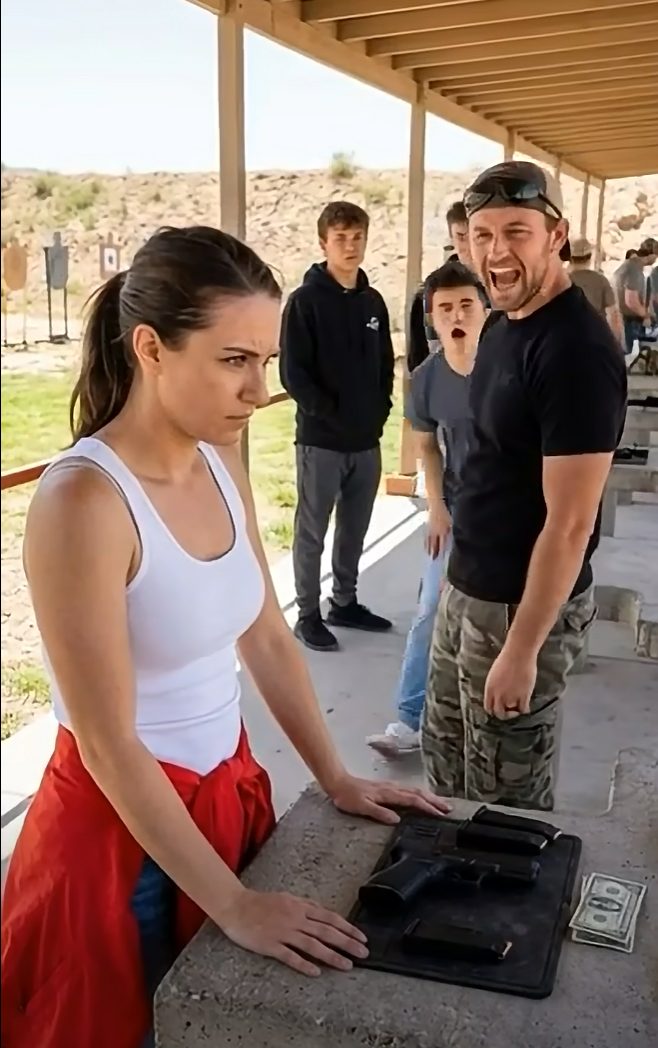
The young Marine noticed her hands first – long before anyone thought to check her ID. Then the range officer picked it up… and everything changed.
The range officer didn’t need to raise his voice.
“Sergeant,” he repeated, this time more quietly, “you might want to reconsider that bet.”
Michael Ducker kept his focus locked on the five silhouettes set twenty-five yards downrange. His stance stayed firm, shoulders squared, chin lifting just slightly – the way it does when a warning comes too late and pride refuses to back down.
“Why would I?” he replied.
Behind him, the youngest Marine had gone completely still.
His name tape read HARRIS. A lance corporal, maybe twenty-two, lean and alert, with the kind of eyes that belonged to someone who paid attention instead of performing. While everyone else had been watching my face, Harris had been watching my hands.
Now his gaze shifted to the worn military ID resting beside the hundred-dollar bill on the bench.
The plastic card was scuffed, one corner softened from years of use – handled in airports, armories, briefing rooms, and places that never made it into official records.
A red jacket nearby stirred slightly in the warm wind.
The bill lifted once, then settled.
Ducker finally turned.
At first, his expression carried irritation. Then his eyes dropped to the ID.
The smile didn’t vanish all at once. It faded – slowly thinning, then freezing in place, like he was forcing it to stay.
The other Marines leaned in.
One narrowed his eyes.
Another went quiet mid-comment, whatever joke he had ready dying before it reached his lips.
The range officer – gray mustache catching the sunlight beneath his wraparound glasses – picked up the ID carefully, as if he already understood what it meant.
How It Started
It had been a slow Tuesday morning at the civilian range outside Camp Pendleton, the kind of day that invites stupid conversations because there’s not enough happening to stop them.
I’d driven out alone. Red jacket, jeans, a range bag that had seen better decades. The counter guy – a kid named Bryce, I think, or maybe it was Brett, the kind of name you forget before you finish saying it – had given me the lane assignment without looking up from his phone. Perfectly fine. I wasn’t there to be recognized.
The Marines were already set up on the far end. Four of them, off-duty by the look of it, in civilian clothes that still somehow read as uniform. That particular posture doesn’t wash out. I know because I’ve spent thirty years trying to understand exactly how it’s built into a person.
Ducker was the loud one. Not mean, not exactly. More like someone who’d been the funniest guy in every room for so long that he’d stopped checking whether the room agreed. Big shoulders, easy laugh, the kind of confidence that fills up space without asking.
He clocked me about thirty seconds after I set up two lanes down.
Not hostile. Just that particular brand of assessment that happens when someone decides you don’t quite belong somewhere and hasn’t figured out yet that they should keep that thought to themselves.
“First time?” he called over.
“No,” I said.
He grinned at his friends. Somebody snorted.
I started my warm-up. Nothing dramatic. Dry-fire checks, grip check, breathing. The same ten things I’ve done in the same order since before Ducker was old enough to enlist.
That’s when Harris noticed my hands.
What Hands Tell You
A shooter’s hands are a record.
They show how many rounds you’ve put through a weapon over how many years. They show the grip you’ve defaulted to until it became involuntary. They show calluses in places that only form one way. Harris was new enough to still be learning what to look for, but he was the kind of person who looked. That’s rarer than it sounds.
He didn’t say anything yet. Just watched.
The bet started the way bets always start. Ducker made a comment about groupings – mine specifically, after I’d run my first target back. The comment wasn’t quite an insult and wasn’t quite a compliment. It was the kind of thing you say when you want to open a negotiation without admitting that’s what you’re doing.
“Not bad,” he said, “for a warm-up.”
I looked at my target. Five rounds. Center mass. One ragged hole where the other four had followed the first.
“That wasn’t a warm-up,” I said.
Somebody laughed. Ducker laughed loudest.
The hundred-dollar bill appeared from somewhere. He set it on the bench between us without ceremony, the way you do when you’re sure you won’t need to think about that money again.
“Twenty-five yards,” he said. “Five rounds. Tighter group wins.”
I looked at the bill.
Then I took out my ID and set it next to his money.
Not for the cash. That was never it. I just wanted something on the table that meant something, and a hundred dollars didn’t mean anything to either of us. The ID meant something. It was the thing that said who I actually was, separate from the red jacket and the civilian range and whatever story Ducker had already written in his head about the woman two lanes down.
Harris saw me set it down. His eyes moved from my hands to the card. He read it. Something in his face went careful and quiet.
He didn’t say a word.
The Range Officer Knew
His name was Gunnery Sergeant Terrence Webb, retired. Ran the range three days a week because he said it kept him sane, though I think he also just liked having somewhere to be. Gray mustache, wraparound Oakleys, a coffee cup that had been empty for two hours.
Webb had been watching from the moment I walked in. Not obviously. He was good at not being obvious. But I’d seen him reset his position twice to keep me in his peripheral line of sight, and that kind of thing doesn’t happen by accident.
He’d seen the ID before Ducker touched it.
When he said “Sergeant, you might want to reconsider,” he wasn’t speaking to Ducker out of pity. He was speaking to him the way you warn someone that the floor’s wet. Here’s the information. What you do with it is your problem.
Ducker, to his credit, didn’t fold immediately. He was stubborn in the way that takes years to build. But when he turned and actually looked at the card – really looked, read the rank, read the record notation along the bottom edge, read the small print that most people wouldn’t know how to interpret – the math changed.
Webb set the ID back down without comment.
Just placed it back on the bench, square with the edge, and stepped back.
Twenty-Five Yards
We shot in order. Ducker first, since it was his bet.
He was good. Genuinely good. Five rounds, clean, a group you could cover with a playing card. He stepped back and crossed his arms and let his work speak, which was fair, because his work was saying something worth listening to.
I stepped up.
The range went quiet in the way it only does when people have stopped pretending not to watch.
I didn’t think about the group. I don’t do that anymore. You think about that stuff until you don’t have to, and then you stop thinking about it and just shoot. The thinking lives in the hands by then. Harris had seen it in my hands before I’d fired a single round, which is why he’d gone still while everyone else was still running their mouths.
Five rounds.
Webb walked the target back himself. Held it up.
One hole.
Not five holes tight together. One hole, slightly larger than a single round, because the other four had found the first one and opened it rather than made neighbors.
Ducker stared at it for a long time.
“What branch,” he said. Not a question, exactly. More like the beginning of a sentence he wasn’t sure how to finish.
I told him.
He nodded slowly. The crossed arms came down.
“How long,” he said.
I told him that too.
Harris, behind him, had gone a color that was somewhere between mortified and impressed. He opened his mouth once, closed it, then said – very quietly, to nobody in particular – “I knew it was the hands.”
What He Did Next
Ducker picked up his hundred dollars. Folded it once, twice. I thought he was pocketing it, which would have been fine. The point was already made.
But he set it back down.
“Buy your own ammo with it,” he said. “I’m not – ” He stopped. Started again. “I’m not taking a bet I lost.”
“You didn’t lose,” I said. “You shot a good group.”
“Not that good.”
He looked at Webb, who was giving him absolutely nothing. Then at Harris, who was studying his own boots. Then back at me.
“I didn’t know,” he said.
“You weren’t supposed to,” I told him. “That’s not on you.”
He thought about that for a second. Picked up the money again. Put it in his pocket this time.
“Next time I’ll ask first,” he said.
“That’s all anybody can do.”
He nodded once, sharp, the way you acknowledge something that cost you something. Then he turned back to his lane, reset his target, and started shooting again. No more commentary. No more crowd work. Just the gun and the target and the distance between them.
Harris lingered a second longer.
“Ma’am,” he said. “I’m sorry about – ” He gestured vaguely at the air between us, at the whole preceding twenty minutes.
“Don’t be,” I said. “You were the only one paying attention.”
He looked at my hands one more time. Then he nodded and went back to his lane.
Webb refilled his empty coffee cup from somewhere, drank it standing up, and went back to pretending he wasn’t watching anything.
The wind picked up again. The red jacket shifted.
Somewhere downrange, paper targets took the weight of rounds that had nowhere else to be.
—
If this one got you, pass it to someone who’d appreciate it.
For more tales of unexpected marksmanship, check out what happened when my instructor said “sure, give it a shot” or when the Marine Sergeant told me to go home. And you won’t want to miss the story of how she told him not to touch the rifle – he did it anyway!



