
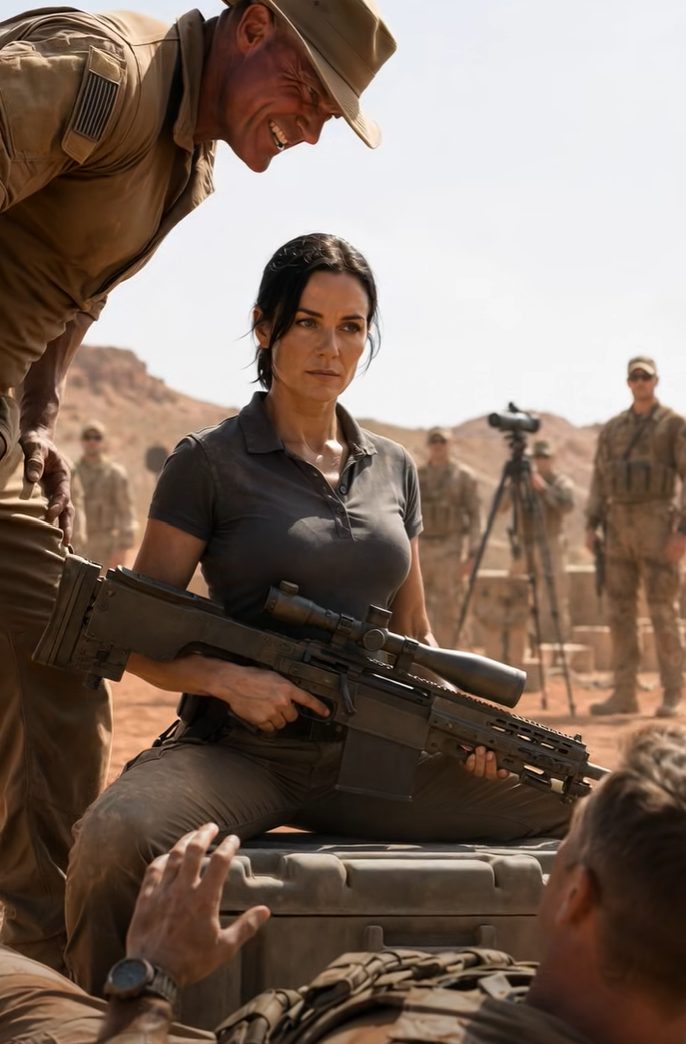
“Touch that rifle again,” the woman said, calm as a locked door, “and you’ll embarrass yourself in front of the entire range.”
Captain Mason Hunt laughed anyway.
The sound cut across the Arizona firing line, sharp and careless, slicing through the hot noon air while a dozen sniper teams paused behind spotting scopes and sand colored barricades. Heat shimmered above the red dirt. Brass casings glittered around their boots like scattered coins, and far downrange, steel targets kept ringing under precision fire.
The woman did not move.
She sat on an overturned ammo crate near the far end of the range, gray polo sleeves rolled once, dark hair tied low against the back of her neck, sunglasses resting beside her boot in the dust. In her lap lay a long anti materiel rifle with its optic detached, the kind of weapon most people touched with both hands and a serious face.
She handled it like she was cleaning a watch.
Mason stopped close enough for his shadow to fall across the rifle.
“That thing weighs more than you do,” he said.
A few men behind him chuckled.
The woman kept wiping the glass with a small black cloth. Her hands were steady, not careful in the nervous way civilians were careful, but exact, as if every movement had already been measured before it happened.
“No,” she said.
That was all.
Mason’s smile thinned.
“No?” he repeated, glancing back at the others. “You hear that? She says no.”
The laughter grew louder, carried by men who wanted Mason pleased and wanted the woman small.
She slid the cloth along the optic housing, checked the adjustment ring, then held it toward the sun. The lens flashed once, blue and clean.
Mason crouched slightly in front of her.
“You even know how to fire that monster?”
She set the optic back into place.
Click.
“Yes.”
The answer landed strangely.
Not defensive. Not proud. Just true.
A few laughs died before they were finished.
Mason noticed, and that annoyed him more than her calm ever could. He had built a career on making silence follow him. Navy Cross. Combat record. Longest confirmed shot in his unit. Guest instructor. Recruiters loved his face. Young snipers copied his stance.
And now this woman sat in the dust as if the range belonged to her.
“Listen, princess,” he said, leaning closer.
She finally looked up.
Her eyes were not angry.
That was worse.
They were quiet, gray, and completely unimpressed.
“Don’t touch the rifle,” she said.
Mason froze for half a second.
Then he smiled, because every man watching expected him to. Because backing away would look like losing. Because the Arizona sun was brutal, and pride always gets louder when men are sweating.
He reached down and grabbed the rifle.
The movement was fast and showy, meant to make the crowd react before she could. His hand closed around the receiver, and he pulled.
The rifle came halfway out of her grip.
Then the woman stood.
No one saw the beginning clearly.
There was only a twist of her foot in the red dust, a small turn of her shoulder, her left hand closing around Mason’s wrist, and the sudden change in his face when his balance vanished.
His boots slid.
His breath caught.
The rifle was no longer in his control.
She stepped inside his reach, turned his wrist down and away, and used his own forward pull against him.
Mason hit the ground hard.
Dust burst into the air.
For one stunned second, the entire firing line seemed to forget how to breathe. Then the guns stopped. One rifle after another went silent, until only the desert wind moved across the range and the steel targets swayed in the distance.
Mason Hunt lay on his back in the dirt, blinking against the white Arizona sun.
The woman stood over him with the rifle in her hands.
She did not smirk. She did not look around for approval. She simply checked the rifle, brushed a thin line of dust from its body with two fingers, and lowered it carefully onto the padded case beside the crate.
“Are you out of your mind?” Mason snapped, pushing himself up on one elbow.
His voice cracked at the edge.
Everyone heard it.
The woman looked down at him.
“I told you not to touch it.”
Behind Mason, the snipers who had laughed now stood in a loose semicircle, their expressions caught between amusement and fear. No one wanted to laugh anymore. Not because Mason had fallen, but because the woman had dropped him without effort.
Mason got to his feet too quickly.
Dust clung to the back of his uniform. A smear of red dirt marked one shoulder. His sunglasses had landed several feet away.
A young lieutenant bent to pick them up, then stopped when Mason shot him a look.
“I slipped,” Mason said.
No one answered.
He brushed at his chest.
“She got lucky.”
The woman crouched again, opened the rifle case, and checked the foam cutouts with the patience of someone waiting for weather to pass.
Mason stepped closer.
“Stand up.”
She ignored him.
His jaw tightened.
“I said stand up.”
She looked at the rifle, not at him.
“No.”
That single word moved through the crowd like a match dropped in dry grass.
Mason’s face changed.
The performance was gone now. This was no longer about teasing a woman with a rifle. This was about a decorated captain lying in the dirt while two hundred trained shooters watched and remembered.
“You think you can walk onto my range,” he said, his voice low, “handle military equipment, disrespect an officer, and just sit there?”
The woman closed the rifle case halfway.
“I was here before you arrived.”
“Not on my line.”
“This isn’t your line.”
That did it.
Mason laughed once, but there was no humor in it.
A few yards away, Master Chief Owen Briggs shifted his weight. He was older than most of the men there, with sun burned skin and eyes that had watched plenty of stupid things become official problems.
“Captain,” Briggs said carefully.
Mason did not look at him.
“Not now.”
Briggs looked at the woman, then at the rifle, then at the badge clipped low against her belt, half hidden by the edge of the ammo crate.
His expression changed.
Only a little.
But enough.
“Mason,” Briggs tried again.
The captain raised a hand without turning.
“I said not now.”
What Briggs Knew
Owen Briggs had twenty-two years on ranges like this one.
He’d seen instructors lose fingers to careless students. He’d seen a colonel faint from heat and nobody say a word about it for six years. He’d seen men try to impress women on firing lines and he’d seen where that went, which was usually somewhere between pathetic and dangerous.
But he had never seen anything like what he’d just seen.
The woman had not even looked at Mason’s face when she took him down. She’d looked at her wrist. At the point of contact. Like the problem was mechanical, not personal.
Briggs had trained with some people who moved like that.
Not many. Three. Maybe four in two decades.
And none of them had been on this range by accident.
He stepped forward, past two of the younger snipers who parted without being asked.
“Captain Hunt.” Louder this time.
Mason turned, finally, with the face of a man who had run out of patience for people who weren’t the problem.
“What.”
Briggs did not say it out loud, because saying it out loud in front of everyone was exactly the kind of thing that turned a bad day into a career ending one. Instead he tilted his head, just slightly, toward the badge.
Mason followed the look.
He stared at the badge for a moment.
The woman had not moved it. It was still clipped where it had been, half tucked behind the crate lip, the way someone clips a badge who isn’t trying to hide it but also isn’t trying to advertise it. It had a lanyard attached, dark blue. The logo on the face was small and the lettering was smaller.
Mason read it.
His expression did something complicated.
“You’re with the program,” he said.
It wasn’t a question.
The woman looked up.
“Yes.”
The Name He Should Have Known
The program was not something Mason knew well, because the program was not something that wanted to be known well. It existed in the gap between agencies, the kind of office that appeared on no public org charts and whose budget lived inside three different line items spread across two departments.
They ran long-range interdiction work in places where the military technically wasn’t. They trained foreign nationals in programs that technically didn’t exist. And once every few years, they produced someone whose file, if you could get to it, made experienced people put the file down and take a walk.
The woman’s name was Carla Reyes.
She was thirty-eight years old. She had a degree in mechanical engineering from a school in New Mexico that most people had not heard of. She had been recruited out of a regional shooting competition in 2009 by a man she described, when she described him at all, as looking like an accountant who’d had a hard decade. She had spent four years in field work, two years running a training program in a country she still referred to by its old name out of habit, and the last three years as a technical evaluator for the program’s long-range acquisition systems.
The rifle in the case was not hers.
It was a prototype. One of six in existence. She had helped design the feed mechanism.
She was here to evaluate it in field conditions.
The range had been cleared for her use from 0900 to 1300.
Mason’s unit had arrived at 1015, two days early, because someone at the scheduling office had transposed a number.
None of this was Carla’s problem.
What Nobody Said Out Loud
Mason stood very still.
Behind him, the snipers had done the math, or enough of it. They couldn’t know everything. But they knew the badge wasn’t base security. They knew the rifle in that case wasn’t standard issue. And they knew the way Briggs was standing, which was the way Briggs stood when he was trying to keep something from getting into an official report.
The young lieutenant who’d bent to pick up Mason’s sunglasses had quietly straightened back up and moved three steps to the left.
Mason turned to Carla.
“Why didn’t you say something,” he said.
Not angry anymore. Something else.
Carla closed the rifle case the rest of the way and latched it.
“I said don’t touch the rifle.”
“That’s not what I meant.”
“I know what you meant.” She stood, picked up the case by its handle. “You meant why didn’t I tell you who I was so you’d have a reason to listen to me.”
Mason opened his mouth.
Closed it.
Carla looked at him for a moment, the way you look at a lock you’ve already opened.
“The reason was always there,” she said. “You just didn’t want to see it.”
She picked up her sunglasses from the dust, put them on, and walked toward the range officer’s station without hurrying.
The Drive Back
Briggs drove Mason back to the base in silence for about six minutes.
Then Mason said, “She didn’t have to do that.”
Briggs kept his eyes on the road.
“Do what.”
“Take me down like that. In front of everyone.”
Briggs thought about that.
“You grabbed her rifle, Captain.”
“I know what I did.”
“Then you know why she did what she did.”
Mason looked out the window. The desert ran flat and red in every direction, broken only by the occasional scrub and the far white shimmer of the road ahead. His shoulder hurt where he’d hit the ground. He wouldn’t mention that to anyone.
“I didn’t know who she was,” he said.
“You knew she was a person,” Briggs said.
That sat in the truck for a while.
“She’s good,” Mason said eventually. Not a concession. Just a fact he was placing somewhere he could look at it.
“She’s better than good,” Briggs said. “I’ve seen the evaluations on that rifle program. She’s the one who solved the feeding problem on the Mark IV. Three engineers couldn’t crack it. She did it in eleven days.”
Mason said nothing.
“And she put you on the ground in about two seconds,” Briggs added, because he was Briggs, “without dropping the rifle.”
Mason’s jaw moved.
“Yeah,” he said.
The truck rolled on.
The Report
There was no official incident report.
Briggs wrote his daily notes in the careful language of a man who had spent two decades deciding what needed to be in writing and what needed to be quietly let go. He noted that Captain Hunt’s unit had arrived ahead of schedule due to a scheduling error. He noted that the range had been temporarily occupied by a technical evaluator from an outside program. He noted that the range was vacated and returned to Hunt’s unit by 1100.
He did not note the fall.
He did not note the badge.
He did not note the two seconds.
What he did note, in the margin of his personal log that no one read, was four words.
She didn’t even flinch.
Three weeks later, Mason Hunt submitted a formal request to attend an advanced combatives refresher course.
The instructor listed on the request was not Carla Reyes.
But the program he requested it through was the same dark-blue-lanyard program, and the scheduling officer who processed the request made a small note in the file.
The note said: Approved. Evaluator Reyes informed.
Whether Carla ever looked at that note, no one could say.
The rifle prototype passed its field evaluation. All six units were approved for the next phase.
The feed mechanism worked perfectly.
—
If this one hit different, pass it along to someone who needed to see it today.
For more tales of unexpected returns and challenging the odds, check out what happened when she walked back onto the range three years after they declared her dead or when someone brought their dead father’s rifle to a competition nobody thought they could win.



