
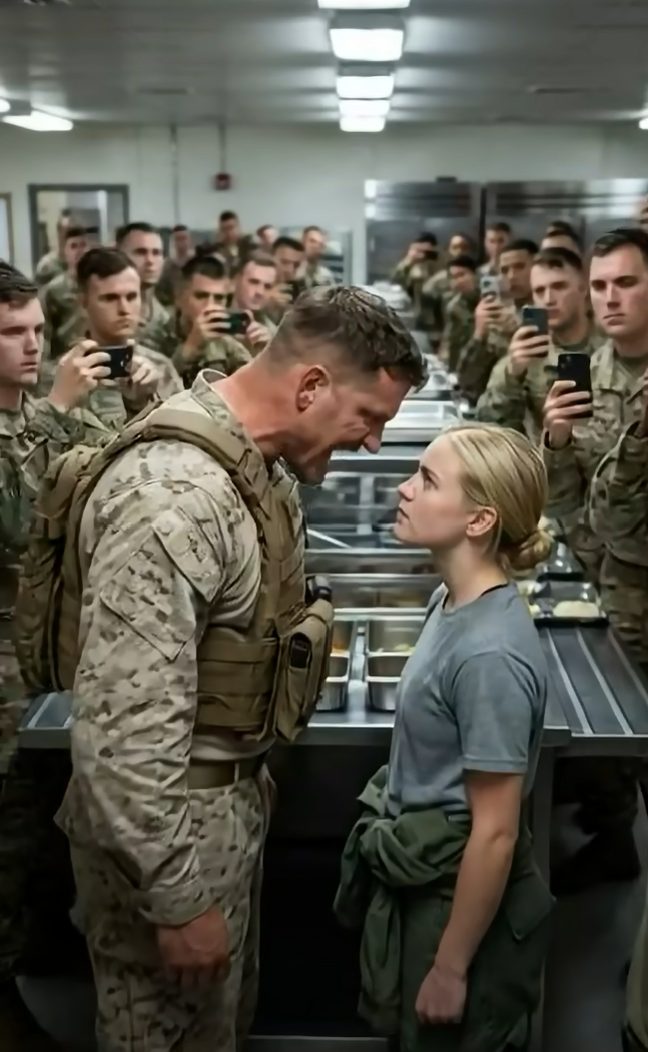
The “helpless” woman they laughed at had one tattoo that made an entire military base fall completely silent.
When she first walked into the mess hall, nobody noticed anything extraordinary about her.
She looked small.
Quiet.
Almost forgettable beneath the din of hundreds of soldiers packed shoulder-to-shoulder, trays clattering, conversations overlapping, the whole room running on its own loud frequency.
To most people watching, she seemed out of place the second she stepped through the doorway.
But there were small things, if you knew what to look for. The way her eyes moved across the room before her body did – a slow, methodical sweep, left to right, corners first. The way her right hand stayed loose at her side, fingers slightly open, like a habit she’d never bothered to break. The scar that ran along her jawline, thin and pale, old enough to have stopped telling its story to strangers.
Nobody noticed any of it.
Sergeant Cole Mercer noticed none of it.
Mercer had spent twelve years in the military and believed he could read weakness within seconds. The way she carried herself – calm, reserved, moving without urgency – looked to him like someone performing confidence they didn’t actually own. A civilian in borrowed posture. An easy target dressed up as discipline.
He smirked at the soldiers around his table before speaking loud enough for the neighboring groups to hear.
“Well, would you look at that,” he called out. “Somebody lost a tourist.”
A few soldiers laughed immediately.
She paused. Just briefly. Then kept walking without turning around.
That only encouraged him.
“Hey.” Mercer pushed back his chair and stood. “Uniform regulations called. They want their costume back.”
Laughter spread fast across the room, the way it always does when someone with rank decides to perform.
Phones appeared quietly in people’s hands.
Soldiers loved spectacle. And humiliation moved faster than any official communication on a base.
Three tables away, a young corporal named Diaz watched without laughing. He’d arrived six weeks ago, still learning which battles were worth picking. He watched the woman’s face instead of Mercer’s, looking for the flinch, the reddening cheeks, the moment someone decides whether to shrink or fight. He didn’t see either.
That bothered him more than the laughter did.
The woman finally stopped near the center of the room and turned slowly toward Mercer. Up close she looked younger than most people expected. Calm gray eyes. Dark hair pulled back without ceremony. A face that had apparently decided, somewhere along the way, that other people’s opinions were interesting data at best.
Mercer grinned wider.
“What unit are you supposed to belong to?” he asked, drawing the mockery out slowly, letting the room stay with him.
She answered without raising her voice.
“Temporary assignment.”
The response landed like an invitation to keep going.
“Temporary assignment,” one soldier repeated, grinning. “That’s what paperwork looks like when it shows up in person.”
Another voice from somewhere near the back: “Careful, Sarge. She might escalate this through proper channels.”
The room erupted again.
Diaz set his fork down. Quietly. Without knowing exactly why.
The Part Nobody Saw Coming
What happened next took about four seconds.
Mercer stepped forward, still performing for the room, still riding the laughter. He was maybe eight feet from her now. Close enough to make it personal. He opened his mouth to deliver whatever came next in his little routine.
She rolled up her left sleeve.
Not dramatically. The way you’d check a watch. One practiced fold of fabric, pushed to the elbow.
Mercer’s mouth stayed open.
The laughter didn’t stop all at once. It tapered, table by table, the way sound dies when something interrupts the frequency. The soldiers closest to her went first. Then the ones behind them, craning to see what the front row was reacting to. Then the back of the room, catching the silence like a signal.
On her forearm, in black ink, was a unit insignia most people in that room had never seen in person. Below it, a date. Below that, three words in Latin that anyone with serious time in would recognize on sight.
Mercer recognized it.
His jaw closed.
The soldier who’d made the paperwork joke looked at the floor. The one who’d done the voice from the back had apparently found something very important to study on his tray.
Diaz leaned forward slightly in his seat. He couldn’t read the Latin from where he sat, but he could read Mercer’s face, and Mercer’s face had gone the specific color of a man who has just realized he picked a fight with someone he cannot win on any level, in any room, in front of any number of witnesses.
She pulled her sleeve back down. One smooth motion.
“Temporary assignment,” she said again. Exactly the same tone as before. “Three days. Then I’m gone.”
She picked up a tray and got in line.
What the Tattoo Actually Meant
The insignia on her arm belonged to a unit that didn’t advertise itself.
The kind that shows up in briefings under initials. The kind whose operational history exists in documents with more redactions than text. Most of the soldiers in that mess hall had heard the name in the way you hear about places you’ll probably never go – abstractly, at a remove, the way you hear about weather in a country you’ve never visited.
Mercer had heard it differently.
He’d served alongside someone who’d washed out of the selection process for that unit. The man had described the pipeline once, in a bar in Ramstein, after three beers and with the specific flatness of someone recounting something they’d genuinely rather not think about. Mercer had listened the way you listen to stories that don’t apply to you.
He wasn’t laughing now.
The date on her forearm corresponded to an operation that had made a single paragraph in a report he’d read two years ago. The paragraph hadn’t named anyone. It had described a situation in which four personnel extracted eleven civilians from a building under active fire, over six hours, with one vehicle and no air support. The paragraph ended with the phrase “mission parameters exceeded.”
Mercer knew what that meant in practice.
He sat back down without saying anything else.
Diaz
Corporal Ray Diaz had grown up in Laredo, the second of four kids, in a house where his mother had a rule about dinner: nobody left the table until everyone was done eating. Not a metaphor. Literal. You sat there. You waited. You didn’t check your phone.
He thought about that rule a lot on base, in rooms like this one, watching people perform for each other.
He watched the woman move through the line with the same unhurried efficiency she’d walked in with. She took a tray. She chose food without deliberating over it. She found an empty table near the window and sat with her back to the wall, facing the room.
Corners first.
Diaz picked up his fork. Ate the last of his food. Considered.
He was twenty-three. He’d been in for two years. He had opinions about a lot of things that he mostly kept to himself because he was twenty-three and had been in for two years and understood, at least intellectually, that this was not the moment in his career where his opinions were the point.
But he stood up anyway.
He crossed the room with his half-finished coffee and stopped at the edge of her table.
“Mind if I sit?”
She looked at him. The kind of look that’s actually a quick assessment dressed up as eye contact.
“Go ahead,” she said.
He sat. Didn’t say anything immediately. Drank some coffee.
“I didn’t think that was funny,” he said finally. “Earlier.”
She glanced up from her food. “Okay.”
“I just wanted to say that.”
“You said it.”
He nodded. Got up. Took his coffee back to his table.
That was the whole conversation.
What Mercer Did Next
He didn’t apologize. Not right away.
What he did was spend the next forty minutes eating his food and not looking at anyone, which on a military base is its own kind of statement. The soldiers at his table ate in a quiet that nobody seemed interested in breaking. The phones had disappeared back into pockets. The spectacle was over and what replaced it was the specific discomfort of a room that had laughed too fast at the wrong person.
Mercer had twelve years in. He’d done two tours. He’d been decorated twice and reprimanded once and had generally navigated his career the way a man navigates a room he knows well – confidently, maybe a little carelessly, assuming the furniture hasn’t moved.
The furniture had moved.
He knew it. The room knew it. The question was what he did with that.
He found her after lunch, outside, near the eastern side of the building where the shade came in for about twenty minutes in the early afternoon. She was standing with a coffee, looking at nothing in particular.
He stopped a few feet away.
“I was out of line,” he said. No preamble.
She didn’t turn immediately. Let the words sit there for a second.
“You were,” she said.
“I didn’t know who you were.”
She turned then. Looked at him straight. “That’s kind of the problem, Sergeant.”
He didn’t have a response to that. Which was unusual for him.
“I don’t need an apology,” she said. “But you’ve got soldiers in there who follow your lead. Whatever they think is funny, whatever they think is acceptable – that comes from you.” She picked up her coffee. “Think about what you want them to learn.”
She walked back inside.
Mercer stood in the shade for a while after that.
The Three Days
She stayed for exactly as long as she’d said.
Nobody found out what the temporary assignment actually involved. The official paperwork, what little circulated, said something about evaluation and cross-unit coordination, which meant nothing specific to anyone who read it.
What people noticed was smaller than that.
She ate in the mess hall all three mornings. Same table. Back to the wall. She didn’t perform friendliness and she didn’t perform coldness. She was just there, the way someone is there when they’ve been in enough places to stop needing any particular place to be something it isn’t.
Diaz saw her once more, the afternoon of the second day, outside the equipment building. She was talking to one of the senior NCOs, a woman named Pruitt who’d been on base longer than most and had the particular authority of someone who’d simply outlasted everyone who’d tried to undermine her. They weren’t laughing, but whatever they were discussing had the easy back-and-forth of people who’d operated in similar conditions and recognized each other from the inside out.
Diaz didn’t interrupt.
On the morning of the third day, she was gone before breakfast. No announcement. No goodbye. The bunk she’d used was stripped and made, the corners sharp, the pillow centered.
The kind of absence that doesn’t leave a mark.
What Stayed
Mercer ran PT differently the following week.
Nobody mentioned it directly. But the soldiers who’d been in the mess hall that day noticed. The jokes that used to fly during breaks in training – the ones that targeted whoever seemed softest or newest – those dried up. Not completely. But enough to notice.
Diaz noticed.
He didn’t know if it would last. Probably some of it would erode, the way things erode when the moment that caused them gets far enough away. That’s just how it worked. You don’t change a room permanently with three days and one rolled-up sleeve.
But some things stick.
The date on her forearm. The Latin. The way Mercer’s face had gone still when he recognized what he was looking at.
The fact that she’d gotten her food, sat down, and eaten her lunch.
Diaz thought about that last part more than anything else. The whole room had been watching her, waiting for a reaction, and she’d just – eaten her lunch. Like the opinion of the room was information she’d received and filed and moved past.
He was still working on that part.
Still figuring out how a person gets there.
He suspected it had something to do with the kind of rooms you’d already been in before that one. The kind of situations where the noise stopped mattering because the work was the only thing left.
He wasn’t there yet.
But he thought about it.
—
If this one sat with you, pass it along to someone who could use it today.
For more tales of unexpected twists and powerful women, check out what happened when She Came Back from the Grave – But Not to Save Us or when She Told a Lieutenant Colonel He Wouldn’t Have Three Seconds. Then He Moved. And if you enjoy a good military mystery, you might also like My Father Told Me This Plane Was Dead. The Air Force Scrambled When I Proved It Wasn’t.



