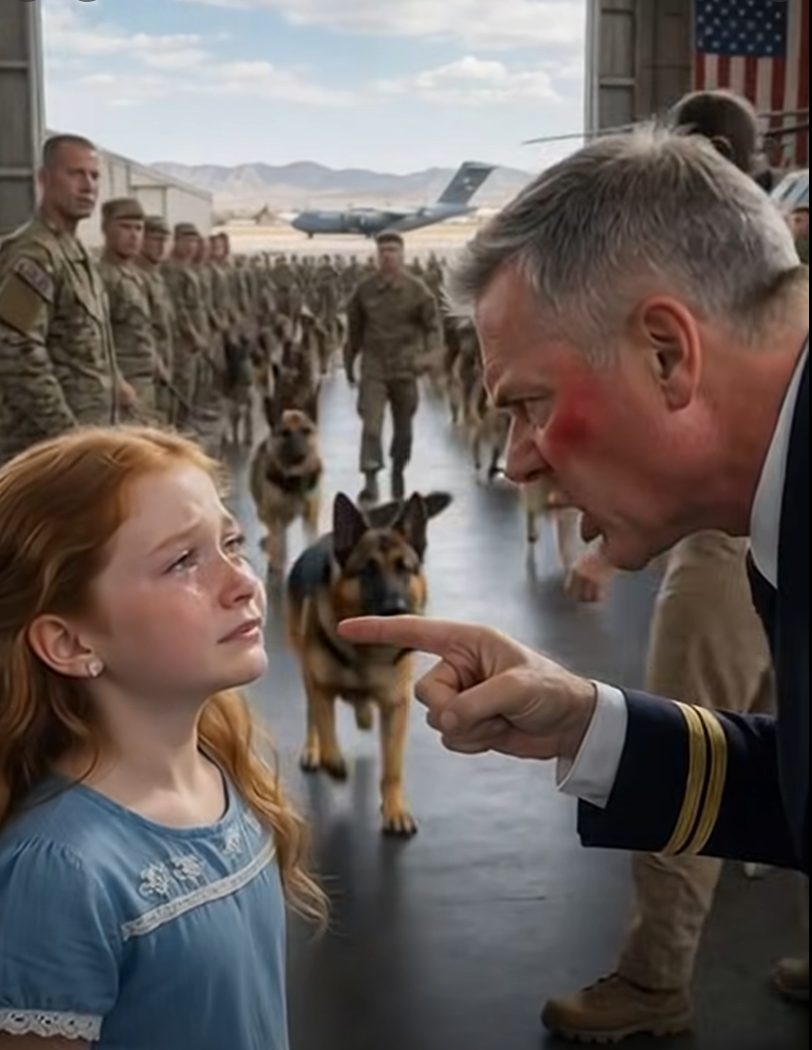
“Your mother is not a Navy SEAL,” Lieutenant Carter Hayes said into the microphone, grinning like he had just stepped on an insect. “Women don’t get that far, son. Don’t make a fool of yourself.”
Two hundred students burst out laughing.
And I stood there, sixteen years old, my fists relaxed at my sides, my jaw clenched tight, and my mother’s dog sitting next to me like carved stone.
I didn’t shout.
I didn’t argue for her.
I didn’t tell him about the nights she came home with sea salt still dried into her hair, bruises tucked beneath her sleeves, and classified silence resting between us at the kitchen table.
I only stared at him.
Because Mom had taught me something when I was young.
The truth does not beg people to believe it.
It waits.
Lieutenant Hayes believed he had embarrassed a teenager in front of an entire high school gym. He believed my mother was some fitness influencer, some confused woman living inside a military fantasy.
He had no idea she was standing against the back wall.
He had no idea the rear doors were already unlocked.
And he definitely had no idea what was waiting outside.
Fifty military working dogs.
One rear admiral.
And the woman he had just said could not exist.
PART 1 – THE LAUGHTER CAME FIRST
“You’re lying about your mother,” Lieutenant Hayes said, and the entire gym laughed like my humiliation was part of the program.
I was standing in the center of Harborview High School’s gymnasium, surrounded by folding chairs, recruiting tables, glossy military pamphlets, and posters that read things like SERVE WITH HONOR and COURAGE STARTS HERE.
Funny.
There wasn’t much courage in that room when everyone chose to laugh at a kid.
My name is Ethan Cole.
I was sixteen years old, a junior, and I had spent most of my life learning how to stay composed when people underestimated me.
Not because I was extraordinary.
Because my mother was.
And being Raven Cole’s son meant you learned early that the world had a strange way of doubting anything it had never witnessed before.
Lieutenant Carter Hayes stood on the polished gym floor in his dress uniform, his chest covered in ribbons, his boots gleaming beneath the fluorescent lights. He looked like the type of man adults trusted before he even started speaking.
That was part of the problem.
He had command presence. He had a microphone. He had a gym full of teenagers ready to believe him.
I had a gray hoodie, beaten-up sneakers, and a truth nobody wanted to accept.
The event was supposed to be simple. Military Career Day. Every branch had its own table. Army, Navy, Air Force, Marines. Even the Coast Guard had a booth near the exit with a banner that kept peeling off the tape.
Teachers said it would be inspiring. Recruiters said it would be informative. My mom had told me, “Stand straight. Ask clearly. Don’t shrink.”
So I didn’t.
When Lieutenant Hayes opened the floor for questions, I lifted my hand. He pointed at me. I stood up.
“My name is Ethan Cole,” I said. “I wanted to ask about special operations selection. Specifically, BUD/S and advancement after qualification.”
His face lit up. That was his field.
“Good question,” he said. “BUD/S is one of the most difficult military training pipelines in the world. Most candidates fail. You need endurance, mental toughness, water confidence, leadership, discipline. What exactly are you asking?”
“My mom completed it,” I said. “She’s a Navy SEAL. I wanted to know what the advancement path looks like after earning the trident.”
The room shifted.
Not loudly. At first, it was only a ripple. A few heads turned. A few students murmured. A teacher by the bleachers froze with a clipboard pressed to her chest.
Lieutenant Hayes blinked.
Then he smiled.
That smile told me everything. It was not confusion. It was not interest. It was the smile of a man who had decided I was foolish and was about to enjoy correcting me.
“Your mom,” he said slowly, “is a Navy SEAL?”
“Yes, sir.”
“A woman Navy SEAL?”
“Yes, sir.”
A few boys behind me snickered. Hayes glanced around the gym like he wanted everyone to enjoy the lesson.
“Son,” he said, “I appreciate your imagination. I really do. But no woman has ever earned the Navy SEAL trident. That is not an opinion. That is documented fact.”
My hands stayed motionless. My face stayed calm.
Inside, something hot rolled through my chest. Not embarrassment. Anger. But Mom had taught me anger was costly. You didn’t spend it just because someone invited you to.
“She didn’t just tell me,” I said. “I’ve watched her train since I was four.”
That made everything worse.
Hayes laughed softly into the microphone.
“I’m sure your mother is very athletic,” he said. “Maybe she runs marathons. Maybe she does CrossFit. Nothing wrong with that. But there is a difference between being fit and being a SEAL.”
More laughter. This time it hit harder. A few students looked away because even they understood it was cruel.
But most of them laughed anyway.
That’s how crowds work. They borrow courage from each other and call it truth.
Lieutenant Hayes kept talking. “Part of service,” he said, pacing slightly now, “is respecting reality. Spreading false information about elite military units dishonors the people who actually earned those qualifications.”
He stared straight at me.
“I’m not trying to embarrass you, son. I’m trying to educate you.”
That was the lie that made my jaw lock tighter.
Because he was trying to embarrass me. Everyone knew it. He just dressed it up in professionalism so adults would call it discipline instead of cruelty.
I sat down. Slowly. Not because I was defeated. Because I understood the rhythm of the moment.
Mom had trained me for this without ever calling it training.
Breathe. Observe. Remember. Let people expose themselves.
PART 2 – SHE WAS ALREADY THERE
At the back of the gym, near the emergency exit, my mother stood with her arms folded.
Raven Cole.
People always got stuck on that. They saw her age before they saw her. They saw her small build before they noticed the way she carried herself. They saw a young woman in camouflage pants, worn boots, a fitted white athletic top beneath an open field jacket, and they thought they understood the whole story.
They never did.
Her dark hair was tied back loosely. A few strands had fallen forward against her cheek. She looked calm. That was how I knew Lieutenant Hayes had crossed a line.
My mother did not get loud when she was angry. She became still.
Beside me sat Kaiser, her German Shepherd. He was not a pet. He was not emotional support. He was a military working dog with eyes that missed nothing.
When the room laughed, Kaiser looked at me. When my breathing changed, his ears shifted. When my mother pushed off from the back wall, he stood before she made a sound.
The room noticed her then. One by one, heads turned.
Lieutenant Hayes followed their eyes.
His smile came back. That polite tone men use when they are about to be disrespectful in public.
“Ma’am,” he said, “are you this young man’s mother?”
“I am,” Mom said.
Her voice was quiet. It carried anyway.
“And you are claiming to be a Navy SEAL?”
Mom looked at him for a long second.
“That’s what the paperwork says.”
A few students whispered. A Navy chief near the side wall, an older man named Delgado, went completely still. I saw it. So did Mom. Lieutenant Hayes did not.
He motioned toward the tactical simulator station beside the Navy booth. It was a demonstration rig with screens, sensors, and a training weapon. Earlier, they had used it to let students try simple reaction drills.
Hayes’ eyes sharpened.
“Well,” he said, “since we have such a rare guest with us today, maybe you’d be willing to give a demonstration.”
The gym fell silent again. This time, nobody laughed.
Mom looked at the simulator. Then back at Hayes.
“You want me to run it?”
“If you’re comfortable,” he said.
He expected her to retreat. I could see it all over his face. He thought this was the moment the lie would fall apart.
Mom held out Kaiser’s lead. I stepped forward and took it.
Her eyes met mine for half a second. No smile. No warning. Just trust.
Then she walked toward the simulator.
PART 3 – THE SIMULATOR
The rig was built for basic demonstration. Threat identification, target sequencing, response time. The kind of setup meant to impress teenagers, not challenge operators.
Mom picked up the training weapon. Checked it without being told to. A reflex so automatic she probably didn’t register doing it.
Chief Delgado, from his spot by the side wall, watched her hands.
The program loaded. Three scenarios, timed. Hayes stood to the side with his arms crossed, looking generous, like he was doing her a favor.
She ran the first scenario in eleven seconds. Clean. No hesitation, no wasted movement.
A few students sat up straighter.
Hayes cleared his throat. “The system is calibrated for – “
She was already in the second scenario.
Eight seconds.
The room went very quiet.
Not the quiet of boredom. The quiet of people recalculating.
Third scenario. Six seconds. Every target correctly identified, every neutral correctly skipped.
The screen flashed a score. The number meant nothing to most people in that gym.
It meant something to Chief Delgado. His chin dropped slightly. Just slightly.
Mom set the training weapon down the same way she’d picked it up. Careful. Deliberate.
Hayes said nothing for a moment.
Then: “That’s a good score for a civilian.”
The word civilian landed like he meant it to.
Mom turned and looked at him. Not with anger. Not with the face of someone who needed him to understand. The face of someone who had already moved past this particular obstacle and was simply waiting for the next part of the day to begin.
“I appreciate the demonstration opportunity,” she said.
And then she looked at me and gave the smallest nod.
I knew what it meant.
I pulled out my phone and sent one text.
Now.
PART 4 – THE REAR DOORS
The sound started low.
A rumble, almost. Not mechanical. Organic. Dozens of paws on concrete, the jingle of harnesses, the controlled movement of animals trained to work in formation.
Then the rear doors of the gymnasium swung open.
All four of them. At once.
And they came in.
Fifty military working dogs, in full gear, each one paired with a handler in operational dress. Belgian Malinois. German Shepherds. Dutch Shepherds. One enormous black Labrador near the back. They moved in two clean columns down the center of the gym, handlers keeping pace, the whole thing so organized it looked rehearsed.
Because it was.
Behind them, in a Navy service uniform with enough hardware on his chest to fill a display case, walked Rear Admiral Dennis Pruitt. Sixty-one years old, gray at the temples, built like a man who had never once in his life eaten a meal he didn’t earn.
He had driven three hours for this.
Mom had called him four days ago, after I’d told her about Career Day.
She hadn’t said she was planning anything. She’d just asked me what time the event started.
The gym erupted. Not in laughter this time. In noise, in chairs scraping back, in students standing to see, in teachers grabbing each other’s arms, in the Coast Guard recruiter near the exit actually dropping his coffee.
Kaiser sat perfectly still beside me.
Lieutenant Hayes had gone the color of old chalk.
Rear Admiral Pruitt walked to the center of the gym floor, looked around once at the students, and then turned to face Hayes.
He did not use the microphone.
He didn’t need to.
“Lieutenant,” he said, and the room went so quiet I could hear Kaiser breathing.
Hayes straightened. Reflex. “Sir.”
“I understand there was some confusion today about the qualifications of one of our operators.”
Hayes opened his mouth.
Pruitt continued right over it.
“Commander Cole has served twenty-two years. She completed BUD/S in the third integrated class. She has four combat deployments, two classified operations I am not going to name in a high school gymnasium, and she currently oversees the Naval Special Warfare K-9 program, which is why she has brought these dogs here today.”
He let that sit for a second.
“She did not come here to prove anything to you, Lieutenant. She came because her son goes to this school, and she wanted these students to see what the program produces.”
Hayes said nothing.
There was nothing to say.
PART 5 – WHAT HAPPENED AFTER
The dogs stayed for forty minutes.
Handlers walked students through the working pairs, explained the training, let a few kids meet Kaiser under Mom’s supervision. The Belgian Malinois near the front, a compact female named Dex, did a controlled apprehension demonstration on a padded volunteer that made the entire junior class go absolutely silent.
Mom moved through the gym like she always moved. Unhurried. Answering questions when students asked them, redirecting when they got too personal, keeping one eye on Kaiser and one on the room.
Lieutenant Hayes sat at the Navy table for most of it. He did not leave. I’ll give him that. He stayed and he watched, and somewhere around the twenty-minute mark I saw him staring at Mom with an expression I couldn’t fully read.
Not quite remorse. Something closer to recalibration.
Chief Delgado walked over to me near the bleachers.
“Your mom,” he said, not quite a question.
“Yeah.”
He nodded slowly. “I served with someone who knew her. From the Coronado days.” He paused. “She’s the real thing, son.”
“I know,” I said.
Before they left, Rear Admiral Pruitt shook hands with the principal, said something quiet to the two Army recruiters that made them both nod, and then stopped in front of me.
He looked down for a moment.
“You held your ground,” he said.
“She taught me to.”
He almost smiled. “She would.”
Then he walked out, and the dogs went with him, and the gymnasium slowly filled back up with the ordinary noise of a school day trying to remember what it was doing.
Mom found me by the bleachers. She put one hand on the back of my neck, the way she’d done since I was small.
“You okay?”
“Yeah,” I said.
Kaiser leaned against my leg.
She looked across the gym toward the Navy table, where Hayes was now talking to a group of students with the careful energy of a man trying to recover his footing.
“He’s not a bad person,” she said.
I looked at her.
“He’s just a person who stopped being curious,” she said. “That’s its own kind of failure.”
She picked up Kaiser’s lead.
“Let’s go get lunch. I’ve got two hours before I have to be back on base.”
We walked out through the rear doors, into the afternoon, into the ordinary Tuesday light, and she didn’t say another word about it.
She never needed to.
—
If this one got you, send it to someone who needs to read it today.
For more stories about unexpected entrances and surprising reveals, check out when She Was Standing in Spilled Coffee When They Walked In and Saw Her, or the time My Father Locked Me in a Cabin at My Grandfather’s Funeral. He Didn’t Know What Was Inside It.. You might also enjoy reading about how My Name Hadn’t Been Said Out Loud in Eleven Years. He Said It in Front of Everyone..