The punch landed in front of live cameras, and for one frozen second, nobody moved.
Then the alarms screamed.
Blood touched the corner of her mouth as she lifted her eyes from the floor – not panicked, not broken, not even angry. Just focused, like she had heard something no one else in the room understood yet.
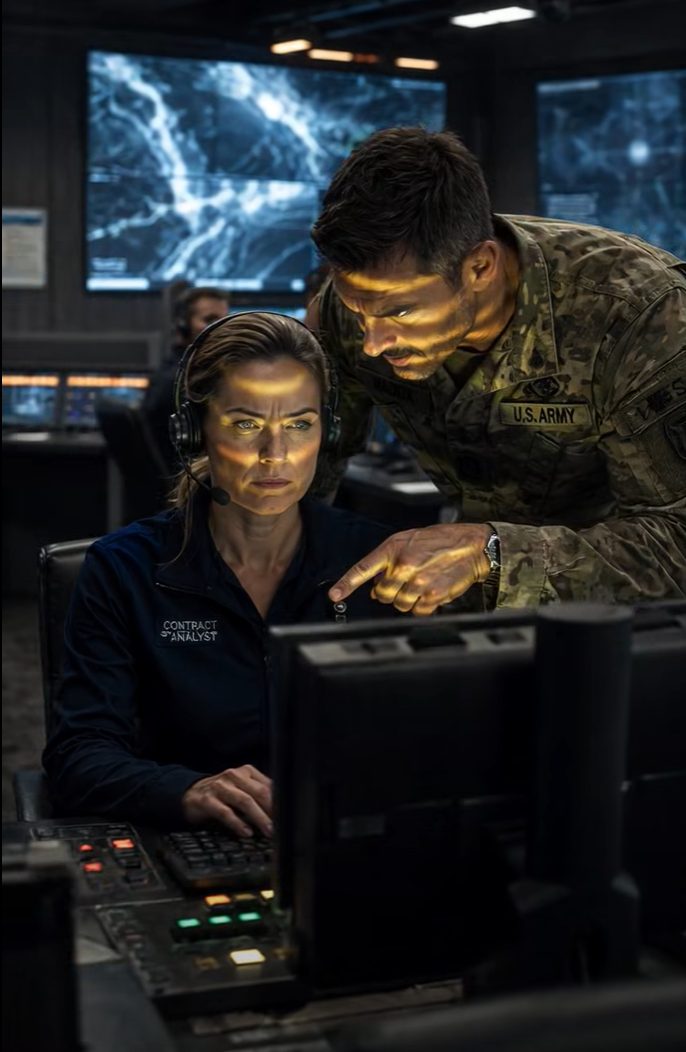
The command hub for Operation Desert Anvil had been built to survive almost anything. Concrete walls. Armed doors. Rows of glowing monitors. Drone feeds. Satellite maps. Lines of code moving across screens like a second language only a few people there could read.
At the center of it sat Claire Whitmore.
Her badge said Contract Systems Analyst.
Her hands said she belonged exactly where she was.
She wore a headset, her hair tied back, her face calm beneath the harsh blue light of the screens. Every few seconds, she adjusted a command line, checked a feed, corrected a signal before anyone else noticed it drifting.
Then Master Sergeant Dean Maddox stormed in.
Everyone called him “Bull,” and he wore the nickname like a warning. Big shoulders. Hard jaw. Voice built for rooms that were used to obeying him.
He stopped behind Claire’s station and looked at her screen with the kind of disgust men use when they are frightened by something they don’t understand.
“Hey, Data Girl,” he snapped. “You lost? This is a war room, not a typing desk.”
Claire didn’t turn around.
“You’re blocking my screen,” she said.
A few technicians went still.
Bull laughed, loud and ugly, making sure everyone heard it.
“Listen, sweetheart. Real soldiers fight. They don’t sit around playing with keyboards.”
Claire’s fingers never stopped moving.
“That keyboard is keeping your soldiers alive.”
The room changed after that.
Not loudly. Not all at once.
Just enough that people began watching from the corners of their eyes.
Bull leaned closer, his breath hot with coffee and anger. “You get off that station right now.”
Claire finally looked up.
Her face was calm, but there was something in her eyes that made the nearest operator stop breathing for half a second.
“This console is assigned to me,” she said. “And you are interfering with an active mission.”
Bull’s mouth twitched.
He didn’t hear the warning.
He only heard disrespect.
“You think you outrank me?”
Claire held his stare.
Then, quietly, almost sadly, she said, “I am a general.”
Silence dropped so hard it felt physical.
One monitor beeped.
Someone whispered, “What?”
Bull stared at her, then let out one sharp laugh.
“No,” he said. “You’re not.”
Before anyone could step between them, his fist came down.
The impact snapped Claire’s head sideways.
A headset clattered against the desk.
A woman near the rear station gasped. Someone shouted for a medic. Two officers half rose from their seats, stunned by what they had just watched happen on every security camera in the room.
Bull stood over her, chest heaving, like violence had proven his point.
Claire pressed one hand to the desk and steadied herself.
A thin line of blood appeared at her lip.
Then the main wall turned red.
UAV CONTROL LOST.
LINK COMPROMISED.
FRIENDLY TARGETING ACTIVE.
Every screen in the room began flashing at once.
Drone feeds flickered, distorted, then snapped into new coordinates.
Not enemy targets.
Allied convoy routes.
Bull’s face emptied.
“Shut it down!” he yelled. “Somebody shut it down!”
Claire lowered herself back into the chair.
“If you cut the link,” she said, wiping blood from her mouth, “you lose the override.”
On the main feed, crosshairs settled over a line of American vehicles moving through the desert.
The room stopped breathing.
Claire placed both hands on the keyboard.
Bull stared at her now – not like a superior officer looking at a contractor, but like a man realizing he had just hit the only person who could stop a massacre.
And as Claire’s code began racing across the screen, one question cut through the silence harder than the sirens:
How did the enemy know their system better than the people sworn to protect it?
Forty-Seven Seconds
The convoy had eighteen vehicles.
Claire knew because she had reviewed the route manifest herself, that morning, at 0430, before the hub filled up and before the coffee went cold and before Bull Maddox decided today was the day he’d make an example out of a woman half his size.
Forty-seven seconds. That’s what she had calculated when she first identified the incursion signature three weeks ago, during a simulation no one else had taken seriously. Forty-seven seconds from the moment a hostile override achieved full lock to the moment the drones’ targeting logic committed. After that, the system would interpret any abort command as a spoofed signal and ignore it.
She had written that in a report.
The report had been filed, stamped, and buried somewhere between a logistics review and a budget meeting.
She typed without looking at the keyboard. Her eyes were on the cascade of nested command windows, four of them open and running simultaneously, her fingers moving across the keys the way a pianist moves through something they learned young enough that it lives in the hands, not the head.
Thirty-one seconds left.
Bull hadn’t moved. He was still standing there, chest still working hard, the knuckles of his right hand going from white back to pink. Around him, the room had reorganized itself into something new. Nobody was looking at him anymore. Every face was turned toward Claire’s screens.
A junior analyst named Terri Plunkett, twenty-four years old and six weeks into her first deployment, was the first one to say it out loud.
“She’s pulling it back.”
What Was on Her Badge
The badge said Contract Systems Analyst because that was what the cover required.
Claire Whitmore had been commissioned at twenty-two, made captain before she was thirty, and spent the next decade doing work that doesn’t appear in official records. Not because it was shameful. Because it was too valuable to advertise. She had designed the original architecture for the drone relay system now running in four active theaters. She had testified before two closed-door Senate subcommittees. She had shaken hands with people whose names you read in history books and whose faces you’d never recognize at a grocery store.
The contractor badge was her idea. She’d argued for it in a meeting three years ago, sitting across from men with more stars on their shoulders than she had, and she had made the case plainly: a woman in civilian clothes draws less attention than a woman in uniform with rank that makes people nervous. Let me move freely. Let me work.
They’d agreed.
So she sat at a console in a forward hub in a desert, wearing a badge that said something untrue, doing work that would never be declassified, keeping her head down and her hands moving.
Right up until the moment Bull Maddox decided she was in his way.
Eighteen seconds.
Her jaw was starting to ache. The specific, spreading ache of a hit that’s still deciding how bad it’s going to be. She breathed through it. Filed it away. Came back to the screen.
Twelve seconds.
The Override
The enemy’s code was good.
She’d give them that. Whoever wrote it understood the system’s architecture at a level that shouldn’t have been possible without access to the original design files. That had been bothering her for three weeks. It was still bothering her now, in the back of her mind, even as her hands dealt with the immediate problem.
Seven seconds.
She found the seam.
Every piece of hostile code has one. A place where the logic transitions, where the foreign instructions have to interface with the native system. That junction is always, always the weakest point. You just have to find it before the clock runs out.
She found it at six seconds.
Her fingers hit four keys in a sequence that wasn’t in any manual.
The main wall went from red to amber.
Then to green.
UAV CONTROL RESTORED.
TARGETING LOCK DISENGAGED.
CONVOY ROUTE SECURED.
The room let out a sound that wasn’t quite a cheer and wasn’t quite a sob. Something in between. Terri Plunkett put her hand over her mouth. One of the senior officers sat back down slowly, like his knees had stopped working properly.
Bull hadn’t moved.
Claire pushed back from the console, just slightly, and turned to face him for the first time since he’d hit her.
Her lip had stopped bleeding. The bruise would be worse tomorrow. Right now it was just a line of dried red at the corner of her mouth and a jaw that would be stiff for a week.
She looked at him for a long moment.
“The convoy is secure,” she said.
Bull said nothing.
“You need to step back from this station now.”
He stepped back.
What Happened Next
Two MPs arrived four minutes later. They had been watching the security feed from a room down the corridor and had seen everything. The strike. The alarm. The recovery. All of it, time-stamped and recorded on three separate cameras with audio.
Bull went with them without speaking. He looked smaller somehow. Not physically. He was still big, still hard-jawed, still the same man who had walked in ten minutes ago expecting the room to arrange itself around him. But something had gone out of him. The specific confidence of a man who has never been wrong in a room full of people watching.
He was wrong in this room. In front of everyone. On camera.
He knew it.
Claire watched him leave, then turned back to her screens and began writing the incident log. She typed it the same way she typed everything: fast, clean, no wasted words.
Terri Plunkett appeared at her elbow with a first-aid kit and said nothing, just set it on the desk and waited. Claire took it without looking up, pressed a gauze square to her lip for thirty seconds, then set it aside and kept typing.
“How did you know?” Terri asked.
Claire finished the sentence she was on.
“I wrote the system,” she said.
Terri stood there processing that.
“The whole system?”
“The architecture. The relay logic. The override protocols.” Claire scrolled up, reviewed a line, corrected it. “Including the part they tried to use against us.”
Terri looked at the screens, then back at Claire.
“Then how did they – “
“That,” Claire said, “is the right question.”
The Right Question
The design files for the relay system lived in three places.
One was a classified server at a facility in Virginia that Claire had last accessed in person, physically, with a key card and a retinal scan. One was an air-gapped backup at a location she wasn’t going to write in this log. The third was a working copy that had been distributed to twelve people for integration testing, eighteen months ago, under a protocol that required every copy to be destroyed upon completion.
Twelve people.
Eleven of them she’d worked with before. People she trusted, which was not a thing she did easily or often.
The twelfth was a last-minute addition she hadn’t approved. A name that had appeared on the distribution list two days before the testing window opened, attached to a requisition order signed by someone two levels above her. She’d flagged it. Been told to stand down. The requisition was legitimate, the clearance was valid, the addition was necessary for operational continuity.
She’d let it go.
She shouldn’t have.
The name on that requisition was going to be the first thing she looked for when she finished the incident log. Then she was going to make a phone call to a number that didn’t appear in any directory, and she was going to have a conversation with someone who would understand immediately why she was calling.
And then, somewhere down a chain of very quiet, very serious decisions, the right people were going to start asking questions about how an enemy combatant had gotten hold of a system architecture that should have been impossible to access.
Bull Maddox had hit her in front of a live camera.
That was going to cost him his career and probably his freedom.
But whoever had handed over those files had cost eighteen soldiers their lives, almost. Had come within six seconds of turning American drones on an American convoy.
That was a different kind of wrong.
The kind that didn’t get fixed in a courtroom.
Claire saved the incident log, closed it, and opened a new window.
She started typing.
—
If this one stayed with you, pass it along to someone who needs to read it.
For more stories of quiet strength and unexpected turns, check out what happened when his Black Hawk landed in the rain, or when the woman he was beating quietly opened her notebook. You might also enjoy hearing about the smiles that faded when the General read her file.