
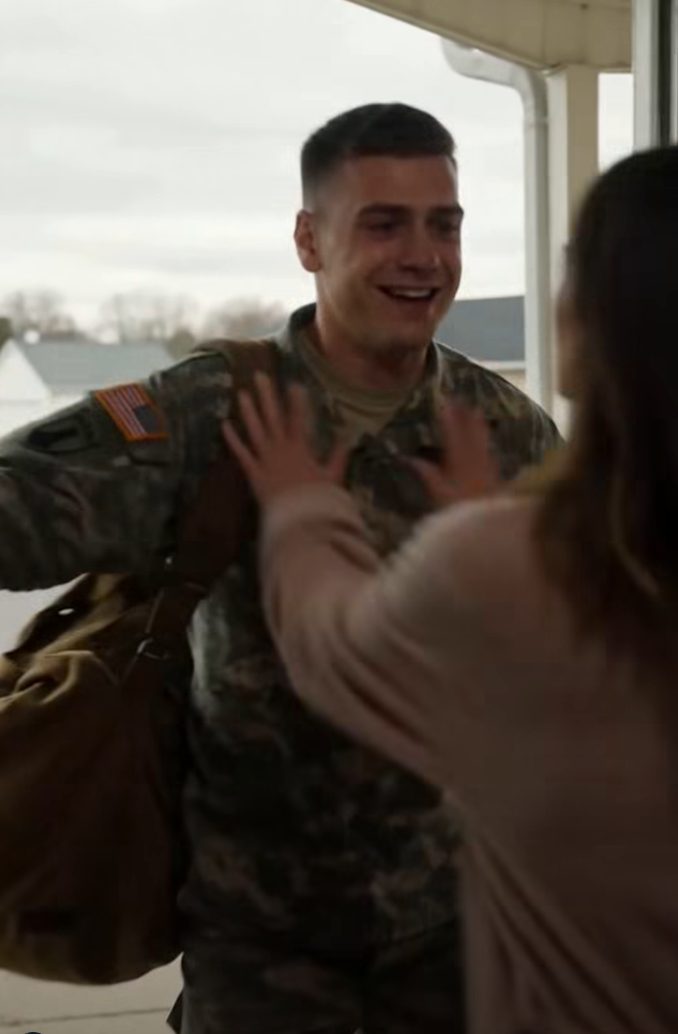
He came home from deployment to find his wife eight months pregnant.
Fourteen months overseas. He could do the math.
He stood in the doorway with his duffel bag still on his shoulder, unable to move, unable to speak, the numbers arranging and rearranging themselves in his head like they might somehow come out different if he just tried again. They never did.
Sarah stood in the kitchen doorway, one hand resting on her stomach, and she was glowing – that word people always used, the word he’d dismissed as cliché until this exact moment when there was no other word for it. She was glowing, and she was watching him with an expression he couldn’t read, and the silence between them stretched tight as a wire.
“Marcus.”
His name in her mouth. Just that.
“I can explain,” she said, and he almost laughed, because wasn’t that what they always said, wasn’t that the line, and he’d heard it a hundred times from a hundred different guys in the barracks who thought their situation was unique, who thought – “I need you to sit down first.”
“I don’t want to sit down.”
“Please.”
Something in her voice stopped him. Not guilt. Not desperation. Something quieter than either of those things. Something that almost sounded like certainty.
He sat.
She disappeared into the bedroom and came back holding something small between her fingers. A pin. Military issue. The kind they gave out at ceremonies, at promotions, at moments that were supposed to matter.
But not just any pin.
His pin. The one he’d sent home eight months ago in a letter he barely remembered writing, during the worst week of the deployment, when Hendricks had stepped on the IED and Marcus had written four letters home in one night because he wasn’t sure any of them would ever be sent. He’d tucked the pin inside – his unit citation, the one he’d been meaning to bring home himself – and written keep this safe without explaining why.
“Do you remember what you wrote?” Sarah asked.
He shook his head slowly.
She unfolded the letter. Her hands weren’t shaking. His were.
If something happens to me, I want you to move on. I mean it. Don’t wait. Don’t be alone. Find someone good and let yourself be happy. You deserve that. You always deserved that.
The words were his. He recognized the handwriting, the particular way he crossed his sevens, the ink smeared at the bottom where he must have been writing fast.
“I got this letter,” Sarah said quietly, “and two days later I got a call from your CO saying you’d been wounded and they weren’t sure – ” Her voice caught. She pressed her lips together and waited until she could continue. “They weren’t sure of the prognosis.”
He’d known about the call. He hadn’t known what it had done to her.
“I thought I was doing what you asked,” she said. “I thought I was trying to survive. And then David – you remember David, your cousin David – he was just there, Marcus, he was just there every day making sure I was eating, making sure I wasn’t disappearing into myself, and I – ” She stopped. “I know what it looks like. I know what you must have thought when you walked through that door. I’ve been terrified of this moment for three months.”
Marcus stared at the pin in her hand.
His pin. His letter. His cousin.
His wife, who had believed she was a widow.
“He doesn’t know you’re back,” Sarah said. “Nobody does yet. I wanted you to walk through the door first. I wanted to tell you myself.” She set the pin on the table between them, gently, like something sacred. “I’m not asking you to forgive me. I’m not asking you for anything. I just need you to know that I never stopped loving you, not for a single day, and I understand completely if that’s not – “
“Where is he now?”
She blinked. “David?”
“Yeah.”
“He’s – he’s been staying in the apartment above the garage. He wanted to be close when the baby – ” She faltered. “He’s a good man, Marcus. I know that doesn’t help. But he is.”
Marcus picked up the pin. Turned it over in his fingers. He remembered writing that letter. He remembered the smell of smoke and the sound of Hendricks’ voice before it went quiet and the particular quality of fear that makes a man say things he means completely in the moment and hopes never have to be honored.
He had meant it.
He stood up slowly, and Sarah flinched – just slightly, just for a second – and that small flinch, that tiny involuntary bracing, broke something open in his chest.
He walked to the back door.
Knocked on the apartment above the garage.
David answered in a t-shirt and bare feet, and his face went through about six different expressions in the span of two seconds – shock, relief, guilt, love, terror, something that might have been joy – before settling into a stillness that looked a lot like a man preparing to accept whatever came next.
Marcus looked at him for a long moment.
“You took care of her,” he finally said.
David’s jaw tightened. “Marcus, I – “
“When I couldn’t.” Marcus held up a hand. “You were here when I couldn’t be.”
“That’s not – it became more than that, and you need to know that I – “
“I know.” Marcus looked down at the pin in his palm. “I know what it became.” He was quiet for a moment. “I’ve got a lot to figure out. We’ve all got a lot to figure out.” He looked up. “But I need you to know that I don’t – I’m not going to – “
He stopped. Tried again.
“That baby’s going to need people who love it,” he said. “That’s the only thing I’m sure of right now.”
He turned and walked back inside.
Sarah was standing exactly where he’d left her, her hand on her stomach, her eyes red, waiting.
He set the pin on the table between them.
Sat back down.
“Tell me everything,” he said. “From the beginning. I want to hear all of it.”
Outside, the sun was going down, and somewhere above the garage, his cousin sat alone in the quiet, and none of them knew yet what shape their lives would take from here.
But Marcus had come home from places where everything was simple and brutal and clear, where you knew exactly who the enemy was and what you were fighting for.
This was harder than any of that.
This was also, he was beginning to understand, the only battle that had ever really mattered.
What Nobody Tells You About Coming Home
The flights back are always too long and somehow too short at the same time.
You spend months counting down, and then somewhere over the Atlantic or the Pacific or whatever ocean it is this time, you realize you’ve spent so much energy surviving the deployment that you forgot to think about what comes after. What you’re going back to. Who you are now versus who you were when you left.
Marcus had done three deployments before this one. He knew the drill. The weird hyper-alertness in grocery stores. The way your wife flinches when you move too fast in the kitchen because she’d forgotten, in the months you were gone, that you do that. The two or three weeks of sleeping badly, of waking up at 0400 out of pure habit, lying in a soft bed in a quiet house thinking about the guys still over there.
He knew all of that.
He did not know how to do this.
He sat at the kitchen table while Sarah talked, and he listened the way he’d learned to listen in the field: everything, all of it, the thing being said and the thing underneath the thing being said. She talked for almost two hours. The call from his CO. The words not sure of the prognosis. The three days she’d spent not sleeping, not eating, sitting by the phone. David showing up with groceries because he’d heard and didn’t know what else to do. Then showing up again. Then again.
“It wasn’t – ” Sarah stopped, started over. “I wasn’t replacing you. I want you to know that. I know that’s probably what it looks like from where you’re sitting but it wasn’t that.”
“I know.”
“You couldn’t have known I’d – “
“I know,” he said again. “I wrote the letter. I meant the letter.”
She looked at him across the table, and he could see her trying to figure out if that was forgiveness or something else. He wasn’t sure himself.
The Letter He Barely Remembered Writing
The night he wrote it, Hendricks had been gone for six hours.
Not dead. Not yet. They’d gotten him out, gotten him to the forward surgical team, and the word coming back was critical but stable, which everyone knew meant we don’t know yet. Marcus had sat in the dark on his bunk and thought about Hendricks’ wife, whose name was Pam, who had two boys under five and who sent her husband packages with those little notes inside written in a handwriting that was unmistakably a kindergarten teacher’s. He’d thought about the call Pam might be getting right now, or might have already gotten, or might get tomorrow.
He’d picked up a pen and started writing.
He wrote four letters that night. One to his mother, one to his brother Gary, one to his CO that was more of a formal document than a letter, and one to Sarah. He didn’t remember much of what was in any of them by morning. Fear has a way of doing that – making you very clear and very honest in the moment and then pulling a curtain over it after. He remembered tucking the pin inside Sarah’s envelope. He remembered the specific feeling of I might not make it back and she needs permission to survive that.
He hadn’t made it back. Not in the way he’d expected to.
He’d made it back in a body bag that turned out to be premature – shrapnel, a collapsed lung, six weeks in Landstuhl that he’d told Sarah was two weeks because he didn’t want her to worry. He’d come back changed in ways he was still cataloguing. And he’d come back to this: a letter he’d written out of love that had done exactly what he’d asked it to do.
David
Marcus had known David his whole life.
David Reyes, his mother’s sister’s kid, four years younger, the one who’d wanted to enlist but washed out of basic with a stress fracture in his left foot that never healed right. David who’d come to every deployment send-off, who’d always shaken Marcus’s hand with both of his and said come back in one piece like it was a personal favor. David who was, genuinely, a good man. Marcus had always known that. He’d counted on it, in the vague way you count on things you don’t think you’ll ever need to cash in.
He sat above the garage now, alone, and Marcus thought about going back up there.
Not yet.
He needed to understand what he felt first, and the honest answer was that he didn’t know. There was something that should have been rage and wasn’t quite. There was something that should have been grief and wasn’t quite that either. What was actually there was more like the feeling after a long mission when you’ve been running on adrenaline for so long that when it finally stops you can’t tell if you’re tired or hungry or hurt or all three. Just a kind of blank that the body makes when it’s used up all its other options.
Sarah had fallen asleep on the couch around nine o’clock, her hand still on her stomach, her face finally slack and unguarded. He sat in the armchair across from her and watched her sleep for a while. Not in a weird way. Just trying to locate himself. Trying to find the thread back to who he was before he walked through the door.
What the Pin Actually Meant
He’d been given the unit citation in a ceremony that took about twelve minutes and felt like it lasted three hours.
The citation was for a specific day in a specific place that he wasn’t supposed to talk about in any detail, involving decisions he’d made that the Army had decided were good decisions and that he himself went back and forth on depending on the night. He’d accepted the pin from his CO with the appropriate gravity and then stuck it in his pocket and thought: I’ll bring this home. Sarah will want to see this.
And then he’d sent it home in a letter instead, during the worst week of his adult life, and given it a different meaning than it was issued with.
He turned it over in his fingers now, sitting in the dark kitchen at eleven-thirty at night, the house quiet, Sarah asleep, the garage apartment light still on.
He thought about what he’d written. Find someone good.
David was someone good. That was the thing he kept coming back to. If he’d actually died – if the shrapnel had been three centimeters to the left, which it nearly was, which the surgeon in Landstuhl had told him with the cheerful bluntness of someone who dealt in near-misses for a living – then David being there would have been exactly the right outcome. He would have wanted that. He’d said so in writing.
The fact that he hadn’t died was the variable he hadn’t planned for.
The Knock
He went back up at midnight.
He knocked twice, and David opened the door like he’d been sitting right on the other side of it. Maybe he had been. His eyes were red. He’d been crying, or trying not to, one of the two.
Marcus stood in the doorway. Neither of them spoke for a moment.
“I don’t know how to do this,” Marcus said finally. “I want you to know that I’m not – I’m not coming up here to do something you need to brace for. I just don’t know how to do this.”
David nodded. His jaw was working.
“You’re going to be that kid’s father,” Marcus said. It wasn’t a question.
“If Sarah – yes. That’s what we – ” David stopped. “I’m sorry, Marcus. I know that’s not enough but I am.”
“I know you are.” Marcus looked past him into the small apartment, the cot-sized bed, the paperback open face-down on the nightstand. David had been living small up here. Making himself small. “I’m not going to ask you to leave. That baby’s coming in what, three weeks?”
“Four. Maybe three.”
“Then you stay.” Marcus looked at him directly. “We’re going to figure the rest out after. All three of us. But you stay.”
David’s face did something complicated. He put one hand over his mouth and looked at the ceiling for a second.
“Okay,” he said. His voice was wrecked. “Okay.”
Marcus went back inside.
He lay down on the couch next to Sarah, not touching her, just close, and listened to the house breathe around him. The refrigerator hum. A car on the street outside. The small sounds a home makes when it’s full of people who are all, separately, trying to figure out how to still be standing in the morning.
He closed his hand around the pin.
Outside, nothing moved. The garage apartment light went off at twelve-forty. Marcus lay in the dark and did not sleep, but it was a different kind of not-sleeping than the field. This kind had a future in it. Unclear, yes. Complicated in ways that would probably take years to sort through, with moments that would be ugly and moments that would be stranger than he could currently picture.
But a future.
He set the pin on the coffee table next to Sarah’s hand.
She stirred, just slightly, and her fingers found it without her waking up, and closed around it.
He watched her breathe.
—
If this one got you, send it to someone who needs to read it.
For more intense stories of betrayal and unexpected turns, check out I Told Him I Was a General. He Punched Me Anyway. or read about The Woman He Was Beating Quietly Opened Her Notebook. And for another tale of a difficult homecoming, don’t miss My Father Hadn’t Spoken to Me in Three Years. Then His Black Hawk Landed in the Rain.



