
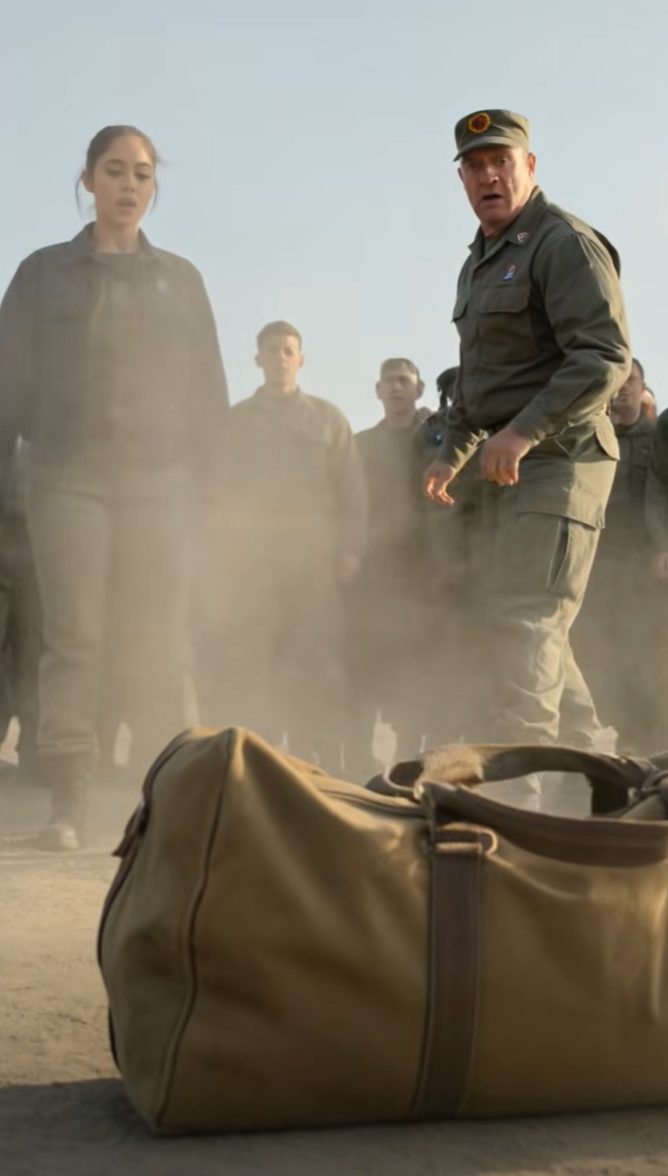
The duffel bag hit the ground.
The crowd fell silent.
Hundreds of recruits watched from the stands.
A young woman stood alone in the center of the training field.
Dust swirled around her boots.
The commander crossed his arms.
He looked unimpressed.
“You’re late.”
The woman didn’t answer.
She simply placed the old duffel bag at her feet.
Several people laughed.
The bag looked ancient.
Worn.
Faded.
Like it belonged in a storage room.
Not on a military field.
Then the commander noticed something.
A patch stitched onto the side.
His expression changed instantly.
Because he recognized it.
Only one unit had ever used that insignia.
And every member of that unit had disappeared during a mission eighteen years ago.
The commander stepped closer.
His voice suddenly quieter.
“Where did you get that bag?”
The woman looked directly at him.
And answered:
“My father told me you’d ask.”
The Name Nobody Said Out Loud
The commander’s name was Garrett Pruitt. Forty-three years in, looked sixty-five, moved like fifty. He had a face that had been in weather a long time. The kind of face that didn’t shift easily.
It shifted now.
He looked at the patch. Looked at the woman. Looked back at the patch. The recruits in the stands had stopped laughing. They could feel something happening, even if they didn’t know what it was.
The patch was small. Black background, gold thread. An angular symbol that looked almost like a compass rose but wasn’t quite. Below it, three letters: V.T.R. Nobody asked what those letters meant. Not here, not in front of two hundred people who hadn’t earned the right to hear the answer.
Pruitt had seen that patch exactly twice in the last eighteen years. Once in a classified file that had been sealed before he could finish reading it. Once in a dream he didn’t talk about.
The woman was maybe twenty-four. Dark hair pulled back hard. Jaw set. She had the stillness of someone who’d been practicing stillness for a long time. Not nervous stillness. The other kind.
“Fall in with the others,” Pruitt said.
Flat. No expression.
She picked up the bag, slung it over one shoulder, and walked toward the recruit formation without another word.
Pruitt watched her go.
Then he turned and walked back toward the command building, and the drill sergeant who’d been standing six feet behind him the whole time pretended he hadn’t seen any of it.
What the Bag Held
Her name was Nora Voss. She’d written it on the intake form in block letters, the way someone does when they’ve written their name on official documents enough times to stop thinking about it. No middle name listed. Hometown: a town in eastern Montana that most people would have to look up on a map.
She’d shown up forty minutes late because her truck had thrown a belt on the highway and she’d fixed it herself, roadside, with tools from under the seat. She hadn’t mentioned this. She hadn’t offered any explanation at all.
The bag had been under her childhood bed for as long as she could remember.
Her father had shown it to her when she was seven. Set it on the kitchen table, unzipped it, let her look inside. There wasn’t much. A field knife with a cracked handle. A compass. A laminated card with hand-printed coordinates. A photograph, folded once, of five men and one woman standing in front of a vehicle she didn’t recognize in a landscape that looked like it could be anywhere dry and flat.
Her father was in the photograph. Second from the left. Younger, thinner, the same eyes.
He’d told her: keep this. Not: here’s the story. Not: here’s what happened. Just keep this, and one day someone is going to ask you about that patch, and when they do, you tell them I said they would.
She’d asked why.
He’d said: “Because it means they were there. And if they were there, they need to know I made it out.”
She’d been seven. She didn’t understand.
She was twenty-four now, and she understood about half of it.
The Unit That Didn’t Exist
The official record said six people went in and none came back.
Pruitt knew that was not entirely true. He’d known it for eighteen years, and he’d also known that knowing it put him in a position he had no clean way out of. Either her father had survived and never reported in, which was one kind of problem. Or her father had survived and been told not to report in, which was another kind of problem entirely. A much larger one.
The mission had been called Vantage. That’s where the V came from.
He sat in his office for an hour after the morning formation, door closed, and thought about a man named Dale Voss whom he had last seen in a briefing room in 2006, who had been one of the six people cleared for an operation that officially never happened in a country that officially wasn’t involved.
Dale Voss. Pruitt had assumed dead. Everyone had. It was easier.
He pulled out a notepad. Wrote nothing on it. Put it away.
Then he picked up his phone and called a number that wasn’t in his contacts, that he’d memorized twenty years ago and used maybe four times, a number that rang twice and then went to a recording that said the line was disconnected.
It had always said that.
Someone always picked up on the third call.
He dialed again.
What She Didn’t Say at Dinner
The recruits ate in a long hall that smelled like industrial cleaner and overcooked rice. Nora sat at the end of a table, eating fast, not talking. The woman across from her, a tall recruit named Cheryl from somewhere in Ohio, had tried twice to start a conversation and gotten short answers both times. She’d given up. That was fine.
The guy to Nora’s left, big, maybe twenty-two, kept looking at her.
“That your bag?” he said. He nodded toward where it sat under the bench by her feet.
“Yes.”
“It’s old.”
“Yes.”
“What’s the patch?”
She looked at him. He had an honest face. Didn’t mean anything, but she registered it.
“Old unit,” she said.
“Yours?”
“My father’s.”
He nodded like that settled it and went back to eating. His name was probably something like Kevin. She didn’t ask.
She thought about the last time she’d seen her father. Three months ago, in the house in Montana, the one with the bad insulation and the dog that had died the previous winter. He’d been sitting at the kitchen table the way he always sat, like the chair might move if he wasn’t careful. He’d watched her pack the bag back up, the knife and the compass and the photograph, watched her zip it closed.
He’d said: “You sure about this?”
She’d said: “Are you?”
He hadn’t answered right away. Then: “I think it’s time someone knew.”
She’d wanted to ask: knew what, exactly? But she’d grown up in a house where some questions had walls around them, and she’d learned not to throw herself at the walls.
She’d just taken the bag and left.
The Third Call
The voice on the other end was a woman’s. Older, clipped, the kind of voice that had spent a career being the last thing between someone and a decision.
Pruitt said: “I need a verification on a name. Dale Voss. V-O-S-S. Vantage unit.”
Silence.
Then: “Where did you hear that name?”
“His daughter is standing in my training yard.”
Another silence. Longer.
“How old?”
“Mid-twenties.”
“And she has the bag.”
It wasn’t a question. Pruitt felt something cold move through his chest. “You knew about the bag.”
“We’ve been waiting for someone to show up with it for a long time,” the woman said. “We didn’t know it would be a kid.”
“She’s not a kid.”
“No,” the woman said. “I suppose she wouldn’t be.”
He heard papers. Or something that sounded like papers.
“Dale Voss is alive,” the woman said. “He’s been in Montana. We’ve known where he was for eleven years. He chose to stay dark. We chose to let him.”
“Why?”
“Because what he knows is complicated, and he was more useful quiet than loud.”
Pruitt looked at the wall of his office. There was a photograph there, a group photo from 2003, back when things were cleaner. Or seemed cleaner.
“And now his daughter is here,” he said.
“Yes.”
“So what do I do with her?”
The woman on the phone was quiet for a moment. When she spoke again, her voice had shifted just slightly. Not softer. But different.
“You train her,” she said. “And you don’t make her wait eighteen years for answers.”
What the Photograph Shows
Pruitt found her after evening formation. She was sitting outside the barracks on an overturned crate, the bag between her feet, not doing anything in particular. Just sitting.
He stood a few feet away.
“Your father,” he said. “Dale Voss.”
She looked up.
“He made it out,” Pruitt said. “I didn’t know that until today. I want you to know that I didn’t know.”
She held his gaze for a moment. Then: “He said you wouldn’t.”
“He sent you here to tell me.”
“He sent me here because I wanted to come,” she said. “The message was extra.”
Pruitt almost smiled. Almost.
“Can I see the photograph?” he said.
She unzipped the bag, found it, handed it over. He looked at it for a long time. Six people, a vehicle, a flat dry landscape. He was in it too, he realized. Far left, half out of frame, younger by twenty years. He hadn’t been sure he’d been there that day. Memory does that.
He handed it back.
“There are things you’re going to want to know,” he said. “Some of them I can tell you. Some I can’t yet.”
“I know.”
“Your father knew too.”
“That’s why he waited,” she said. “He was waiting until someone was ready to tell it right.”
Pruitt looked at her for another moment. The dust had settled. The field was empty behind her.
“You’re still late from this morning,” he said.
She picked up the bag. “I fixed my own truck on the side of the highway.”
“I know. I checked.”
She stood up.
“Does that count for anything?” she said.
Pruitt turned and walked back toward the command building.
“Be at the range at oh-five-hundred,” he said, over his shoulder. “Don’t be late.”
She watched him go. Then she looked down at the bag. The patch faced up. Gold thread on black.
She’d carried it for seventeen years without knowing what it meant to carry it.
She was starting to find out.
—
If this one got you, pass it on to someone who’d stay up too late reading it.
If you’re still hungry for tales of defiance, read about how she climbed back over that railing and looked him dead in the eyes or when she was kneeling on the gravel, bleeding, while they laughed – then the convoy arrived.



