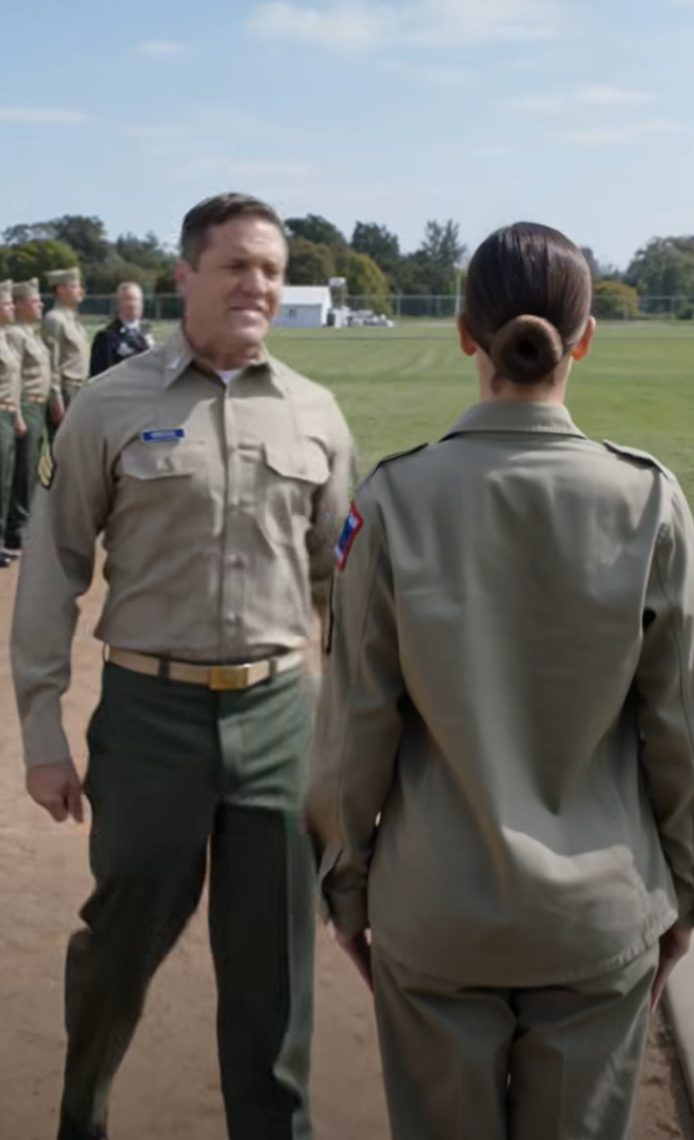
“You lost, ma’am?” Sergeant Brenner sneered, his voice echoing across the silent training ground.
The woman stood alone at the edge of the field. Her uniform was regulation but ancient – faded by the sun, sleeves frayed, and completely blank. No rank. No name tape. No unit patch. Just empty Velcro.
“She probably stole it,” a recruit snickered from the back of the formation. “Stolen valor.”
Brenner stepped closer, grinning. “You’re on active military ground. Identify yourself or I’ll have you removed.”
She didn’t answer. She just stood at perfect parade rest, shoulders squared, eyes locked on the horizon.
“I said identify yourself!” Brenner barked, grabbing the collar of her jacket. “Take it off. Let’s see if you’re even wearing a standard issue shirt.”
She didn’t resist. She let the jacket slide down her arms.
The laughter died instantly.
Three deep, surgical scars slashed across her back. They weren’t from an accident. They were from torture. The kind of marks only a prisoner of war comes home with.
Brenner’s face went pale. He stepped back.
Suddenly, a black staff car screeched to a halt on the grass. General Hale, the base commander, slammed the door open and marched toward them.
Brenner snapped to a trembling salute. “Sir! I was just – “
The General walked right past him. He didn’t even look at the Sergeant. He was staring at the woman’s back.
General Hale’s hands started to shake. He removed his cap, and in front of 200 stunned recruits, the two-star General dropped to his knees in the dirt.
“Mara?” he whispered, his voice cracking. “We… we buried you seven years ago.”
The woman slowly turned around. She reached into her pocket and pulled out a scorched, bent dog tag. She pressed it into the General’s hand.
Her voice was hoarse, like she hadn’t spoken in years.
“You didn’t bury me, Dad,” she said. “You buried my cover story.”
She leaned in close. Only the General could hear what she said next.
His face went white. Then red. Then he stood, turned to Sergeant Brenner, and said five words that ended the man’s career on the spot.
What Brenner Didn’t Know
My name is Mara Hale. That’s not on any active roster, any personnel file, any base directory. It hasn’t been for nine years.
I know what it looks like when someone sees my back for the first time. I’ve watched it happen enough times. There’s a sequence to it. The confusion, then the recognition that those marks aren’t random, then the silence. Always the silence. Brenner went through all three stages in about four seconds, which was faster than most.
He’d been running his mouth for six straight minutes before that. I’d counted.
I came to Fort Decatur on purpose. I could’ve walked through the main gate, flashed credentials that don’t officially exist, and had my pick of conference rooms. But I needed to see the training ground. Specifically, I needed to see whether the protocols my father had reportedly updated in 2019 were actually being practiced or just filed somewhere and forgotten.
Turns out: forgotten.
I also needed to see my father. That part I hadn’t planned to do in front of two hundred recruits. That part I hadn’t planned at all, honestly. I’d assumed he’d be in his office. I didn’t know he was running an inspection that morning. I didn’t know a lot of things about my father’s schedule anymore, because for seven years I’d been officially dead, and dead people don’t get the newsletter.
The uniform was mine. Original issue, from my first deployment. I’d kept it in a bag in a storage unit in Tucson that nobody knew about except me and a woman named Carol who ran the front desk and had never once asked a question in her life. God bless Carol.
The blank Velcro was intentional. I wasn’t hiding anything. I just wasn’t ready to be anyone yet.
The Scars
I don’t talk about the scars much. Not because they hurt, though they did, once. It’s more that explaining them requires explaining the eighteen months that came before them, and those eighteen months belong to a file that’s still classified at a level where even most generals don’t have clearance.
My father does. He has clearance for everything. That’s how I knew he’d know, the second he saw them, exactly what had happened and exactly what it meant that I was standing there alive.
What he didn’t know was that I’d been back in the country for four months.
Four months. I’d been living in a motel outside Flagstaff, eating gas station food and sleeping eleven hours a night and watching terrible television and just. Existing. Remembering how to be a person who exists without a purpose assigned to every breath.
I wasn’t ready to call him. I kept picking up the phone and putting it down. What do you say? Hey, Dad. Surprise. Sorry about the funeral. He’d cried at that funeral. One of my old handlers told me, years later, that my father had cried, which was the most shocking piece of intelligence I’d received in my entire career, and I once received confirmation that a sitting foreign minister was running a blackmail operation out of his vacation home in Montenegro.
My father doesn’t cry. He didn’t cry when my mother left. Didn’t cry when his own father died. He’s a man built from a particular kind of American granite that doesn’t do that.
But he cried at my funeral.
So I kept putting the phone down.
The Five Words
What I whispered to him, there on the training ground, was the name of a man. Just a name. Twelve letters, two syllables in the last name. Someone my father had trusted. Someone who had been feeding my location to the wrong people for nearly two years before anyone figured it out, and by then I was already somewhere without windows.
That name is why I came back now. Not four months ago when I landed. Now. Because that man was scheduled to be at Fort Decatur in seventy-two hours for a joint briefing, and I needed my father to know before he walked into a room with him.
I watched my father’s face process it. The whiteness first, which was shock. Then red, which was fury of a very specific kind, the kind that’s been waiting years for a place to go.
He stood up. Brushed the dirt off his knees, which was such a him thing to do, the instinct to be presentable even in the middle of something seismic. Put his cap back on. Squared his shoulders.
Then he turned to Brenner.
Brenner was still standing there with his salute dropping, completely lost, sweat showing through his collar.
My father looked at him for a long moment. Not with anger. Worse than anger. The way you look at something you’ve already decided about.
“You’re done here,” he said.
Five words. Flat. No decoration.
He didn’t explain. Didn’t reference the jacket, the scars, the spectacle Brenner had made in front of his own recruits. Just: you’re done here. The kind of sentence that closes a door and doesn’t leave a handle on the inside.
Brenner opened his mouth.
“Dismissed, Sergeant.”
That was the last order my father ever gave him.
What Came After
The recruits didn’t move for a solid ten seconds. Two hundred kids just standing in formation, staring. I almost felt bad for them. That’s not a training scenario anyone writes into a curriculum.
My father put his hand on my shoulder. Not a hug. He’s not a hugger, and neither am I, and we both knew this wasn’t the place. But his hand on my shoulder, the weight of it, the way he kept it there a beat longer than necessary.
That was enough.
His aide, a young captain named Ferris who looked like he’d rather be literally anywhere else on earth, materialized at his elbow. My father said something to him quietly. Ferris nodded and started walking the recruits off the field with the particular brisk efficiency of a man trying to pretend he hasn’t just witnessed something that will rearrange his entire understanding of the world.
We walked to the staff car. My father held the door. I got in. He got in the other side.
We sat there for a minute. The engine wasn’t running.
“Four months,” he said finally. Not a question.
“Yeah.”
“Flagstaff?”
I looked at him. “How did you – “
“Carol at the storage place called me six weeks ago. Said a woman matching your description had been in. She said she’d been watching the news every night for seven years waiting for someone to explain what happened to you.” He paused. “She seemed to think I should know.”
I made a mental note to send Carol flowers. Or possibly a fruit basket. Something significant.
“I wasn’t ready,” I said.
“I know.”
He didn’t say anything else about it. Didn’t push. Didn’t list all the ways those four months had been hard on him, which they obviously had been, because he’s still human under all that granite. He just accepted it as the operational reality and moved forward, which is maybe the most my-father thing he’s ever done, and also maybe the most generous.
What Gets Buried
Here’s the thing about a cover story. You build it to protect something real. The whole point is that the fiction takes the hit so the truth can keep moving.
My death protected an operation that, as of eight months ago, is now complete. I can’t say more than that. I won’t. But it’s done, and the people who needed to be stopped have been stopped, and the name I whispered to my father is going to have a very bad seventy-two hours, and none of that required me to stay dead any longer.
So I came back.
The scars stay. You don’t get to come back from certain things without evidence. I’ve made my peace with that, mostly. Some mornings more than others.
Brenner’s going to land somewhere soft, probably. Men like that usually do. He’ll tell the story differently, I’m sure. The version where he was just doing his job, maintaining security, following protocol. He wasn’t entirely wrong about the protocol part. An unidentified person on active military ground should be challenged. He just could’ve done it without the grin.
The recruits who were there that morning are going to remember it for the rest of their careers. I know this because I once watched something happen on a training ground that I still think about thirty years later, and those things lodge in you. The ones that don’t make sense until suddenly they do.
I hope it teaches them something worth keeping.
My father and I had dinner that night in his office, takeout from a Thai place near the base that he’d apparently been ordering from every Friday for three years. We talked for four hours. Not about the operation, not about the man whose name I’d whispered, not about the mechanics of what came next.
Just. Talked. The way people do when they’ve been waiting a long time to do it.
He told me the dog tag had been bent before it got to him at the funeral. Someone had told him it was from the blast. I told him that was true, technically. He looked at me in a way that said he had more questions and was choosing, for now, not to ask them.
Smart man, my father.
Always has been.
—
If this one hit different, pass it on – someone in your life needs to read it.
If you found this story touching, you might also appreciate the tale of how the General dropped to one knee when he saw her faded jacket, or perhaps the heartwarming moment when a dog put his head in a veteran’s lap, seven years after his buddy died.