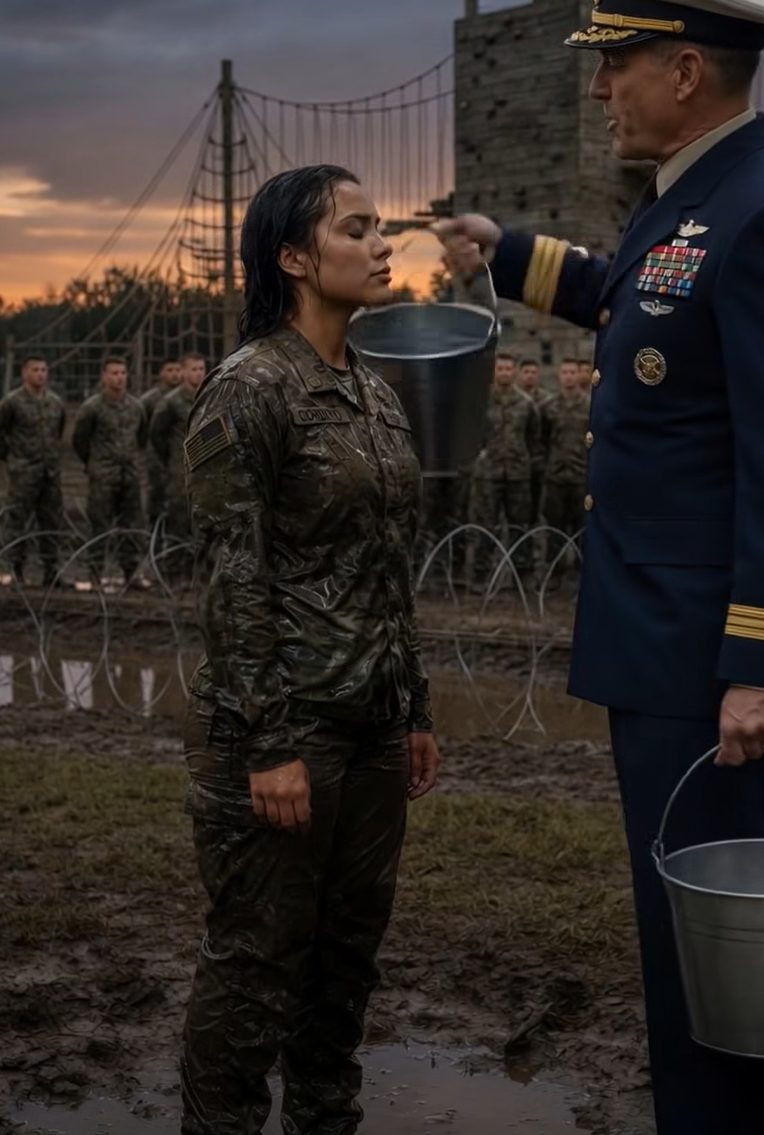
The heat crashed over Specialist Ava Cordero like liquid fire. It soaked through her uniform instantly, burning against her skin while every muscle in her body fought the urge to recoil. But she refused to move. Refused to give him the satisfaction.
The entire hall fell silent.
Fifty soldiers stood frozen in place, watching General Harris Thorne tower over her with the empty metal bucket still hanging from his hand. His face glowed red with anger and pride, like he believed he had just taught the perfect lesson.
“I’ve seen weak recruits before,” he barked, loud enough to echo off the walls, “but you? You’re an embarrassment to this uniform.”
Ava kept her jaw tight.
Thorne circled her slowly, boots scraping against the concrete floor.
“I can only imagine how disgusted your family must be,” he sneered. “If your father could see you standing here right now, he’d probably deny you were ever his daughter.”
A few soldiers lowered their eyes. Others stared straight ahead. Nobody interrupted him. Nobody ever did.
Then the General laughed.
“Go on,” he mocked, spreading his arms wide. “Call your daddy. Maybe he can come rescue you.”
The room erupted with nervous chuckles.
Ava didn’t react immediately. She simply wiped a drop of scalding water from her cheek, reached into her pocket, and pulled out her phone with steady hands.
Her voice came out calm. Almost too calm.
“Dad,” she said quietly into the receiver. “A general here wants to meet you.”
Across the room, Thorne smirked.
“Oh, this should be entertaining.”
Five minutes later, the massive double doors at the far end of the hall burst open.
Heavy footsteps echoed through the chamber.
And the moment the man entered… General Harris Thorne stopped smiling.
Before the Bucket
Here’s what nobody in that room knew about Ava Cordero.
She’d grown up on base housing. Not visiting it, not driving past it on the way somewhere better. Living in it. The kind of government-beige two-bedroom where the pipes groaned in winter and the neighbors were always getting reassigned just when you learned their names. She’d attended eleven schools by the time she was sixteen. Learned to make friends fast and leave faster.
Her father was gone more than he was home. That was just the math of it. She didn’t complain about it, not even as a kid, because complaining about it would have meant admitting it bothered her, and admitting it bothered her would have meant she didn’t understand why he had to go. She understood. She always understood.
What she got instead of a father who stayed was a father who wrote letters. Long ones. Pages, sometimes. He wrote about the landscape wherever he was deployed, about the soldiers under his command, about what it felt like to be responsible for other people’s lives. He never sugarcoated it. He’d write about fear the same way he’d write about weather: plainly, without drama, as a thing that existed and had to be accounted for.
She still had every letter. Cardboard box under her bed, back in the apartment she barely used.
She’d enlisted two years ago, right after finishing her degree. Her mother had cried. Her older brother, Dennis, had called it the most predictable thing she’d ever done, which was probably accurate. She’d gone through training at Fort Jackson, done her AIT, gotten assigned to the 3rd Infantry Division. She was good at her job. Not flashy good. Quietly, dependably good, the kind of good that doesn’t get you noticed until someone looks closely.
Thorne had never looked closely.
What He Thought He Saw
General Harris Thorne had been commanding Fort Stewart’s training operations for three years. Before that, two combat deployments, one commendation for valor, and a reputation for running the tightest ship in the southeast. He was not stupid. That’s the thing people get wrong when they picture men like him.
He was smart, and he was effective, and he had decided somewhere along the way that both of those things gave him permission.
Permission to be hard in ways that crossed into cruel. Permission to single people out, grind them down, test them until they cracked, and call it preparation for war. Some of his officers had complained, quietly, to people who couldn’t do much about it. A few had transferred out. Most just learned to keep their heads down.
He’d noticed Ava three days into the rotation. She was small. She moved efficiently, without wasted motion, and she didn’t talk much, and somehow all of that read to him as a problem. He’d spent thirty years learning to read soldiers, and the ones who went quiet on him were either the best or the ones about to break.
He’d decided, without much evidence, that Ava Cordero was the latter.
The bucket thing was a training exercise. That’s what he’d call it if anyone asked. Stress inoculation. The water had been heated past the point of comfort but not past the point of injury. He’d done it to four other soldiers that week. He’d done it in front of the group because humiliation, he believed, was a tool.
What he hadn’t done was check her file.
That was the mistake. Not the bucket. Not the words. The file.
Five Minutes
After Ava made the call, Thorne had laughed.
He’d turned to the room and made a show of it, arms spread, letting the soldiers see how unbothered he was. Some of them laughed with him. Some of them didn’t, but they made the sounds of it anyway, because that’s how rooms work when a general is performing.
Ava had stood there, still wet, phone back in her pocket. She hadn’t said another word to him. Hadn’t looked at him, actually. She’d looked at the far doors, and she’d waited.
Thorne had started to pace again, working through what he was going to say next, when one of his aides appeared at his elbow.
“Sir.” The aide kept his voice low. “There’s a vehicle outside.”
“What kind of vehicle.”
The aide swallowed. “Staff car, sir. Four-star plates.”
Thorne’s pacing slowed.
“Who – “
The double doors opened before he could finish the question.
The Man Who Walked In
He was older than Thorne had expected, though he couldn’t have explained why he’d expected anything at all. Sixty-two, maybe sixty-three. Gray at the temples, more gray in the close-cropped beard he’d apparently started growing since the last official photo on file. He wore his uniform like it had been installed on him at birth.
Four stars on each shoulder.
General Raymond Cordero. Chairman of the Joint Chiefs of Staff. The highest-ranking military officer in the United States.
He walked in like he owned every building he’d ever entered, which was not arrogance exactly, more like a man who had stopped having to perform authority so long ago that he’d forgotten it was something you could perform.
Two aides flanked him. They stopped at the door. He kept walking.
The room had gone so quiet Thorne could hear his own pulse.
Cordero crossed the floor without hurrying. He didn’t look around at the assembled soldiers. He didn’t look at Thorne. He walked straight to his daughter, and he put one hand briefly on her shoulder and looked at the wet fabric of her uniform and the faint redness still visible on her forearm.
“You okay?” he asked her.
“Yes sir,” Ava said.
He looked at her for another second. Then he turned to Thorne.
Thorne had been in combat. He’d been shot at, mortared, ambushed. He’d held his nerve through things that had broken other men. But standing in front of Raymond Cordero’s eyes right now, with fifty soldiers watching, his mouth went dry.
“General Thorne,” Cordero said.
“Sir.” The word came out smaller than Thorne intended.
“I understand you had something to say about my family.”
What He Didn’t Do
Here’s what Raymond Cordero did not do.
He did not raise his voice. He did not dress Thorne down in front of the assembled soldiers. He didn’t pull rank in the blunt, theatrical way Thorne might have done in his position. He didn’t reach for his phone to call anyone, didn’t mention consequences, didn’t make promises about what was coming.
He just looked at Thorne the way a man looks at something he’s already decided about.
Then he said, “Walk with me.”
They went to the far end of the hall, near the windows, while fifty soldiers stood very still and Ava Cordero toweled off her forearm with the back of her sleeve.
Nobody heard what was said. The conversation lasted maybe four minutes. Thorne’s aide, a young captain named Garrett, watched the general’s face the whole time and said later that he’d never seen that particular color on a man before. Not quite pale. More like the blood had relocated somewhere else and couldn’t find its way back.
When they came back, Thorne stopped in front of Ava.
He didn’t look comfortable doing what he did next. He looked like a man performing an action his body didn’t want to perform. But he did it.
“Specialist Cordero,” he said. “The conduct you experienced today was out of line. That’s on me.”
Ava looked at him. “Yes sir,” she said. “It was.”
Thorne’s jaw tightened. He nodded once, turned, and left the hall.
The Part She Hadn’t Expected
Her father stayed for eleven minutes.
He talked to three other soldiers while he was there, asked one of them where he was from, talked briefly about the Georgia heat with another. He was good at that. Had always been good at that. The making-people-feel-like-people thing. Ava had grown up watching him do it and had never quite figured out how to replicate it herself.
Before he left, he came back to her.
“You didn’t have to call,” he said quietly.
“I know.”
“Why did you?”
She thought about it. The honest answer was that she’d been angry, and the anger had made her reckless, and the recklessness had made her reach for the most direct solution available. She wasn’t sure that was a flattering answer.
“He told me to,” she said. “So I did.”
Her father looked at her for a long moment. Something moved across his face that she couldn’t quite name.
“Your grandfather would’ve done the same thing,” he said.
He left. His aides followed. The staff car pulled away from the building and the hall slowly, incrementally, began to breathe again.
After
Thorne was reassigned four weeks later. Fort Bragg. A different command, less prominent. The official language was neutral, the way official language always is. Nobody said the word consequence out loud.
Garrett, the aide, told someone who told someone else that the four minutes by the window had involved a very specific accounting of Thorne’s conduct over the past eighteen months. Not just the bucket. A pattern. Cordero had apparently known about it for longer than anyone realized, and had been waiting, with the patience of a man who’d spent four decades learning to wait, for the right moment to address it.
Ava heard this third-hand, through a corporal named Pete Okafor who’d been in the room and had an excellent memory for detail.
“Did you know he knew?” Pete asked her.
“No,” she said.
“Did you know he’d come?”
She thought about the letters in the cardboard box. The ones about responsibility. The ones about what it felt like to be accountable for other people’s lives.
“Yeah,” she said. “I knew he’d come.”
She went back to work. The heat was still bad, the kind of August heat that sits on you like a second uniform. She didn’t think about Thorne much after that.
She thought about her grandfather a little. She’d never met him. He’d died in Vietnam the year before her father was born.
She figured that was probably the point her father had been making.
—
If this one hit you somewhere real, pass it on to someone who’d get it.
For more stories about unexpected turns, you won’t want to miss reading about when They Dragged Me Into Court In Chains And Called Me A Traitor. Then The Doors Opened, And The General’s Face Went Pale, or the time I Asked the General What Kind of Demonstration He Wanted. He Should Have Walked Away. And for another tale of intense moments, check out My Sergeant Shoved Her Twice Before Anyone Realized What Was on Her Shoulder.