
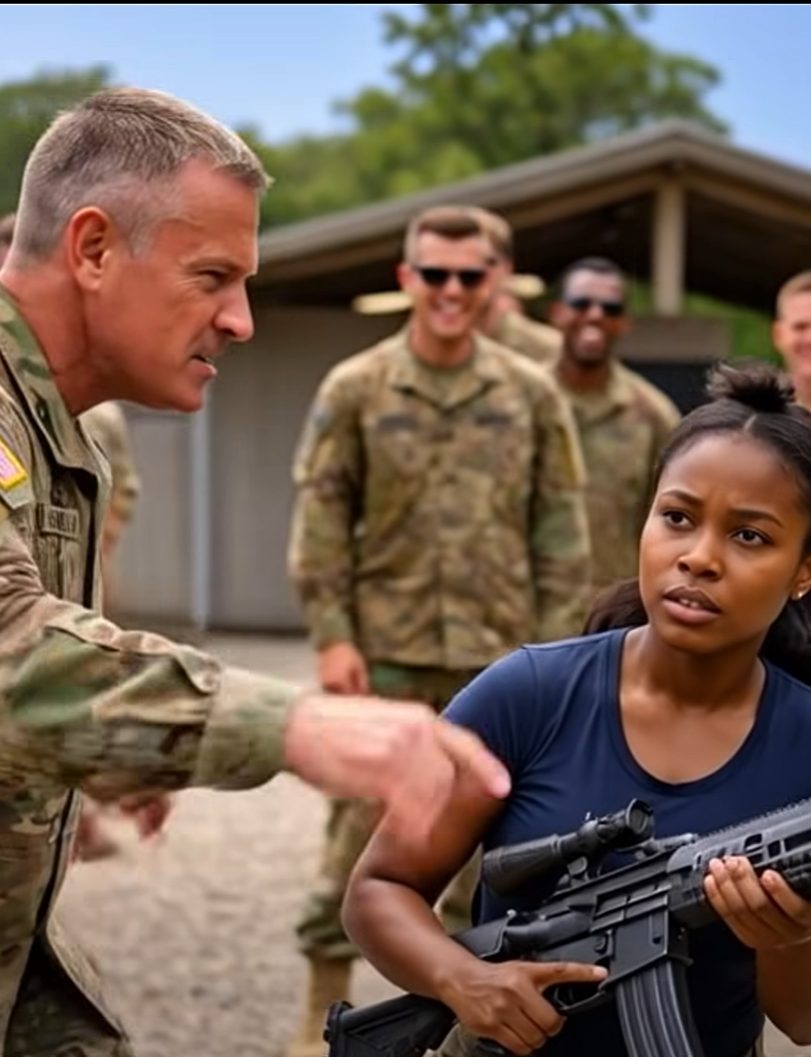
The Woman He Chose to Humiliate Had Already Buried More Secrets Than His Career Could Survive. By the time the last shot echoed across Fort Reynolds, no one remembered General Caldwell as the man in command.
Part I
By the time General Richard Caldwell noticed the woman in the navy blouse standing near the back of the crowd, the morning had already begun to curdle.
The sky above Fort Reynolds was a bright, merciless blue, and the shooting range shimmered beneath the hard light of late morning. Rows of folding chairs had been set in front of the firing line, where polished rifles and scoped carbines rested on black display tables like ceremonial relics. Officers moved in pressed uniforms. Civilians murmured politely. Donors smiled for cameras. Everything had been arranged to communicate order, pride, and military excellence.
And at the center of it all stood Caldwell.
He wore his rank the way other men wore armor. Silver-haired, broad-shouldered, with a voice built to fill parade grounds and crush objections, he moved through the crowd as if the base itself belonged to him. The younger officers laughed too quickly at his jokes. The older veterans straightened when he passed. He looked every inch the decorated general America expected to see at a Veterans Day demonstration.
But Maya Thompson had known men like him before.
She stood beneath the edge of the canopy where the shade barely softened the heat, watching with stillness so complete it made people overlook her. Her navy blouse was plain. Her tan slacks unremarkable. She had registered under the name Thompson Carter, one of the few remnants of a marriage long dead and best left buried. She had come because the invitation had mentioned veterans, community, and honor. She had almost thrown it away.
Now she wished she had trusted her instinct.
Caldwell’s speech rolled across the range with theatrical weight.
“America’s military was built by men and women who understood that excellence is not negotiable,” he declared, hands clasped behind his back. “The battlefield doesn’t reward feelings. It rewards competence. Precision. Discipline.”
A few people applauded.
Maya did not.
His gaze swept the audience with practiced calculation. She noticed what others either missed or pretended not to see: the way his expression cooled when speaking to a Latina captain; the way he cut off a female major who tried to add context to one of his stories; the slight pause, heavy with contempt, before he thanked the Black sergeant managing the equipment table.
He never said too much. Men like Caldwell never did. They preferred the language of standards, the polished vocabulary of tradition and merit. They buried prejudice beneath medals and protocol.
Maya folded her arms and kept watching.
She had spent years learning how to disappear in plain sight. In Kandahar, in Mosul, in mountain villages no map named correctly, survival often belonged to the person no one thought to notice. She knew how to read a crowd, how to anticipate shifts in mood, how to sense danger before it became action.
So when Caldwell’s eyes found her, she felt the moment land like a pin sliding into place.
His stare sharpened.
A Black woman. Civilian clothes. Standing alone. Quiet.
An opportunity.
“Well now,” he said, smiling toward the back rows. “We’ve got a broad range of citizens here today. Ma’am – yes, you. Navy blouse. Why don’t you come forward?”
The crowd turned.
A wave of attention slid across Maya’s skin, but her expression did not change. She stepped out from the shade and walked toward the firing line with measured calm. Every movement was precise, economical, instinctive. She heard the soft crunch of gravel under her shoes and the quick murmur of people trying to guess who she was.
Caldwell extended a rifle toward her with false courtesy.
“Have you ever handled one of these before?”
A faint smile tugged at the corner of his mouth. The cameras leaned closer.
Maya looked at the weapon. A modern precision rifle, clean and well-maintained, fitted with a scope better suited to demonstration than combat. She took it carefully, like someone unfamiliar might.
A few people chuckled.
“Well,” Caldwell said loudly, turning so the audience could hear every word, “today might be your lucky day. We’re always happy to show civilians what real discipline looks like.”
Another ripple of laughter.
Maya adjusted her grip just slightly wrong on purpose.
The crowd relaxed. Caldwell’s smile deepened.
There it was – the part he enjoyed. Not instruction. Not service. Humiliation.
He stepped closer. “Careful now. It’s not a prop for a photo opportunity.”
More laughter, sharper this time.
For one long second, Maya considered ending it right there. She could have corrected her stance, checked the wind, and split the target before he finished his next insult. But she had learned patience in darker places than this. Let a man reveal himself fully, and he often handed you the weapon yourself.
So she lifted her gaze to him and asked softly, “Would you like me to shoot, General?”
He heard meekness where none existed.
“I’d like you to try,” he said.
He turned back to the audience with the smug confidence of a man who thought the next sixty seconds belonged to him forever. “Ladies and gentlemen, this is what I mean when I say standards matter. Everybody wants to wear the image of strength these days. But holding a rifle and being a warrior are not the same thing.”
The words landed hard.
A young lieutenant in the front row stared down at her lap. One of the older veterans laughed under his breath. Someone from the media crew shifted uncomfortably.
Maya walked to the firing line.
Heat shimmered above the sand berm. The target sat far downrange, white and still in the distance. She placed her feet, just a fraction off. Rolled her shoulders. Drew in one quiet breath. Beneath the calm surface of her face, old muscle memory stirred like a creature waking after long sleep.
Kandahar flashed behind her eyes: moonlight over broken walls, the smell of dust and cordite, a radio whispering coordinates in her ear, a child crying somewhere too close to a kill zone. She felt again the scar above her eyebrow, small but permanent, left by a night no one at Fort Reynolds would survive in memory.
When she had first enlisted, they had laughed then too.
A drill instructor had once looked at her file and said, “You’re too small, too quiet, and too smart to enjoy this.”
Her sniper trainer had said something worse: “The most dangerous thing on a battlefield is the person everyone thinks doesn’t belong there.”
He had been right.
Behind her, Caldwell spoke again, his tone honeyed with contempt. “Take your time, ma’am. No pressure. Though I suppose that’s the first thing pressure teaches you.”
Maya let the audience hear him.
Let them all hear him.
Because humiliation was most satisfying when returned in full view of witnesses.
She raised the rifle.
Her posture changed.
It was subtle at first, so subtle only a trained eye would catch it. The lazy uncertainty vanished. Her spine aligned. Her shoulders settled. Her cheek found the stock with natural precision. Her breathing slowed. Her finger rested exactly where it should.
The Black sergeant at the equipment table blinked.
A veteran in the second row leaned forward.
Caldwell’s smile flickered.
He sensed it before he understood it: something had shifted.
Maya looked through the scope and saw not just the paper target but the ghosted overlays of a thousand others – moving targets, hidden targets, targets that had meant life or death, not applause. Wind speed. Distance. Sight correction. Her mind calculated everything in silence.
Then she lowered the rifle again.
The crowd exhaled with amused disappointment.
Caldwell’s grin returned.
And Maya, still calm, turned slightly toward him and said, “General, would you prefer the center ring, or would you like me to make a point?”
The laughter died so quickly it seemed to collapse inward.
Caldwell stared at her.
For the first time that morning, his control slipped.
“What did you say?”
Maya looked at him with quiet politeness. “I asked what kind of demonstration you wanted.”
The cameras zoomed in.
He should have stopped there. A wise man would have. A cautious one would have stepped back, laughed it off, and changed course.
But arrogance is a kind of hunger. And once it smells blood, it rarely retreats.
So Caldwell folded his arms and said, “Center ring, ma’am. Unless that’s beyond your capability.”
Maya nodded once.
Then she turned back toward the target and took aim.
What the Sergeant Already Knew
Staff Sergeant Darnell Pruitt had been managing the equipment table since six that morning.
He’d laid out every rifle himself, checked each scope, wiped down every surface twice. He was thirty-four, eleven years in, and he had learned early that his job at events like this was to be invisible and competent in exactly equal measure. Say nothing. Do everything. Vanish the moment Caldwell’s eyes moved in his direction.
He’d gotten good at it.
But when the woman in the navy blouse changed her grip, Darnell stopped pretending to check a clipboard.
He’d seen that posture before. Not often, but enough. There was a staff sergeant he’d trained with at Bragg who moved like that: no wasted motion, no performance, just the body doing what it had been built to do. That sergeant had three confirmed kills before she turned twenty-six and refused every promotion that would’ve moved her off a rifle.
This woman moved the same way.
Darnell set down the clipboard.
The veteran in the second row, a man named Gary Hatch, seventy-one years old, Vietnam-era, had been sitting with his arms crossed and his jaw tight for most of Caldwell’s speech. He’d been invited as a community dignitary and had already decided he wouldn’t be coming back. He’d seen too many of these events: the same speech, the same performance, the same contempt dressed up as tradition.
But when the woman raised the rifle a second time and her whole body went quiet, Gary Hatch sat up straight.
“Lord,” he said, to nobody.
The Shot
Maya exhaled halfway and stopped.
She did not think about Caldwell. She did not think about the cameras or the crowd or the young lieutenant who was now watching from the corner of her eye with an expression that looked like hope she hadn’t asked for.
She thought about nothing.
That was the thing nobody told you, the thing that couldn’t be taught in a classroom or explained at an event like this. The moment before a shot wasn’t full of focus. It was full of absence. Every trained thought, every calculation, every piece of technical knowledge fell away until there was only the target and the breath and the space between.
She’d been in that space in Mosul when a wall collapsed forty meters to her left and she’d held the shot anyway.
She’d been in that space in a mountain pass outside Kunar province, her spotter unconscious, temperature at eleven below, her hands so cold she’d had to feel for the trigger by memory.
She was in it now.
The shot broke clean.
The sound cracked across the range and rolled back off the berm, and for a fraction of a second everyone stood completely still.
Then the target monitor lit up.
Center ring. Dead center. Not close to center. The kind of center that made the range officer behind the scoring table straighten up and look again.
Nobody laughed.
Caldwell’s arms were still folded. His face had gone the particular blank that men wear when they are still deciding whether what just happened actually happened.
Maya lowered the rifle.
She did not look at the target. She did not look at the crowd. She looked at Caldwell with the same quiet politeness she’d worn since he’d first called her forward, and she waited.
What He Did Next
He should have applauded.
Any other version of that man, a man with even a small amount of grace, would have started clapping, said something generous, and let the morning become something other than what it was about to become.
Caldwell did not applaud.
He looked at the target monitor for a long moment. Then he looked at the rifle in her hands. Then he looked at her, and something ugly moved behind his eyes, and he said, “Beginner’s luck.”
The range went very quiet.
Darnell Pruitt put both hands flat on the equipment table.
Gary Hatch made a sound in his throat.
The young lieutenant in the front row closed her eyes.
Maya said, “Would you like me to do it again?”
Caldwell’s jaw worked. He was calculating, she could see it, the way men like him always calculated when the ground shifted under them. Not whether he was wrong. Whether he could still win.
“Go ahead,” he said.
She did it again.
Same spot. Within a centimeter. The kind of grouping that didn’t happen by accident, that didn’t happen by luck, that only happened when someone had spent years in conditions where missing meant something that couldn’t be undone.
The media crew wasn’t pretending to film the display tables anymore.
Every lens in the place was on Maya.
What Came Out Afterward
She hadn’t planned to say anything.
She’d planned to hand back the rifle, nod politely, and walk to her car. She had a three-hour drive back to Raleigh and a sister’s birthday dinner and no interest in becoming a story. She’d spent twelve years being very deliberate about not becoming a story.
But then Caldwell, loud enough for the cameras to catch it, said to the officer beside him, “Someone obviously helped her set that up.”
And Maya stopped walking.
She turned around.
“I did two tours in Afghanistan,” she said. Her voice was not raised. It didn’t need to be. “One in Iraq. I was attached to a special operations unit for the last four years of my service. My MOS was 0317. I qualified expert every year I was in. My last confirmed shot in the field was at 847 meters in a twenty-knot crosswind.”
She let that sit for exactly three seconds.
“I came here today because the invitation said this event honored veterans. I was willing to be a good sport about the rest of it.” She glanced at the target monitor once, briefly. “I’m not willing to be called a fraud.”
Caldwell opened his mouth.
She kept going, not louder, just steadier. “You have a female major on your staff who couldn’t finish a sentence this morning. You have a sergeant who’s been invisible to you for six hours despite doing every piece of actual work at this event. And you picked the Black woman in civilian clothes to be your demonstration of what failure looks like.”
The cameras were not moving at all now.
“I don’t know what you’ve built your career on, General. But it wasn’t what you said up there.”
She picked up her bag from the chair where she’d left it.
“Thank you for the demonstration.”
After
She made it to the parking lot before Darnell Pruitt caught up with her.
“Ma’am.” He was slightly out of breath. “I just – I wanted to say – “
He stopped. Tried again.
“My daughter wants to enlist,” he said. “She’s seventeen. And I keep trying to figure out what to tell her about – about all of it. What it’s actually like.”
Maya looked at him.
“Tell her it’s worth it,” she said. “Tell her the people who laugh are always the ones who should’ve been paying attention.”
Darnell nodded. His eyes were doing something he was working hard to control.
She shook his hand and got in the car.
The drive back to Raleigh took three hours and fourteen minutes. She didn’t turn the radio on. The scar above her eyebrow caught the afternoon light in the rearview mirror somewhere around mile marker 74, and she looked at it for a moment, then looked back at the road.
Gary Hatch, she would learn later, had sent a letter to the base commander that same evening. Six paragraphs. He’d been writing letters like that since 1971 and he was very good at them.
The media footage was online before she crossed the state line.
She didn’t watch it for two days.
When she finally did, what she noticed wasn’t the shot, or her own face, or Caldwell’s expression cycling through its small disasters. What she noticed was the young lieutenant in the front row. The moment Maya had said 847 meters, the lieutenant had looked up from her lap.
She was smiling.
—
If this one hit somewhere real, pass it along to someone who needs to see it.
If you’re looking for more stories of unexpected strength and turning the tables, you might enjoy reading about My Sergeant Shoved Her Twice Before Anyone Realized What Was on Her Shoulder or the quiet power in I Served Them Coffee Every Thursday. They Had No Idea I Was the Reason Their Patch Existed.. And for another tale of someone proving their mettle against all odds, check out My Sleeve Was Already Torn When I Put the Third One Down.



