
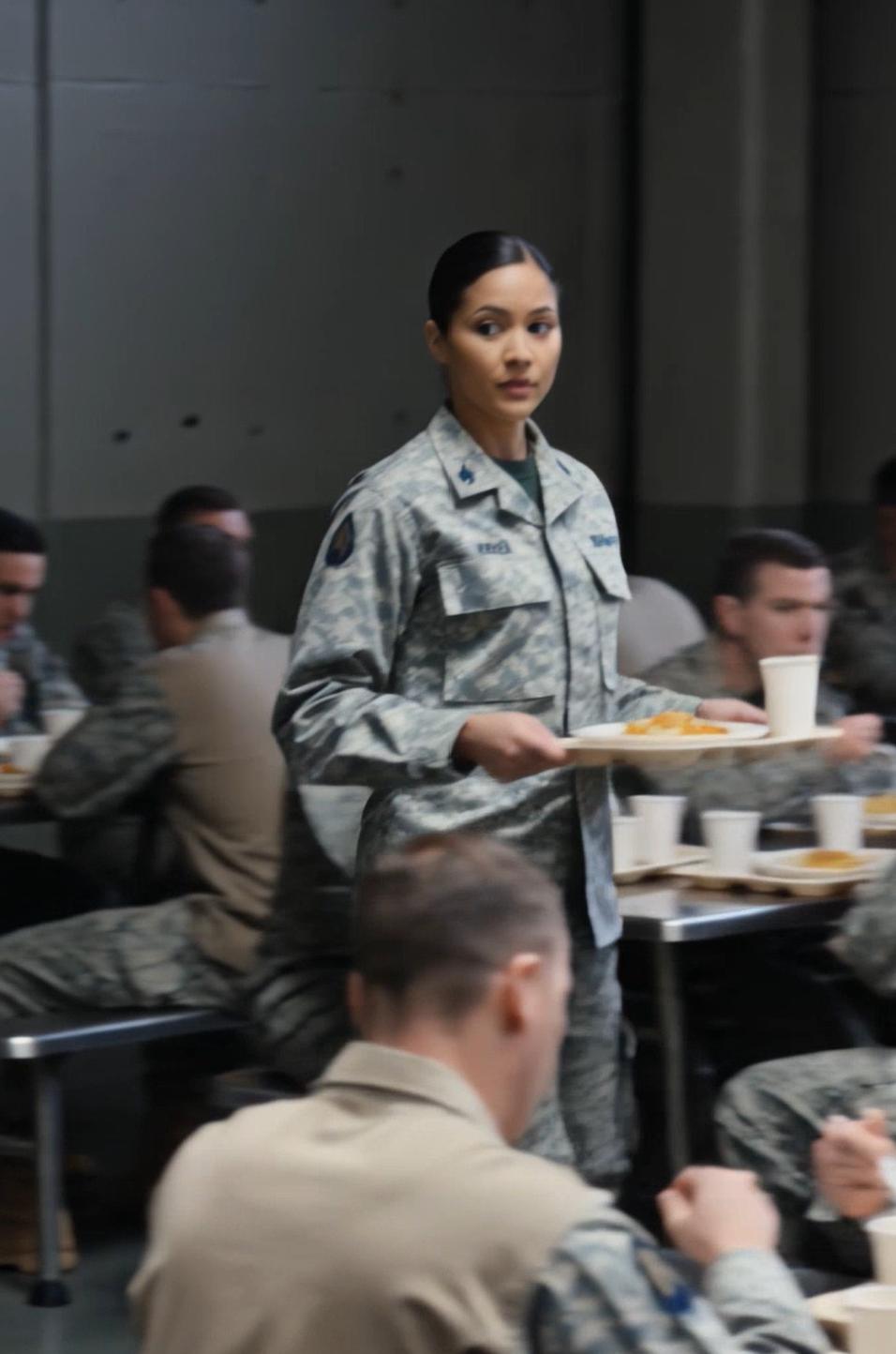
The mess hall at Griffin Point Training Annex was loud in the way military cafeterias always were – metal chairs scraping, boots thudding, jokes bouncing off concrete walls. Thirty-seven Marines from an attached security platoon crowded the tables, comfortable in their own noise.
They’d been told a new evaluator was coming. Someone from outside their chain of command. Nobody seemed worried.
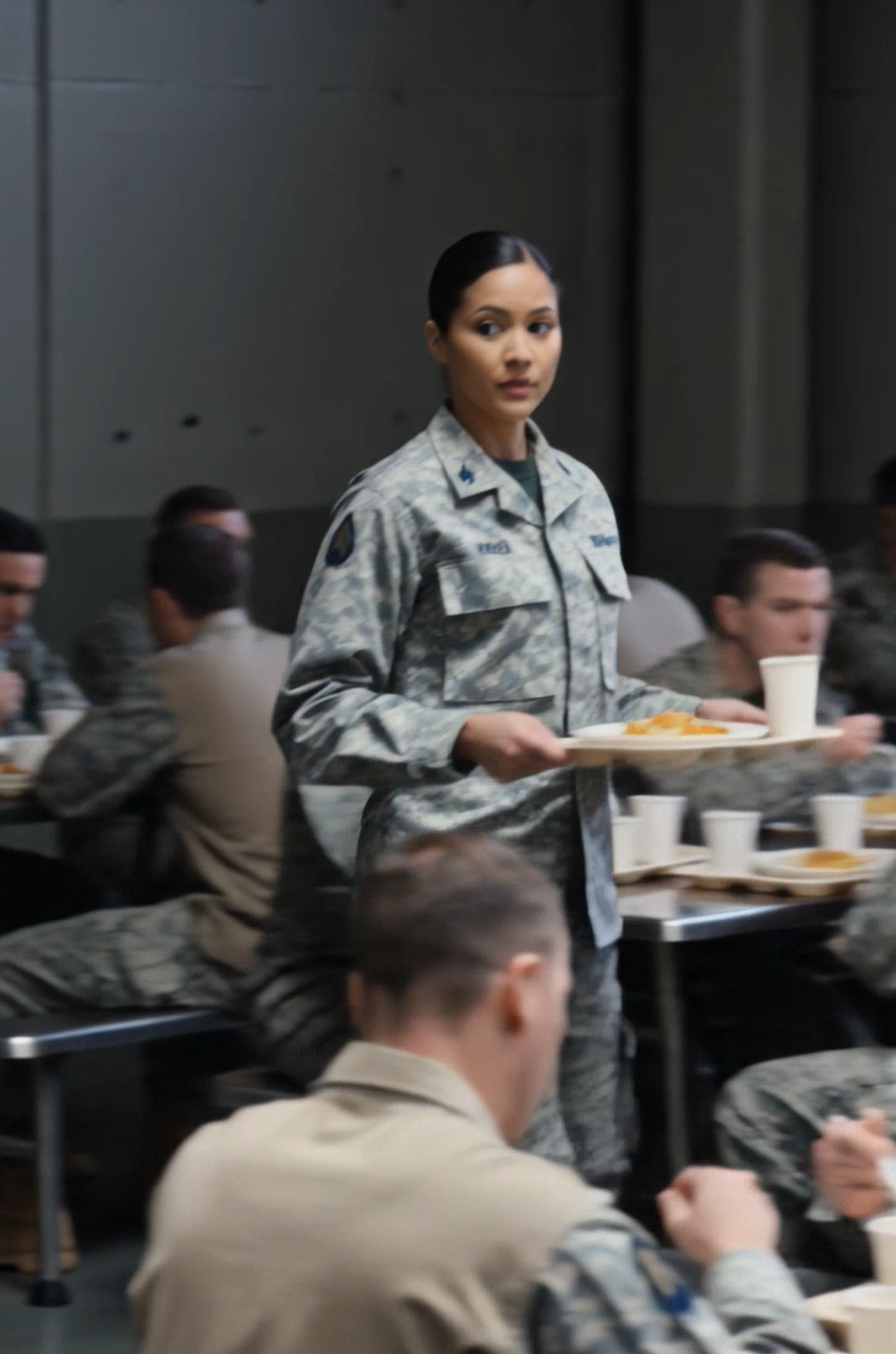
She walked in wearing plain utility uniform. No rank on her collar. No name tape anyone could read from a distance. She moved through the chow line like she belonged there, took her tray, scanned the room once, and sat alone near the center aisle.
Corporal Derek Flynn noticed her immediately.
He was the kind of guy who treated confidence like a weapon. Good at his job. Loud about it. Too sure that intimidation counted as leadership.
“New girl?” he called across the aisle, drawing laughter from the nearby tables. “You lost?”
She didn’t react. Took a sip of water. Kept eating.
That silence irritated him.
Flynn stood, swaggering over with two friends trailing behind like backup. He leaned in close enough to invade her space.
“Griffin Point isn’t a daycare. If you can’t handle the vibe, you can leave.”
Still nothing. No flinch. No nervous smile.
He reached down and grabbed a fistful of her hair, yanking her head back just enough to make a point.
“I asked you a question.”
The mess hall went quiet. Not all at once – in waves. The Marines closest to him laughed first. Then the laughter died as they watched her face.
She wasn’t scared.
She was smiling.
She set her fork down very carefully, the way a person sets down something they don’t want to break. Then she spoke for the first time, low enough that only Flynn could hear it.
“Corporal. You have three seconds to let go of my hair before I make a decision you can’t take back.”
Flynn snorted. “Or what, sweetheart?”
“Two.”
His buddies were grinning. Someone in the back whistled.
“One.”
What happened next took maybe four seconds. Marines who were there still argue about the order of it. One second Flynn was standing over her with a fistful of hair. The next, his face was pressed flat against the laminate tabletop, his own arm bent behind him at an angle that made a Sergeant near the door wince and look away.
She hadn’t even stood all the way up.
She leaned down near his ear, calm as still water, and said something quiet. Flynn’s face went from red to white to a color Marines don’t have a name for.
That’s when the doors at the back of the mess hall opened.
Lieutenant Colonel Brenda Holcomb walked in with two MPs and the base commander himself. The entire room snapped to attention – everyone except Flynn, who couldn’t move, and the woman, who slowly released his wrist and straightened her uniform.
The base commander looked at her. Then he did something nobody in that mess hall had ever seen him do.
He saluted her first.
And when he spoke, his voice carried to every corner of the room.
“Ma’am, I am so sorry. We weren’t expecting you until…”
He trailed off. Looked at Flynn. Looked at the thirty-seven Marines frozen at attention.
Then he said the eleven words that ended Corporal Derek Flynn’s career before his lunch had even gone cold.
“Arrest him. He just assaulted a United States Senate investigator.”
A collective, silent shock sucked the air out of the room. You could have heard a pin drop on the concrete floor.
The MPs moved with brisk efficiency, uncuffing Flynn from the woman’s grip and securing his wrists behind his back with a harsh metallic click. His swagger was gone, replaced by a slack-jawed confusion.
“Senate what?” Flynn mumbled, the words muffled against the tabletop he was still partially pinned to.
The woman finally stood to her full height. She wasn’t particularly tall, but she owned the space around her. She reached into her pocket and pulled out a simple, government-issue wallet, flipping it open.
She held it up for the base commander, Colonel Matthews, to see. He nodded grimly. Then she turned it toward the frozen platoon.
The ID badge was simple. A photo of her, looking just as composed as she did now. Underneath her picture, her name: Eleanor Vance. And beneath her name, a title that made a few Marines physically recoil.
Special Investigator, Senate Armed Services Committee.
“Corporal Flynn,” Eleanor said, her voice no longer a whisper but a clear, commanding tone that needed no volume to be heard. “You were correct. This isn’t a daycare.”
She paused, letting her eyes sweep across every single face in the room. Each Marine felt that gaze like a personal inspection.
“This is the United States Marine Corps. It is supposed to be a place of honor, courage, and commitment. What I just experienced was none of those things.”
Her eyes landed on the two Marines who had flanked Flynn. “And what I just witnessed from the rest of you was a failure. A failure of courage. A failure of leadership.”
Colonel Matthews stepped forward. “Ms. Vance, my office is prepared. We can debrief there.”
“Thank you, Colonel,” she said, her gaze not leaving the platoon. “But my evaluation began the moment I stepped on this base. And my first debrief is with these Marines.”
She turned to Flynn, who was now being lifted to his feet by the MPs. His face was a mask of disbelief.
“You’re done, Corporal,” she said, not with malice, but with a finality that was far more chilling. “But the problem you represent isn’t.”
With that, she turned and walked toward the commander’s office, leaving a crater of silence in her wake. Every Marine in that room knew they hadn’t just watched a Corporal get arrested.
They had watched their entire world get turned upside down.
In Colonel Matthews’ office, the air was thick with tension. Lt. Col. Holcomb stood stiffly by the window, while the Colonel sat behind his desk, looking ten years older than he had that morning.
“Ms. Vance,” he began, “I cannot apologize enough. Flynn’s record was… aggressive, but he was a decorated Marine. I never imagined—”
“You never imagined he would do it in front of you,” Eleanor corrected him gently, taking a seat without being asked. “But you knew. You all knew.”
She placed a thin manila folder on his desk. It wasn’t thick, but it landed with the weight of an anchor.
“That’s because this isn’t about Corporal Flynn,” she continued. “It’s about Private Marcus Thorne.”
The name hung in the air. Holcomb shifted uncomfortably. Matthews’ eyes narrowed, trying to place the name among the thousands of Marines on his base.
“Private Thorne,” Eleanor said, “is a quiet, unassuming twenty-year-old from Ohio. Top of his class in marksmanship. Scored off the charts on his mechanical aptitude tests. By all accounts, a model Marine.”
She opened the folder. Inside was a single, multi-page, handwritten letter.
“Six months ago, Private Thorne started being singled out by Corporal Flynn. It wasn’t hazing. It was targeted, relentless bullying.”
She detailed it for them. The ‘accidental’ destruction of his personal belongings. The constant, demeaning verbal abuse in front of the platoon. The way Flynn would assign him pointless, exhausting tasks to ensure he was always too tired to socialize or even write home.
“Private Thorne followed protocol,” Eleanor said, her voice tightening just a fraction. “He went to his Sergeant. Nothing happened. The Sergeant told him to ‘man up.’”
“He then went to his platoon leader, a young Lieutenant. The Lieutenant filed a report, but it was conveniently ‘lost’ before it ever got to a command level.”
Colonel Matthews looked physically ill. “We have systems in place for this. The IG’s office…”
“A twenty-year-old kid who has been told by his entire chain of command that his problems don’t matter isn’t going to trust another office in that same system,” Eleanor stated plainly. “So he did something else. He wrote a letter.”
She slid the letter across the desk. “He didn’t write it to the Inspector General. He wrote it to his state senator.”
The story poured out from the pages. It was a kid’s plea for help, written with a clarity and dignity that was heartbreaking. He didn’t just complain; he documented. Dates, times, witnesses. He wrote about his love for the Corps and how that love was being eroded by one man’s cruelty and the silent complicity of others.
“The senator,” Eleanor explained, “happens to sit on the Armed Services Committee. He read this letter and, instead of filing it away, he read it aloud in a closed-door session.”
She leaned back in her chair. “That’s when I got the assignment. Not just to investigate a complaint, but to investigate the culture that allows a man like Flynn to thrive and a man like Thorne to be silenced.”
The first twist wasn’t just her identity; it was that her entire presence on that base was the direct result of one young Private’s desperate act of courage.
“So you coming here, the plain uniform, sitting alone…” Holcomb said, the pieces clicking into place. “That was a test.”
“It was a confirmation,” Eleanor replied. “I read Flynn’s file. I knew his psychological profile. I knew he targeted those he perceived as weak or alone. I gave him a target he couldn’t resist.”
The smile she’d given in the mess hall suddenly made sense. It wasn’t a smile of amusement. It was the smile of a hunter whose trap had just been sprung.
“My brother was a Marine,” she said softly, her professional mask slipping for just a moment. “He was a lot like Private Thorne. Quiet, brilliant, dedicated. He almost left the Corps because of a man like Flynn. Someone stood up for him. That’s the only reason he stayed to have the career he did.”
She looked at both officers. “Who was going to stand up for Private Thorne?”
The silence in the room was their answer.
The weeks that followed were a quiet storm. Corporal Flynn was processed for a dishonorable discharge and faced federal assault charges. But Eleanor wasn’t finished.
She held one-on-one interviews with every Marine in that platoon. Not as an investigator threatening their careers, but as someone who simply wanted to understand.
She found the good kids who were too scared to speak up. She found the ones who laughed along because they were terrified of being the next target. She found the Sergeant who told Thorne to ‘man up’ and discovered he was a man who had been treated the same way as a Private and believed it was a rite of passage.
She wasn’t on a witch hunt. She was diagnosing a disease.
Working with Colonel Matthews and Lt. Col. Holcomb, who were now fully, grimly committed to fixing the problem, they implemented changes. It wasn’t just another series of boring slide presentations on leadership.
They created a peer-to-peer mentorship program, pairing new Marines with seasoned Corporals who were vetted for their character, not just their job performance. They overhauled the anonymous reporting system, routing it through an independent third-party agency so no complaint could ever be ‘lost’ again.
Eleanor herself led a series of mandatory leadership workshops. She didn’t use a podium. She stood in the center of the room and told stories. She told them about Private Thorne. She told them about her brother.
She taught them that true strength wasn’t the ability to crush someone weaker; it was the courage to lift them up. That integrity wasn’t about what you did when the Colonel was watching; it was about what you did when a lone Marine was being targeted in a crowded mess hall.
Slowly, the culture at Griffin Point began to shift. The noise in the mess hall changed. The boisterous, aggressive joking was replaced by a quieter, more confident camaraderie.
Three months later, Eleanor Vance made one last, unannounced visit. She didn’t wear a uniform this time, just simple civilian clothes.
She walked past the training grounds and saw a group of Marines running drills. Leading one of the fire teams was a young man who carried himself with a new, steady confidence.
He was calling out instructions, his voice clear and respected. He stopped to help a struggling teammate adjust his pack, offering a quiet word of encouragement.
It was Marcus Thorne. He had been promoted to Lance Corporal a week prior.
His former Sergeant, the one who had brushed him off, had personally recommended him for the promotion, citing his “unwavering moral fortitude.” In his own interview with Eleanor, the Sergeant had broken down, admitting he was ashamed for perpetuating a cycle he himself had hated. He was now one of the strongest advocates for the new mentorship program.
That was the second, more profound twist. The karmic reward wasn’t just about Flynn’s fall. It was about redemption. It was about the good men who had been silent finding their voices and becoming the leaders they were meant to be.
Marcus happened to look up and saw Eleanor watching from a distance. He didn’t salute—she was a civilian, and it would have drawn attention.
Instead, he gave her a small, almost imperceptible nod. A nod of thanks. A nod of shared understanding.
Eleanor smiled, a genuine, warm smile this time, and nodded back.
Her work was done.
True strength is rarely the loudest voice in the room. It’s not found in swagger or intimidation. It’s found in the quiet fortitude to do the right thing when no one is watching. It’s in the courage to write a letter, to offer a hand, to stand up for someone who is alone. One person’s quiet integrity can expose a flawed system, and their courage can inspire the change that rights it. It reminds us that our character is not defined by the power we wield over others, but by the protection we offer them.



