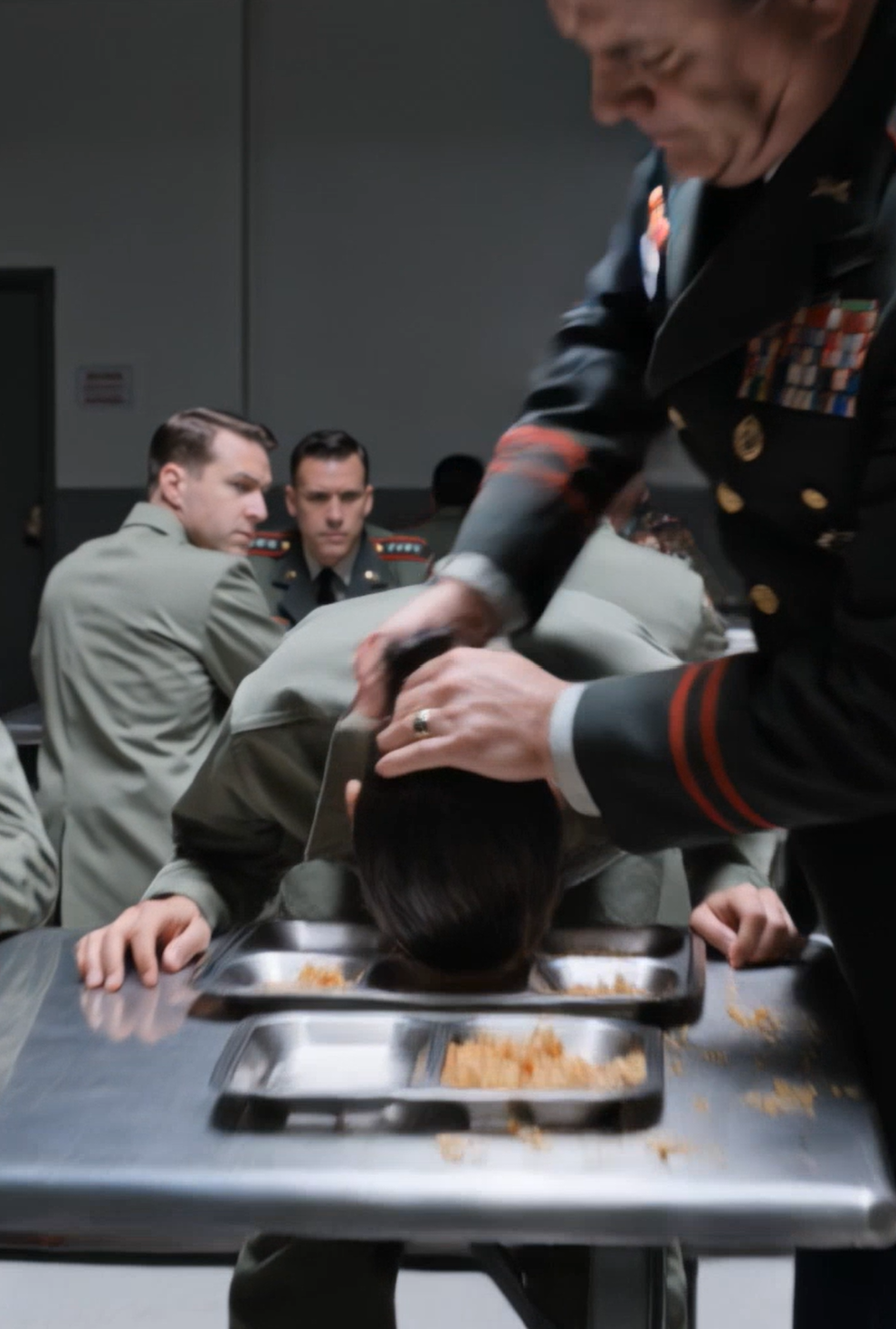
The mess hall went dead silent when Major Sterling’s hand connected with my face.
I’m the only woman in this unit. Twenty-three years old. Fresh transfer. And from day one, Sterling decided I was his personal target.
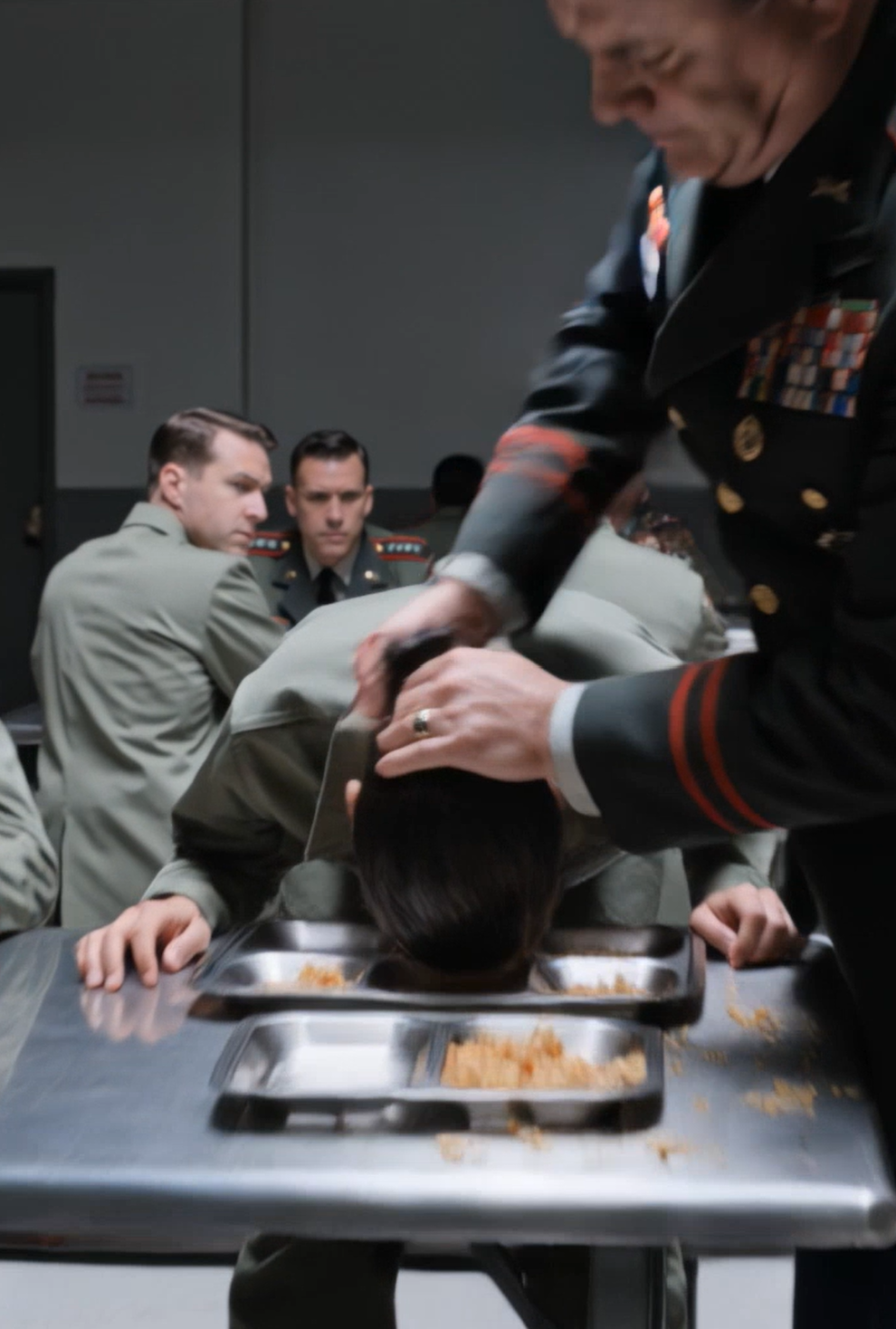
“You don’t belong here, Private,” he’d sneered every morning for three weeks. He’d “accidentally” spill coffee on my uniform. He’d assign me latrine duty during my off-hours. He’d mock my last name during roll call – pronouncing “Whitaker” like it was a disease.
Tonight, he went too far.
I dropped a tray. That’s it. One tray. And he backhanded me across the face in front of forty soldiers.
The blood ran down my cheek. Hot. Slow.
But I didn’t flinch. I didn’t cry. I didn’t move.
I just looked up at him and smiled.
That smile cracked something in his face. He leaned in close, his breath sour against my ear. “You think this is funny, Private?”
“No, sir,” I whispered back. “I think it’s perfect.”
His scowl twitched. The room held its breath.
“Because in about ninety seconds,” I said, my smile widening, “that door behind you is going to open. And the man walking through it has been waiting eleven years to meet the officer who ‘broke’ his daughter.”
Sterling’s face went white.
He hadn’t read my full transfer file. He hadn’t checked the emergency contact. He hadn’t asked why a Private had been quietly reassigned to HIS unit, specifically, by direct order from Command.
The heavy steel door creaked open behind him.
Sterling slowly turned around.
And when he saw the four silver stars glinting on the shoulder of the man in the doorway, his knees actually buckled.
My father, General Whitaker, didn’t look at Major Sterling. Not yet. His eyes, the same shade of blue as my own, found me across the room.
He scanned my face, his gaze lingering on the thin line of blood. His expression didn’t change, but I knew him. A storm was gathering behind that stoic mask.
He took a slow step into the mess hall, his polished boots echoing in the cathedral silence. Every soldier in that room snapped to attention, their backs ramrod straight, their eyes fixed forward.
All except Sterling. He was frozen, a statue of pure terror.
“Major Sterling,” my father’s voice was low, but it cut through the air like a razor. It wasn’t a question. It was a summons.
Sterling swallowed hard, his Adam’s apple bobbing. He tried to puff out his chest, to regain some semblance of authority, but it was like watching a balloon deflate.
“General, sir,” he stammered, attempting a salute with a trembling hand. “An unexpected honor.”
My father finally turned his gaze on him. “I’m sure it is,” he said, his voice dropping another ten degrees. He took another step, closing the distance between them. “You have something that belongs to me.”
Sterling’s eyes darted around nervously. “Sir, I… I don’t understand.”
My father- a man who commanded armies with a simple word- raised a single finger and pointed it toward my cheek. “That blood.”
The Major’s face, which had been ghost-white, somehow lost even more color.
“At ease,” my father commanded to the rest of the unit. The words were a dismissal, and the soldiers, sensing history being made, practically evaporated from the room.
Soon, it was just the three of us. The bully, the victim, and the reckoning.
“My office. Now,” my father said, turning his back on Sterling without waiting for a reply. He walked over to me.
He didn’t say a word. He just gently took a handkerchief from his pocket and pressed it against my cheek. His touch was firm, familiar. Safe.
“You okay, Clara?” he asked, his voice now soft, just for me.
“I am now, Dad,” I whispered back.
The walk to Sterling’s own office was the longest fifty yards of his life. My father and I walked side-by-side, while the Major trailed behind us like a dog expecting to be whipped.
Once inside, my father didn’t sit behind the desk. He stood in the center of the room, turning it into his own command post. Sterling hovered near the door, as if plotting an escape.
“Sit down, Major,” my father said, gesturing to the uncomfortable visitor’s chair. Sterling practically fell into it. My father gestured for me to take the Major’s own comfortable seat behind the desk. I did. The small shift in power was not lost on anyone.
“Let’s talk about eleven years ago,” my father began, his eyes locking onto Sterling.
Sterling just looked confused. “Sir, with all due respect, I didn’t know you eleven years ago. I’ve never met you before tonight.”
“Oh, I know,” my father said. “But you’re a student of history, aren’t you, Major? You’ve studied men like him. Bullies who hide behind a uniform. Men who break things just to watch them shatter.”
He pulled a worn photograph from his breast pocket and laid it on the desk in front of Sterling.
It was a picture of a young man in uniform, barely twenty years old, with my same blue eyes and my father’s strong jaw. He was smiling, a wide, brilliant grin full of life and promise.
“My son,” my father said, his voice thick with a grief that never truly went away. “Daniel Whitaker.”
Sterling stared at the photo. “Your son, sir? I… I never knew you had a son.”
“He was a Private, just like Clara,” my father continued. “Full of potential. He wanted to serve, to make a difference. He was assigned to a unit under a charismatic officer. A man everyone admired, a man who was untouchable.”
My father’s gaze hardened. “This officer decided Daniel was his personal project. He hazed him, belittled him, humiliated him. Not in front of everyone, like you. He was smarter. He did it quietly. He chipped away at my son, piece by piece, until there was nothing left.”
I watched Sterling’s face. He was listening, but there was no recognition. Only fear.
“Daniel left the service on a medical discharge. Post-Traumatic Stress. They broke his spirit. He came home a ghost. He’s been living in the shadow of that man’s cruelty for eleven years,” my father said. His voice cracked, just for a second.
He took a breath and regained his composure. “We couldn’t prove a thing. It was my son’s word against a decorated hero. So I made a promise. I swore I would find a way to stop men like him.”
I picked up the story. “When I enlisted, Dad and I made a plan,” I said, my voice steady. “We started looking for officers with similar complaints. Little things, swept under the rug. Patterns of behavior. Your name, Major Sterling, came up more than once.”
Sterling looked from me to my father, a flicker of comprehension in his eyes. “You… you transferred here on purpose?”
“I requested it,” I corrected him. “I needed to see for myself. I needed to document everything. I needed you to cross a line that was so bright, so public, that no one could ignore it. Tonight, when you struck me in front of forty witnesses… you gave my father the one thing he didn’t have eleven years ago. Undeniable proof.”
The room was silent. The trap had been laid, sprung, and Sterling was caught right in the middle of it.
But then, my father did something I didn’t expect. He pulled out a second file, a thick one, and dropped it on the desk.
“This is the file on the officer who destroyed my son’s life,” he said. He opened it to a personnel photo. It was a man with a cruel smile and cold, dark eyes. “His name was Lieutenant Colonel Marcus Thorne.”
Sterling stared at the photo. His whole body went rigid. It wasn’t the look of a man seeing a stranger. It was a look of painful, deep-seated recognition.
“You know him,” my father stated. It wasn’t a question.
Sterling’s breathing became shallow. He looked like he was going to be sick. He didn’t answer.
“Answer the General, Major,” I said, my voice sharp.
He finally looked up, and the arrogance, the anger, it was all gone. All that was left was a raw, gaping wound of a man.
“He was my father,” Sterling whispered, the words barely audible.
The confession hung in the air, a stunning, unbelievable twist. My own father stiffened beside me. This was not part of the plan.
“Your… your father?” my father asked, his General’s composure finally cracking.
Sterling nodded, a single tear tracing a path through the sweat on his face. “My name isn’t Sterling. It’s Thorne. I changed it as soon as I was old enough. I wanted nothing to do with him. I spent my whole life trying to escape his shadow.”
He looked at me, and for the first time, I didn’t see a monster. I saw a scared little boy.
“My father… he was a tyrant,” Sterling – or Thorne – continued, his voice breaking. “He broke everyone around him. My mother. My sisters. Me. He’d tell me I was weak, that I’d never measure up. That the only way to lead was through fear.”
He buried his face in his hands. “When I saw your last name on the transfer roster, Whitaker, I didn’t connect it to the General Whitaker. I just saw a name synonymous with power, with a legacy. A real family. I was jealous. I was angry.”
His confession came tumbling out. “When I looked at you,” he said, pointing a shaking finger at me, “I didn’t see a soldier. I saw everything I hated about the system. The privilege. The connections. I thought you were just playing soldier. So I did what he taught me to do. I tried to break you to prove I was strong.”
He sobbed, a pathetic, broken sound. “I became him. I became the man I swore I would never be.”
The mess hall silence had nothing on the quiet that filled that office. My father and I just stared, the architects of a plan that had just detonated in a way we never could have imagined. We came for a monster, but we found his son, haunted and twisted by the same ghost that haunted our family.
My father walked over and placed a hand on Sterling’s shoulder. The man flinched, then looked up, shocked.
“Son,” my father said, and the word held no irony, only a deep, profound sadness. “Revenge isn’t what I wanted. I wanted justice. I wanted to prevent this from ever happening to another soldier, to another family.”
He looked at me, then back at Sterling. “A court-martial would be easy. Ruin your career, your life, and call it a day. But that’s my predecessor’s way of doing things. That’s Marcus Thorne’s way.”
My father removed his hand and stood tall. “I have a different idea. A new program is being established. A leadership course focused on identifying and rooting out toxic command cultures. It needs an instructor. Someone who knows, firsthand, how that poison works. Someone who can speak about it with authority.”
Sterling looked up, confused. “Sir?”
“Your punishment, Major, is not to be drummed out of the service. Your punishment is to spend the rest of your career fixing the damage that men like your father—and you—have caused,” my father declared. “You will be reassigned. You will lead this program. And the first story you will tell every new class of officers will be your own. You will tell them about Daniel Whitaker. And you will tell them about Clara Whitaker. And you will tell them why your name is no longer Thorne.”
It was a brilliant, karmic sentence. Not an ending, but a beginning. A chance for redemption forged in the fires of his own personal hell.
Sterling could only nod, tears of shame, and perhaps relief, streaming down his face.
Days later, I took a leave of absence. I drove to the quiet, small house where my brother Daniel lived. He was sitting on the porch, staring at the trees, the same way he had for years.
I sat down next to him. I didn’t say anything for a long time.
“It’s done, Danny,” I finally said.
He turned his head slowly, his blue eyes cloudy.
“The man who did this to you… his legacy is over,” I explained. “And his son… his son is going to spend his life making sure it never happens again.”
I told him everything. About the plan, the slap, the confession. About how the cycle was finally, truly broken.
When I finished, a single tear rolled down my brother’s cheek. But then, something incredible happened. The corner of his mouth twitched.
And for the first time in eleven years, my brother smiled. It wasn’t the bright, brilliant grin from the photograph, not yet. But it was a start. It was hope.
We came looking for vengeance, but we found something far more valuable. We found that the deepest wounds can’t be healed with hatred. True justice isn’t about tearing someone down; it’s about giving them a reason to build themselves back up, better than they were before. It’s about breaking a cycle of pain and, against all odds, creating a new one of healing.