
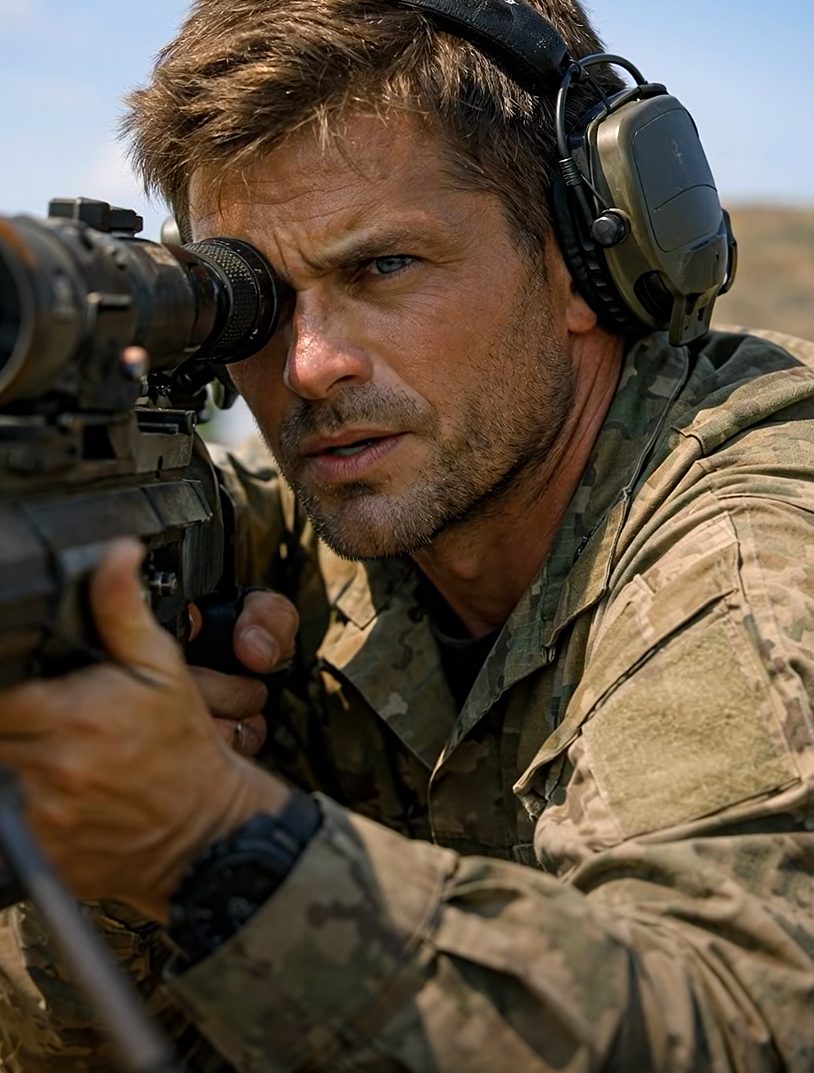
“Commence firing.”
I clicked the stopwatch before I could second-guess myself – and even then, I was already bracing for the disaster.
Because standing in front of that Barrett .50 cal, adjusting her gloves with calm, almost deliberate movements, was a fifty-two-year-old Navy Admiral who hadn’t left the Pentagon in three years.
I tried to hide my smirk.
Didn’t quite succeed.
Around me, the younger officers didn’t even bother trying. Their whispers carried across the range in low, amused bursts.
“Bet she doesn’t hit one.”
“Recoil’s gonna knock her flat.”
“Someone get this on video.”
She didn’t react.
Not a flicker.
Perfectly pressed uniform. Clean lines. The kind of composure that came from years of command – budget meetings, procurement hearings, the long fluorescent grind of Washington. Not from this.
That’s what we all thought.
We’ve all done it – sized someone up in the first ten seconds and decided we already knew their story. I’d done it a hundred times. I was doing it now.
Though somewhere in the back of my mind, something small and inconvenient nagged at me. The way she’d picked up the rifle earlier – not tentative, not performative. Just… familiar. Like greeting something she hadn’t held in a while.
I pushed the thought aside.
The rifle itself sat heavy on the bench, matte black and mean-looking. The kind of weapon that punished bad habits. The kind that exposed you.
Six steel silhouettes waited downrange – scattered between 300 and 1,300 meters.
Ninety seconds.
That was the standard.
I glanced at her again.
Still calm.
Still unreadable.
“Whenever you’re ready, ma’am,” I said, voice neutral, though a quiet certainty ran underneath it. A foregone conclusion dressed up as courtesy.
She didn’t answer.
She lowered herself into the prone position instead.
And something shifted.
It wasn’t obvious at first. Nothing dramatic. No sudden tension.
Just… stillness.
Her breathing slowed – measured, controlled. Not the awkward, self-conscious kind you see when someone’s trying to reconstruct training from memory.
No.
This was practiced.
Refined.
Remembered.
The smirk faded from my face before I even realized it.
The Barrett thundered.
The sound slammed across the range like a shockwave – deep, violent, undeniable.
The recoil drove hard into her shoulder.
But the scope – Didn’t move.
Not even a fraction.
What Happened Next Took About Four Seconds
The first silhouette went down at 300 meters.
Clean. Fast. No hesitation between the shot and the next breath.
She worked the bolt without lifting her cheek off the stock. Just her hand, moving the way a hand moves when it’s done this ten thousand times. Not thinking about the motion. Past thinking about it.
The second silhouette was at 700 meters.
Gone.
The whispers behind me stopped.
I remember that specifically. The way the ambient noise of the range just… cut out. Not because it was quiet. The shots were enormous, each one a physical thing you felt in your chest. But the commentary stopped. The jokes stopped. Somebody behind me said “huh” and then said nothing else.
She paused for maybe half a second between the second and third shots. I thought she was adjusting. Recalibrating. Catching up.
She wasn’t pausing.
She was already moving to the fourth.
The third silhouette was at 1,100 meters. That’s over half a mile. The Barrett can reach it, technically, but reaching and hitting are two different things at that distance. Wind matters. Humidity matters. The shooter’s heartbeat matters. You’re not aiming at where the target is. You’re aiming at where the bullet will be when it gets there.
She hit it.
Forty-one seconds on the stopwatch.
I know because I was watching the stopwatch and the range at the same time, trying to split my attention, and I kept losing track of the time because I kept watching her instead.
What Nobody Told Us Before She Got There
Rear Admiral Carol Pruitt had been assigned to our installation for a joint readiness review. Standard stuff, on paper. She’d come down from D.C. with a small staff, a packed schedule, and a reputation for asking questions that made procurement officers sweat.
Nobody had told us anything else about her.
So we’d filled in the blanks ourselves, the way people do. Pentagon Admiral. Fifties. Probably came up through logistics or intelligence. Probably hadn’t been in the field in decades. Probably hadn’t needed to be.
Our range master, a Master Chief named Dobbins, had set up the qualification course as a demonstration. Not a test. The Admiral wasn’t required to shoot. She’d asked to.
That detail should have told us something.
Dobbins had been polite about it. He’d offered a different platform. Something lighter, more forgiving. An M4 maybe, or one of the newer systems. Something that wouldn’t embarrass her if her fundamentals had gone soft.
She’d looked at the Barrett on the bench and said, “That one.”
Dobbins had glanced at me. I’d given him nothing.
We’d set up the course. Six targets, standard spacing. Ninety seconds on the clock. Same as we’d run for every qualification that month.
She’d listened to the brief with her hands clasped behind her back. Asked one question: “Same wind call throughout, or do you want me adjusting per target?”
Dobbins had blinked. “Adjusting per target, ma’am.”
She’d nodded like that was fine. Like that was whatever.
The Part That Actually Got Me
Five targets down. Fifty-eight seconds.
The last silhouette was at 1,300 meters. That’s the edge of the course. We’d put it there mostly for show, if I’m being honest. It was the kind of distance that looked impressive on a range card. Most shooters, even good ones, took multiple attempts. The wind off the tree line at that end of the range was inconsistent. We’d had qualified snipers blow the last target and still pass the course.
She took one breath.
Let half of it out.
The Barrett fired.
The silhouette dropped.
Sixty-three seconds total.
Nobody said anything for a moment. Not Dobbins. Not the junior officers behind me, the ones who’d been ready to film a disaster. Not me.
She stood up from the prone without using her hands. Just a controlled press, knees, feet, upright. Set the rifle back on the bench with two hands. Pulled off her right glove one finger at a time.
Then she looked at me.
Not smug. Not performing anything. Just waiting, the way someone waits when they’ve done what they came to do and are ready to move on to the next thing on the schedule.
“What’s the standard?” she asked.
“Ninety seconds, ma’am. Four of six for a pass.”
“And six of six?”
“That’s…” I looked at Dobbins. He looked at the ground. “That’s not a category we score for, ma’am.”
She almost smiled. I think. It was a small thing, gone fast.
“Noted,” she said.
What I Found Out Later
I asked Dobbins about it afterward, once the Admiral’s group had moved on to the next part of the review. He’d been around longer than me. I figured he might know something.
He did.
Turns out Rear Admiral Carol Pruitt had not always been Rear Admiral Carol Pruitt, budget review specialist, Pentagon fixture, the kind of officer who showed up in conference rooms and made commanders nervous about their procurement timelines.
Before any of that, she’d been Lieutenant Commander Pruitt. And before that, just Lieutenant Pruitt. And before any of those ranks, she’d spent three years as a Naval Special Warfare support officer attached to a SEAL team operating out of a base in Virginia that Dobbins named but I won’t repeat here.
She’d qualified on the Barrett .50 cal in 2003.
She’d re-qualified every two years after that, quietly, at whatever range was available, because she believed that if you were going to sit in rooms and make decisions about the people who carried these weapons, you should at least know what the weapons felt like.
She’d never stopped.
Not once in twenty-one years.
Dobbins said he’d heard about her from a range officer at Coronado who’d watched her shoot a few years back. Said the guy had described it almost word for word the way I’d just seen it. The stillness. The breathing. The scope that didn’t move.
“Did you know before she got here?” I asked him.
He picked up a spent casing off the bench. Turned it over in his fingers.
“Heard a rumor,” he said. “Wasn’t sure it was the same person.”
“Why didn’t you say anything?”
He set the casing down.
“Figured it’d be more useful for everyone to find out the regular way.”
The Part I Keep Thinking About
We’d had her story written before she picked up the rifle. All of us. Me, the junior officers, probably half the installation. Pentagon Admiral. Three years behind a desk. Soft hands, sharp suits, no business being on a live range with a weapon that size.
We were so confident in that story that we’d stopped looking for evidence against it.
The way she’d handled the rifle when she first picked it up. The single question she’d asked about wind calls. The fact that she’d specifically requested the Barrett when Dobbins offered her something easier.
It was all there. We just didn’t want to see it because it didn’t fit the version we’d already decided on.
I’ve thought about that a lot since. How many times I’ve done that exact thing. Looked at someone’s rank, their age, their posture, the way they dress, and built a whole person out of a first impression. Decided I already knew what they could and couldn’t do.
And then stopped paying attention, because why would you keep watching something you’ve already figured out.
The stopwatch was at sixty-three seconds.
Six targets.
Six hits.
I clicked it off.
—
If this one stayed with you, pass it on to someone who needs the reminder.
If you loved this story about defying expectations, you might enjoy reading about They Called Me the Daughter Who Quit. Then the Admiral Saluted Me. or even They Thought the Old Janitor Was Nobody. Then Someone Recognized Her.. For another tale of a powerful moment with an admiral, check out The Admiral Stood Up and Saluted Me First. The Room Went Dead Silent..



