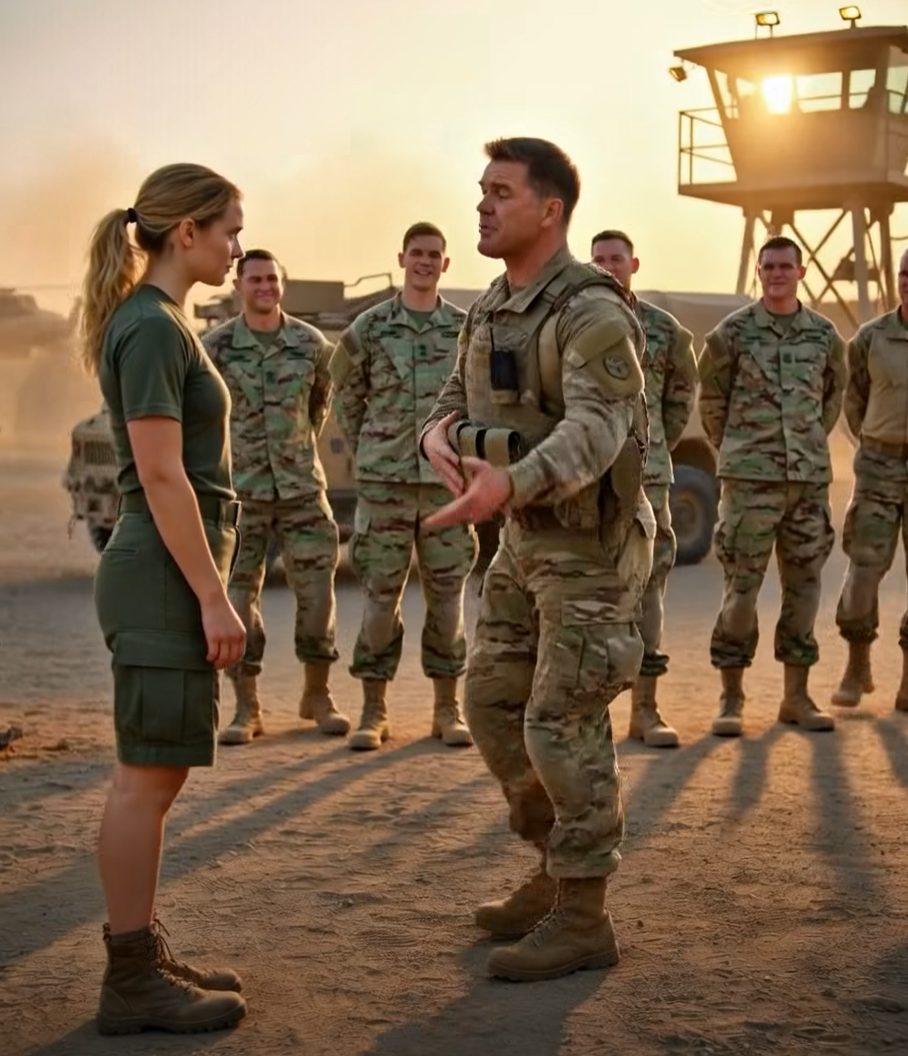
“So tell me, sweetheart… what’s your rank? Or are you just here to polish rifles?”
Admiral Victor Kane’s voice cut through the desert heat, deliberate and sharp, like he already knew the answer he wanted.
Six officers moved with him in a tight formation, uniforms crisp, laughter easy as they crossed the firing line. The afternoon sun burned down over Fort Davidson’s open range, where a small group of personnel ran qualification drills in the distance.
Dust drifted in slow spirals from the dry ground. The air smelled of gun oil, metal, and spent rounds.
The woman they were addressing didn’t look up.
Twenty-nine, composed, her uniform plain – no visible insignia, no rank tabs. She sat cross-legged in the narrow strip of shade beside the equipment shed, focused entirely on the disassembled M110 sniper rifle laid out before her.
Her hands moved in small, precise motions. Cloth gliding over the bolt carrier group in steady circles.
Every movement controlled. Efficient. Practiced.
The kind of precision that doesn’t come from instruction manuals.
Kane stepped closer, gravel crunching under his boots. Fifty-eight, decorated, carrying the weight of rank in every movement.
His shadow stretched across her hands.
She didn’t stop.
“I asked you a question.”
Lieutenant Brooks stepped in beside him, arms crossed, posture relaxed with confidence.
“Maybe she doesn’t speak English, sir,” he said lightly. “Or maybe she’s maintenance. They’ve been letting anyone on ranges lately.”
A few officers chuckled.
Behind them, a younger lieutenant leaned toward his friend, voice low but not low enough.
“Ten bucks she can’t even assemble that thing.”
“Twenty says she’s never fired past a handgun.”
More laughter followed.
Near the range control tower, Range Master Ellis turned his head.
Sixty-two, posture still rigid despite the years, eyes sharp beneath a weathered brow. He had seen thousands of shooters come through this range.
His gaze settled on the woman.
Then narrowed.
Not at her presence – but at her hands.
The way she held the bolt carrier.
The angle of her wrists.
The rhythm of her breathing.
Four counts in. Hold. Four counts out.
Repeat.
His jaw tightened slightly.
That wasn’t standard.
Kane leaned down a fraction, voice dropping into that controlled tone that masked irritation.
“Look at me when I’m speaking to you.”
For a brief second, her hands paused.
Then she placed the bolt carrier down. Set the cloth beside it with exact alignment.
No hesitation. No shake.
When she raised her head, her eyes were calm – gray-green, unreadable.
They met his without flinching.
“No rank to report, sir.”
Her voice was even. Neutral.
“Just here to shoot.”
Brooks let out a short laugh.
“You hear that? She’s just here to shoot.”
He glanced back at the others.
“Hope someone shows her how to handle recoil. These rifles aren’t exactly beginner-friendly.”
Another officer smirked.
“Maybe we should spot for her. Make sure she doesn’t hurt herself.”
More quiet laughter rippled through the group.
Ellis shifted his weight slightly, one hand hovering near the radio at his belt. He didn’t touch it.
Not yet.
But his attention had sharpened completely.
His eyes returned to her hands – remembering the exact finger placement.
Speed reassembly positioning.
Low-light ready.
Not something taught in standard training rotations.
Kane straightened.
“You’re cleared to be here?”
“Yes, sir.”
“And you intend to shoot?”
“Yes, sir.”
“At what distance?”
For the first time, something faint crossed her expression.
Not quite a smile.
Something quieter.
“Eight hundred meters, sir.”
The reaction came immediately.
Laughter broke louder this time.
Brooks shook his head, grinning.
“Eight hundred? On this range?”
“Does she even know where that marker is?”
“I want to see this.”
Even Kane allowed a slight smirk, the corner of his mouth lifting.
Only Ellis didn’t react.
His eyes had shifted.
Locked onto something just above her collar.
Where the fabric had moved – barely.
Enough to reveal a small piece of ink.
Dark.
Clean.
Precise.
A sniper’s mark.
Not decorative. Not casual.
The kind that isn’t given – it’s earned, signed off, and never spoken about.
Ellis inhaled slowly.
Kane noticed the change.
Followed his gaze.
Then he saw it.
For a fraction of a second, his expression froze.
The smirk disappeared.
His posture stiffened, almost imperceptibly.
His eyes sharpened, focusing in a way they hadn’t before.
Behind him, the laughter began to fade – one voice at a time, without anyone understanding why.
Brooks frowned slightly.
“Sir?”
Kane didn’t answer.
Because the woman had already picked up the rifle again.
This time, when her hands moved, there was no trace of demonstration in them.
No hesitation. No awareness of the audience.
Just execution.
She rose to her feet in one smooth motion, slung the rifle forward, and stepped toward the firing line with quiet certainty.
Ellis’s hand finally touched the radio at his belt – but he didn’t press it.
Not yet.
Because something told him this wasn’t a situation to interrupt.
Kane’s voice, when it came again, was different.
Lower.
Tighter.
“Where did you serve?”
The woman paused for half a second.
Just enough to acknowledge the question.
Not enough to turn around.
“Classified, sir.”
Silence followed.
Real silence this time.
The kind that settles heavy.
Kane took a step forward, eyes fixed on her back now.
“Who authorized – “
He stopped mid-sentence.
Because she had reached her position.
Dropped to prone.
And in one fluid sequence, faster than most could track – the rifle was assembled, seated, and locked into her shoulder.
No wasted motion.
No adjustment.
Just precision.
Ellis felt it then.
That unmistakable shift in the air.
Not tension.
Recognition.
Kane’s jaw tightened.
For the first time since stepping onto the range, he wasn’t in control of the moment anymore.
And he knew it.
The woman settled behind the scope, breathing already aligned, body perfectly still against the ground.
Eight hundred meters stretched out ahead.
Wind drifting slightly left.
Dust moving in thin lines across the surface.
Her finger rested along the trigger.
Not pulling.
Waiting.
And in that suspended second – just before the shot – every person on that range realized the same thing at once.
She hadn’t come there to prove she belonged.
She had come there because she already did.
What Happened Next
The shot broke the silence the way a door breaks when it’s been kicked in.
Clean. Absolute.
Then nothing.
No follow-up movement from the target. No need for one.
Ellis looked through his spotting scope for exactly two seconds. Then he lowered it.
He didn’t write anything down. Didn’t reach for the radio.
He just stood there for a moment with his hand resting on the fence post, looking at the eight-hundred-meter marker, and then he looked at Kane.
Kane was still watching the firing line.
Brooks had stopped talking entirely. His arms had uncrossed somewhere in the last thirty seconds and he hadn’t noticed yet.
The two lieutenants who’d made the bet were quiet in the way people go quiet when they want to pretend they didn’t say what they said.
The woman didn’t move from prone immediately. She stayed down, breathing through the follow-through, cheek still against the stock. Watching the target. Confirming what she already knew.
Then she rose, slow and unhurried, and ejected the brass.
Caught it.
Held it for a second between two fingers, looking at it.
Then she set it in her jacket pocket and started clearing the rifle.
The Question Kane Couldn’t Stop Asking
He walked to her.
Not with the same energy as before. The six-man formation had dissolved without anyone ordering it. Brooks drifted back a step. The lieutenants found something to look at near the equipment shed.
It was just Kane now.
He stopped about three feet from her, hands at his sides, and watched her break down the M110 with the same unhurried efficiency as before.
“That tattoo,” he said.
She didn’t answer right away.
“Where’d you get it?”
She glanced up briefly, then back to the rifle.
“Earned it,” she said.
It wasn’t a correction. It wasn’t hostile. It was just the accurate answer, delivered without any interest in how it landed.
Kane was quiet for a moment. He looked at the ink again, the small piece of it visible above her collar. He’d seen that mark before. Not often. Three times, maybe, in thirty-eight years of service. Never on someone who’d introduced themselves to him at a firing line.
He’d always known, in the abstract, that operators existed outside the normal chain of visibility. People whose files sat in folders he’d never be handed, whose assignments didn’t show up in briefings he attended. He knew this the way you know a thing intellectually without it ever becoming real.
It was becoming real.
“Who do you work for?” he asked.
“Can’t tell you that, sir.”
“Can’t or won’t?”
She thought about that for a second.
“Both,” she said.
Ellis Already Knew
The range master had seen her file.
Not the full version. Nobody outside a very small room had the full version. But two weeks before this afternoon, a single-page authorization had come through his office, routed through channels he hadn’t seen used since a training exercise in 2019 that he still wasn’t allowed to discuss.
Name: Danielle Pruitt.
Access: Full range, all distances, no supervision required.
Authorization code: a string of letters and numbers that meant, in plain terms, that she outranked the authorization itself.
Ellis had read it twice. Filed it. Told no one.
He’d expected her to come in quietly, use the range, leave. That was how these things usually went. They didn’t make noise. They didn’t get into conversations. They didn’t get noticed.
He hadn’t accounted for Kane.
He watched the Admiral now, standing three feet from her, working through something he clearly hadn’t prepared for. Ellis had seen Kane operate in high-pressure situations. The man was good. Genuinely good, the kind of officer who earned his stars rather than inheriting them.
But this was a different kind of pressure.
This was the pressure of being wrong in front of people who watched you be wrong.
Ellis walked over slowly. Not to intervene. Just to be close enough.
Kane glanced at him.
“You knew,” Kane said.
“I had a clearance notice, sir.”
“You could have said something.”
Ellis looked at him for a moment.
“No, sir,” he said. “I really couldn’t.”
Brooks Tries
To his credit, Brooks didn’t slink away.
He waited until Kane stepped back, then approached on his own, hands in his pockets, posture doing its best to look casual. He was thirty-four, good-looking in the way that had probably worked for him his whole life, and he was smart enough to know he’d stepped in something.
“That was a hell of a shot,” he said.
Danielle glanced at him.
“Thanks.”
“Eight hundred meters, open range, no spotter. That’s not nothing.”
“No,” she agreed.
He stood there a moment, working up to whatever came next.
“I said some things earlier – “
“I know.”
” – that I probably shouldn’t have.”
She looked at him then. Not long, not hard. Just enough.
“You said what you thought,” she said. “That’s more honest than most.”
He blinked.
It wasn’t absolution. She wasn’t offering that. But it was something, and he took it and walked away before he could ruin it.
What She Didn’t Say
She fired twice more that afternoon.
Nine hundred meters. Then, when the light started going flat and the wind shifted, a thousand and fifty.
The last one she called herself, no reading from Ellis, no wind meter. She lay there for a full ninety seconds before the shot, just watching the dust, watching the grass at the far end of the range, watching the way the heat moved.
Kane watched all three shots from the range control fence.
He didn’t say anything else to her. She didn’t invite it.
But he stayed.
That was the part Ellis remembered later, when he told the story – only twice, only to people who’d already heard versions of it from elsewhere. He remembered that Kane, for all his rank and all his certainty, stayed on that range for two hours and watched a woman he’d mocked shoot three rounds that should have been impossible and didn’t say a word.
Not because he had to.
Because he wanted to understand what he was looking at.
Danielle packed the rifle into its case just before 1700. Efficient. No ceremony. She snapped the latches, stood, slung the case over one shoulder.
She walked past Kane on the way out.
He straightened slightly.
She gave him a nod. Brief. Not warm, not cold.
Just acknowledgment.
He returned it.
That was all.
She walked to the lot, put the case in the back of a gray government-issue truck with no markings, and drove off the base through the east gate.
Ellis watched the truck until it turned onto the highway and disappeared.
Behind him, the range was quiet.
The brass she’d caught was still in her pocket.
The targets at eight hundred, nine hundred, and a thousand and fifty meters had three holes in them, each one centered, each one clean.
Nobody moved to collect them for a while.
—
If this one stayed with you, pass it along to someone who’d get it.
If you’re looking for more stories about folks who faced down disrespect and came out on top, you won’t want to miss ” She’d Been “The New Girl” for Months. Then Six Marines Walked In at 3 A.M.” or how about ” My Sergeant Shoved My Face Into The Dirt. He Had No Idea What I Was Already Building Against Him.” And for a truly outrageous tale of workplace woe, check out ” My Own Manager Dumped a Bucket of Water on Me Inside My Building.”