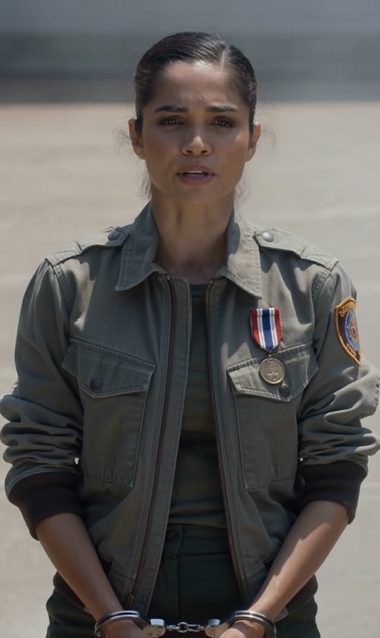
“Lock her up, she’s lying,” the corporal barked, his words slicing through the parking lot heat that bounced off the asphalt in waves. People stopped walking, turned, started murmuring. Metal closed around Diana’s wrists, her worn Army field coat pulling sideways in the scuffle – the patch on her shoulder catching light, bright as proof nobody wanted to see. She said nothing. Didn’t move. Mouth set. Eyes flat. Quiet… right up until the black SUVs pulled in.
And then everything changed – badly – for somebody else. One nod did it.
They grabbed her in front of everyone at 3:42 p.m., when the sun over the lot was hot enough that the painted lines looked like they were swimming.
The visitor entrance had been running normal – cars pulling up, badges getting scanned, trunk checks happening one after another. Vendors with deliveries. Soldiers coming back from town. A Coast Guard captain already p*ssed before he even rolled his window down.
Nothing about the tan SUV pulling in should’ve broken that pattern. It was older than what usually came through – mud caked behind the wheels, a chip in the side mirror. In the back seat: just a gym bag and a uniform on a hanger. Nothing weird. Nothing flagged.
Except the woman driving.
Not because she seemed jumpy – she didn’t.
Not because she acted entitled – she didn’t.
She looked like somebody who’d worked in rough places for a long time, somebody who didn’t bother putting on a show. Her hands sat easy on the wheel. Her face said nothing. Brown hair pulled back without fuss. No jewelry except a thin band on her finger that flickered when she reached for the gear shift.
And over a black tank top – A washed-out green Army field jacket.
Lived in. Soft at the cuffs. Real.
The name strip said: HOLLAND.
Above it, ribbons. Below the chest pocket – a patch the young gate guard in the booth couldn’t quite place.
Corporal Tyler Walsh had made his name catching things that were off. Eighteen months at Fort Marston had drilled it into him: second-guessing got you in trouble. He went with his gut. He moved fast. And right now – everything about her was setting him off.
Soon as he clocked that jacket, he stepped out of the booth.
The SUV stopped. The window came down.
“Afternoon,” she said.
Way too even.
Walsh leaned toward the window, looking at the visitor pass on the dash. Real. Logged. But his eyes went straight back to the jacket. The patch. The way she wore both like she’d earned them.
Something hot crawled up his neck.
“Step out, ma’am.”
She did. No pushback. No attitude. Smooth, easy, done.
That bothered him more than if she’d argued.
She stood on the hot blacktop, shorter than he’d guessed, but planted in a way that made her seem bigger than she was. The jacket didn’t sit on her like dress-up. It sat on her like it had been there a long time.
People started watching. Other gate staff looked over. A delivery driver k*lled his engine. The Coast Guard captain craned his neck.
“You know why I pulled you out?” Walsh said.
She looked at him. Calm. Not bothered. Like somebody watching weather move in from a long way off.
“No.”
He jabbed a finger at her chest. “That jacket. Those ribbons.”
She glanced down. Looked back up.
“What about them?”
“Those aren’t yours.”
Quiet then – but not the kind he was expecting. Not nervous. Not insulted. Heavier than that.
“Pretending to be an Army officer is a federal crime,” Walsh said, louder, because people were listening now. “Especially a colonel.”
The word jumped through the crowd.
“Colonel?” somebody said.
“Bullsh*t,” somebody else said.
She didn’t even turn her head.
“ID.”
She gave it to him.
Real card. Real seal. Real photo.
Name: Colonel Diana Holland.
For a second, he hesitated.
Then his pride shut it down.
Fake IDs were a thing. Stolen IDs were a thing. And Walsh had already opened his mouth – out loud, with everyone watching. Walking it back now wasn’t fixing a mistake. It was eating sh*t in public.
“Where’d the jacket come from?”
“It’s mine.”
“And the patch?”
Nothing.
“Army surplus? Grandpa’s closet? eBay?”
A couple of the other guards laughed – mean, short, riding on his confidence.
She didn’t blink.
“What unit you saying you’re with?”
“I’m not saying anything.”
Somebody behind him snorted. Walsh ran with it. “Take the jacket off.”
That’s when her face moved. Just a little.
The air in the lot went tight.
“No.”
Soft. Final.
Something dropped in Walsh’s stomach – a feeling he couldn’t name, his gut telling him this wasn’t her being difficult… this was her being in charge.
But people were watching.
And he picked pride.
“That’s it,” he said, turning to the other guards.
“Hook her up.”
The cuffs clicked.
And right then – The black SUVs rolled through the gate.
Three Vehicles. No Plates.
Not base plates. Not government plates. Nothing.
The SUVs came in single file, moving at the speed of people who don’t need to hurry. Tinted glass. Clean, despite the weather. The kind of clean that means somebody wiped them down that morning because it was expected.
They stopped fifteen feet from where Walsh was standing.
Nobody got out for a moment.
Then the rear door of the middle vehicle opened, and a man in civilian clothes stepped onto the blacktop. Dark slacks. White shirt with the sleeves rolled to the elbow. No tie. He was around fifty, gray at the temples, the kind of face that had made a lot of decisions and stopped apologizing for them years ago. He had a lanyard around his neck but he’d flipped the badge face-in, which meant he knew exactly what he was doing.
He looked at Diana Holland in cuffs.
He looked at Walsh.
He didn’t say anything right away. Just took in the scene the way you take in a traffic accident – quick, complete, clinical.
“Corporal.” His voice was level. Not loud.
Walsh straightened. “Sir, this individual was attempting to access the installation with what I believe to be fraudulent credentials and misappropriated uniform items. She refused to comply with a lawful order and I – “
“Stop talking.”
Walsh stopped.
The man walked toward Diana. He stopped in front of her and looked at the patch on her shoulder, the one Walsh couldn’t place. He nodded once, slowly, like he was confirming something he already knew.
Then he turned back to Walsh.
“Who authorized the restraints?”
“I did, sir. Corporal Walsh, gate security, I have the authority under – “
“I know what authority you have.” Flat. “I’m asking you why you used it on a colonel with valid credentials and an active access pass.”
Somebody in the crowd made a sound. Not a laugh. Something shorter than that.
Walsh’s jaw tightened. “The ID could be – “
“It’s not.”
“The patch – “
“Is real.”
Walsh looked at the other guards. Neither of them looked back.
“Sir, with respect, I can’t just take somebody’s word on – “
“You’re not taking anybody’s word.” The man reached into his shirt pocket and produced a folded document. He held it out. Walsh took it. Opened it.
It took him about four seconds to read it.
His face went the color of old chalk.
What the Paper Said
Nobody else saw it. Walsh folded it back up and handed it over without a word, and the man with the lanyard put it back in his pocket like it was a grocery receipt.
But three people standing close enough caught the header on the document before it closed.
Joint Chiefs letterhead.
Diana Holland hadn’t come to Fort Marston as a visitor.
She’d come to conduct an unannounced readiness assessment of the installation’s security infrastructure – gate protocols, credentialing procedures, response times, guard decision-making under pressure. The kind of assessment that didn’t get announced because the whole point was to see what actually happened, not what happened when everyone knew they were being watched.
The mud on the SUV was real. The chip in the mirror was real. The gym bag in the back seat was real.
The field jacket, the ribbons, the patch – all of it was exactly what it looked like. Hers. Earned. Worn because she’d been in the field two days before and hadn’t bothered changing.
She hadn’t said she was a colonel when Walsh pulled her out of the car. She’d said nothing, because nothing was exactly the right answer. Anything she said would’ve coached him. And coaching him would’ve defeated the point.
She’d handed over the ID because he asked. She’d refused to remove the jacket because she wasn’t going to strip her own rank off her back to make a gate guard comfortable.
That was the assessment.
Walsh had just handed her twelve pages of notes without knowing it.
Getting the Cuffs Off
The man with the lanyard looked at the guard standing to Walsh’s left. Young guy, maybe twenty, who’d been watching the whole thing from six feet back without saying a word.
“Get those off her.”
The young guard moved fast. Unlocked the cuffs. Stepped back.
Diana rolled her wrists once. Not making a show of it. Just checking.
She looked at Walsh.
He was standing very still, the way people stand when they’re trying to decide whether there’s anything left to say. His face had moved past the chalk color into something more complicated. Not quite embarrassment. Worse than that. The specific feeling of having been completely, publicly, unfixably wrong.
She didn’t say anything to him.
That was the worst part, probably. If she’d said something – dressed him down, told him what an idiot he was, made it loud and official in front of everyone still watching – he could’ve absorbed it. Taken the hit and moved on.
She just looked at him for a second, the way you look at something you’ve already catalogued, and then she looked away.
She turned to the man with the lanyard. “Give me ten minutes.”
He nodded.
She walked back to the tan SUV, reached through the window, and pulled a yellow legal pad off the passenger seat. She uncapped a pen. She stood there in the sun, next to the car, and started writing.
Walsh watched her write for a minute before he understood what she was doing.
She was finishing the report.
Right there. In the parking lot. While the crowd thinned out and the delivery driver finally started his engine again and the Coast Guard captain, who had watched all of it without saying a single word, rolled his window back up and drove through the gate.
What Came After
Walsh got pulled off the gate at 4:15.
Not fired. Not arrested. Pulled – reassigned to administrative duties pending a review, which in practice meant a desk inside the building, no gate access, and a lot of time to think about the last forty minutes of his life.
The review took three weeks.
The people who’d laughed – the two guards who’d made the short, mean sounds when Walsh asked about the Army surplus – both got written up. Not for laughing. For failing to intervene when a superior officer’s credentials were being actively ignored. There’s a distinction there, and it’s the kind of distinction that ends careers if you’re not careful.
The young guard who’d unlocked the cuffs without hesitating got a note in his file. A good one.
Diana Holland’s assessment report on Fort Marston’s gate security ran to twenty-two pages. Walsh’s name appeared in it four times. None of the appearances were positive, but none of them were personal either. She wrote about decision patterns, not people. About what the incident revealed about training gaps and protocol drift. About how confidence without competence is its own kind of security failure.
She’d seen it before. Different bases, different names, same shape. A young guy who’d learned to trust his gut and hadn’t yet learned that his gut could be wrong. Who’d been told that hesitation was the enemy and hadn’t been taught what to do when moving fast was the mistake.
She didn’t recommend he be discharged. She recommended retraining.
The Part Nobody Talks About
Here’s the thing about that patch Walsh couldn’t place.
It wasn’t obscure. It wasn’t classified. It was the combat patch of the 75th Ranger Regiment – the tab worn on the right shoulder, which under Army uniform regulations is where you wear the patch of the unit you deployed with in combat. Not the unit you’re currently assigned to. The unit you were with when it got real.
Walsh had eighteen months at a stateside gate.
He’d never seen one up close before.
He’d looked at it and felt something was off, and he wasn’t entirely wrong – it did mean something he didn’t recognize. He just had the direction backwards. It wasn’t proof she was faking. It was proof she’d been somewhere he hadn’t.
The jacket was soft at the cuffs because she’d worn it a long time. The ribbons were faded at the edges because they weren’t new. The ring on her finger – the thin band that flickered when she reached for the gear shift – was a deployment ring, the kind some soldiers wore in the field instead of their actual wedding bands because losing a ring in the sand was easier than explaining it.
None of that was readable to someone who hadn’t been there.
Walsh had looked at a woman who didn’t perform authority and decided she couldn’t have it.
That was the whole error. Everything else was just what happened next.
3:58 p.m.
Diana Holland capped the pen, tucked the legal pad under her arm, and walked toward the man with the lanyard.
She didn’t look back at the gate.
She didn’t look at Walsh, who was still standing near the booth, not quite sure when he was supposed to go back inside.
She handed the legal pad over, said something too quiet to carry, and got back in the tan SUV.
The engine turned over.
She pulled through the gate – properly this time, badge scanned, bar lifted, logged – and drove onto the installation.
The mud behind the wheels caught the afternoon light.
The chip in the mirror stayed chipped.
And the parking lot went back to being a parking lot: cars pulling up, badges getting scanned, trunk checks happening one after another. Normal. Routine. The same as before, except it wasn’t, because the report existed now, twenty-two pages of it, and somewhere in there was a paragraph about what this entrance looked like at 3:42 p.m. on a Wednesday when nobody was watching.
Except somebody was.
Somebody always is.
—
If this one got you, send it to someone who needs to read it.
For more stories of respect earned and given, check out what happened when a general dropped to his knees in the dirt when he saw one soldier’s back or when another general dropped to one knee for a woman in a waiting room. And for a truly heartwarming moment, read about the dog who comforted his buddy’s friend seven years after his passing.