Nobody at the Fort Bragg community appreciation day expected anything from the seventy-five-year-old man in the faded denim jacket.
He stood near the back of the crowd, quiet, thin, and almost invisible. The kind of old man people politely step around without wondering who he used to be.
His name was Earl Jessup. To most of the families on Ridgerest Road, he was just a widower who drank cold coffee on his porch and waved at passing trucks. He had a habit of squinting at the horizon even when there was nothing there – like he was still scanning for something nobody else could see.
But on that October morning, the base had set up a challenge that was humiliating every shooter who tried it.
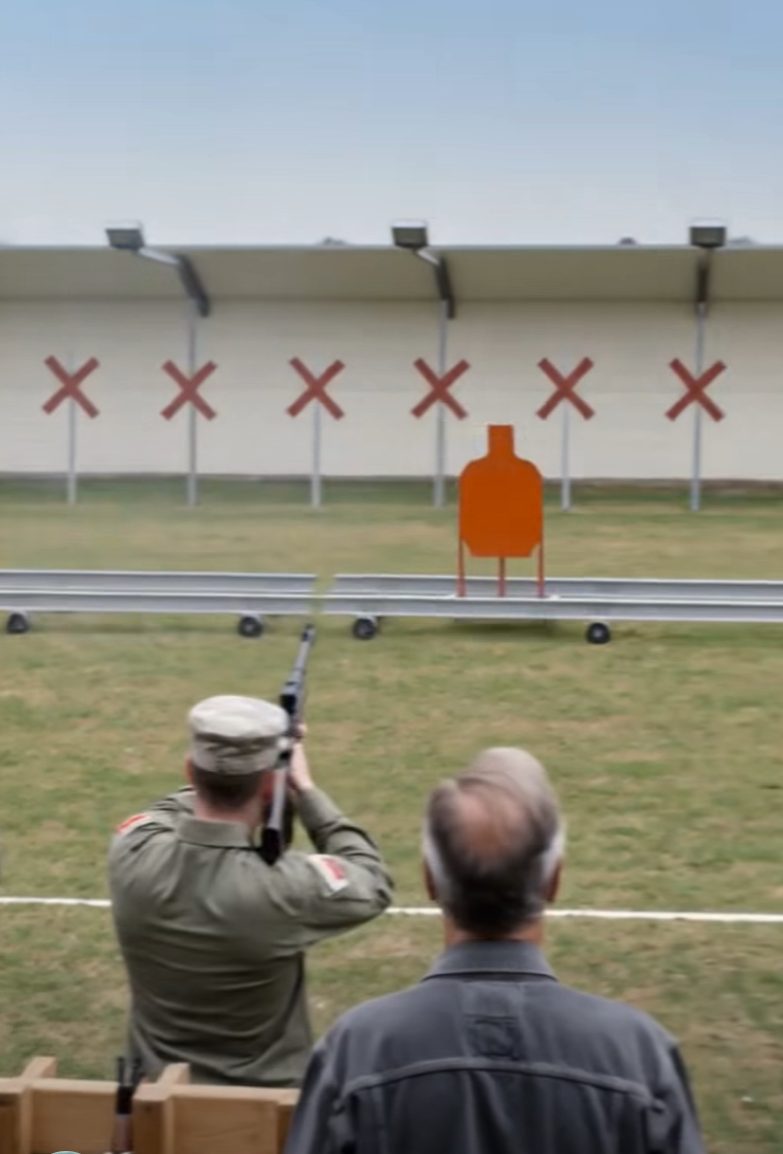
Three hundred yards downrange, an orange steel silhouette moved across a motorized rail at unpredictable speeds. It stopped, jerked, reversed, accelerated, then slowed again.
Forty-three active-duty soldiers had stepped to the firing line. Infantrymen. Marksmanship competitors. Young men and women who trained with rifles all week.
Every single one missed.
The scoreboard looked like a graveyard – nothing but red X’s, row after row. Teenagers filmed the misses on their phones. Families cheered whenever a shooter came close. But the soldiers knew the truth: that target was winning.
Then a young specialist from the 82nd Airborne missed all five of his shots, walked back red-faced, and his buddy clapped him on the shoulder and said it loud enough for the whole line to hear.
“Don’t feel bad. Even that old fossil by the fence couldn’t hit it with a map and a telescope.”
The Fossil Heard Every Word
Earl didn’t flinch. Didn’t turn his head.
He just kept looking at the target.
I was standing maybe eight feet from him when it happened. I’d been watching the whole morning, mostly because my husband was one of the soldiers who’d already missed, and I felt bad for him in the way you feel bad for someone when there’s nothing useful you can do. I had a cup of lukewarm coffee in my hand and I’d been people-watching more than target-watching.
Earl had been there since the event opened. I’d noticed him the way you notice a post or a signpost – registered his presence, filed it away, moved on. He had a paper cup of something. He wasn’t talking to anyone. He wore a hearing aid in his left ear and the jacket had a small American flag pin on the lapel, the kind you get at a hardware store for two dollars.
When the specialist’s buddy made the crack about the old fossil, a few people nearby laughed. Not mean laughter, not exactly. More like the uncomfortable kind that fills silence because someone doesn’t know what else to do.
Earl turned his head then. Slow. He looked at the kid who’d said it.
The kid noticed. Looked away first.
Earl set his paper cup down on a fence post. He straightened up, and I don’t know how to explain this except that something changed in how much space he seemed to take up. He walked to the range officer, a staff sergeant named Pruitt who’d been running the line all morning with a clipboard and a patient expression that was starting to crack around the edges.
“I’d like to try,” Earl said.
Pruitt looked at him. Not dismissive, just assessing. “Sir, you’re welcome to. Five shots, same rules as everyone else. You familiar with the M18?”
“I’ll manage.”
What the Paperwork Didn’t Say
Pruitt handed him the pistol. Then Earl did something I didn’t expect.
He stood at the line and he didn’t pick it up immediately. He watched the target for a full thirty seconds. Just watched it. The way you watch something when you’re not looking at it so much as learning it. The target slid left, stopped, slid right, jerked back, paused, slid left again.
The crowd had gone a little quiet already just from the novelty of him being there. Old man, civilian clothes, hearing aid. A few phones came up.
My husband found me in the crowd and came to stand next to me. He’d already heard about the crack from the specialist’s buddy. He crossed his arms.
“This is gonna be rough,” he said, not unkindly.
Earl picked up the pistol.
His grip looked wrong at first. Not bad-wrong, just different. Older. Like watching someone hold a tool they learned on a version that doesn’t exist anymore.
His first shot hit.
Not close. Not near the edge. Center mass, dead middle of the silhouette, while the thing was mid-slide and moving.
The range went quiet in a specific way. The kind of quiet where people look at each other to confirm what they just saw.
Second shot.
Hit.
Third shot. The target had reversed direction and was accelerating back the other way.
Hit.
My husband uncrossed his arms.
Fourth shot. The target stopped dead for about half a second then lurched forward.
Hit.
There was a sound from the crowd now. Not cheering yet. Something more confused than that. Like everyone was holding a question they hadn’t figured out how to ask.
Earl fired the fifth shot.
Hit.
Five for five. Three hundred yards. Moving target. A pistol. And he shot like he had the whole afternoon and nowhere else to be.
The Part Nobody Expected Next
The silence lasted about four seconds.
Then it broke, and it broke loud. The crowd did that thing where scattered applause becomes a wall of it in under two seconds flat. Someone behind me let out a sound that was half laugh, half something else. The staff sergeant with the clipboard – Pruitt – was staring at the target downrange like it had personally offended him.
The specialist’s buddy had gone quiet in a way that was different from everyone else’s quiet.
Earl set the pistol down. He picked up his paper cup from the fence post. He took a sip.
Pruitt walked over. He wasn’t smiling exactly but his face was doing something.
“Sir,” he said. “I have to ask.”
Earl looked at him.
“Who are you?”
Earl didn’t answer right away. He looked back downrange at the orange silhouette still moving on its rail, back and forth, back and forth, like it didn’t know what had just happened to it.
“Earl Jessup,” he said. “I live on Ridgerest Road.”
“Before Ridgerest Road.”
Earl was quiet for a moment. He finished whatever was in his cup.
“Sergeant First Class,” he said. “Retired. Three tours. Two in places you’ll find on a map, one in a place that wasn’t on any map they’d show you.” He paused. “I was a sniper for twelve years before they moved me into training. Spent the last eight years of my service teaching people like your young specialist over there how not to miss.”
Pruitt looked at the specialist.
The specialist looked at his boots.
Ridgerest Road
I talked to Earl afterward. He didn’t seem to want to linger at the range, so I fell into step beside him as he was walking toward the parking area, and I don’t know what made me do it except that I’d been watching him for two hours and I felt like I’d been given a small piece of something and I didn’t want to put it down yet.
I told him I lived on Ridgerest Road too. Three houses down from him, actually.
He stopped. Looked at me with that squinting expression, the horizon-scanning one.
“You’re the one with the yellow door,” he said.
I told him yes.
“Your husband was up on the line this morning.”
I told him yes to that too.
He nodded like that confirmed something.
We walked a little further. He moved carefully but not slowly. His hands were steady. I’d watched those hands at three hundred yards and they hadn’t wavered, but up close I could see the knuckles, the old scar tissue along his right forearm, the way he favored his left side just slightly.
I asked him why he’d never mentioned any of it. Twelve years as a sniper. Twenty-something years of service. He’d lived on our street for six years since his wife passed and I’d never heard a word of it.
He looked at me like the question was a little funny to him.
“Who would I tell?” he said.
I didn’t have an answer for that.
“Carol knew,” he said. Carol was his wife. She’d died in the spring three years ago, the kind of death that’s quiet and then sudden. I’d brought over a casserole I don’t think he ever ate. “She knew all of it. Didn’t need anyone else to.”
He stopped at an old Ford pickup, the kind of truck that’s been repainted once and you can tell. He opened the door.
“Your husband shoots with his right shoulder but he’s left-eye dominant,” he said. “That’s his problem. Tell him to try switching.”
He got in the truck. The engine turned over on the second try.
What My Husband Did the Next Morning
I told him what Earl said.
My husband’s name is Dennis and he is not a man who takes instruction easily, especially about shooting, especially from someone he didn’t ask. He made a face. He said something about how one good day at a range didn’t make someone an expert on his technique.
I let it sit.
Three days later I came home and he was in the backyard with a paper target set up against the fence and he was shooting with his left shoulder.
He didn’t say anything about it. I didn’t either.
A week after that he knocked on Earl’s door with a six-pack of whatever beer he’d guessed at and they sat on Earl’s porch for three hours. I watched them from our kitchen window at one point, not to spy, just because the image caught me. Two men, thirty years apart, sitting in the October cold, talking about something I couldn’t hear.
Dennis came home and said Earl had offered to work with him on Saturdays if he wanted.
He wanted.
The Thing About the Horizon
I think about what the specialist’s buddy said sometimes. The fossil comment. I don’t think he was a bad kid. I think he looked at Earl and saw the denim jacket and the hearing aid and the paper cup and did the math the easy way.
We all do it. File someone away. Decide what they are by what they look like right now, today, in this moment, with no thought for what they were carrying before you met them.
Earl Jessup spent twelve years lying still in places that would make your hair stand up, waiting for one moment to matter. He spent eight more years giving that knowledge to other people. He watched his wife die slowly and he moved to a house on a quiet road and he drank cold coffee and squinted at horizons and waved at passing trucks.
And on a Saturday in October, he picked up a pistol he’d never fired before and hit a moving target five times at three hundred yards, then put the gun down and finished his drink.
He didn’t explain himself. Didn’t hang around for the applause. Didn’t look at the kid who’d made the crack.
He just went back to being Earl Jessup from Ridgerest Road.
The one with the cold coffee and the yellow door three houses up.
—
If this one got you, pass it along to someone who needs to hear it.
If you love a good underdog story, you’ll be thrilled by the time she asked “May I take a turn?” and the SEALs went quiet or when she was just an analyst, then she said the number. And for a tale of unexpected justice, my father watched the video at 0347 and made one phone call is sure to captivate.