
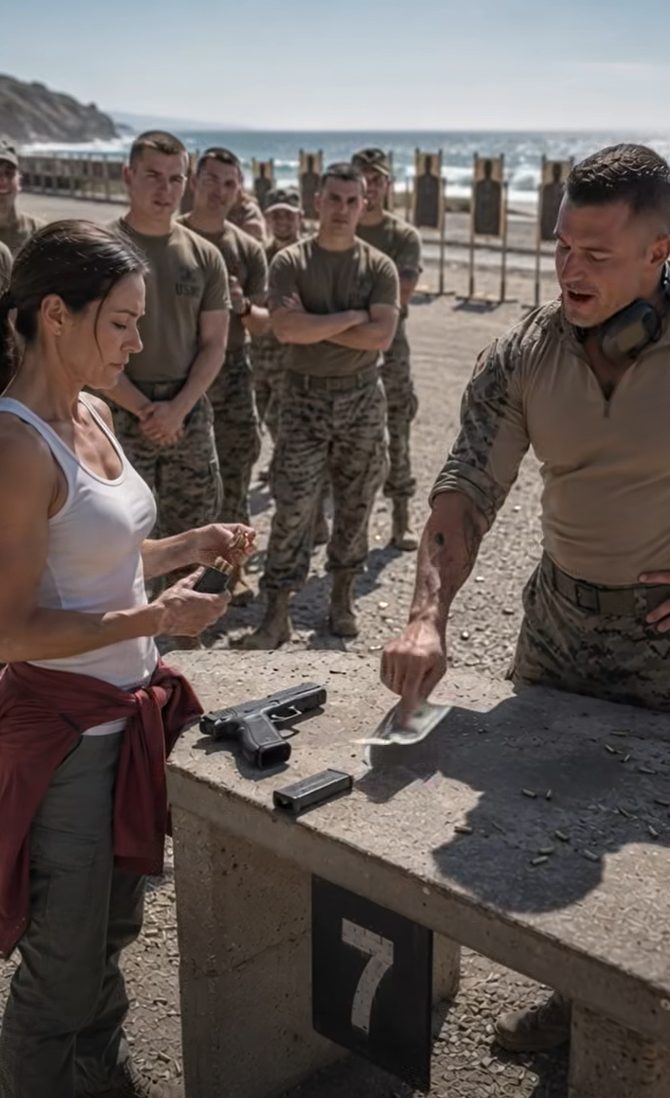
Sergeant Cole Ryder put one hundred dollars on the bench to humiliate a quiet woman at lane seven – then the range officer saw her ID.
“Five shots,” Ryder said, sliding the bill forward with two fingers. “Twenty-five yards. Four seconds. Try not to embarrass yourself too badly, sweetheart.”
The coastal wind snapped across the firing line and lifted one corner of the money like it was trying to leave before the mistake became permanent.
A few young Marines laughed behind him.
The woman did not.
She stood beside the bench in a white tank top, a red jacket tied around her waist, and the kind of stillness that made people underestimate her for exactly the wrong reasons. She looked like any civilian who had wandered into a Saturday range for fun.
That was what Ryder saw.
That was all Ryder saw.
He did not notice the old scars crossing her wrist. Pale. Uneven. Faded, but not gone. The kind of marks that did not belong to a careless life.
He did not notice the way her thumb found the edge of each round without looking.
He did not notice the calm pressure of her hands as she slid another bullet into the Glock magazine.
But the youngest Marine behind him did.
His smile disappeared first.
The range was packed with heat, salt air, and the sharp stink of burnt powder. Brass glittered on the concrete. Targets moved in the wind. Somewhere down the line, someone had stopped taping paper halfway, frozen with one hand raised.
Ryder enjoyed that.
He enjoyed being watched.
He had broad shoulders, sunburned forearms, and the easy posture of a man who had spent years being obeyed before he finished speaking. His haircut was sharp. His confidence sharper.
The younger Marines stood behind him like he had already won.
“I’ve been watching you for ten minutes,” Ryder said, loud enough for nearby shooters to hear. “You seem pretty comfortable here.”
The insult was wrapped neatly inside the sentence.
Cute civilian. Weekend shooter. Another person who watched videos online and thought a pistol made her dangerous.
The woman pressed the last round into the magazine.
Click.
Then she looked at him.
Her eyes were blue-gray, but there was nothing soft in them. Nothing loud either. Just stillness. A cold, deliberate stillness that did not ask to be understood.
“That your professional opinion?” she asked.
One Marine coughed, trying to hide a laugh.
Ryder’s jaw tightened.
“Sergeant Cole Ryder,” he said. “Marksmanship instructor. MCRD San Diego.”
She blinked once.
“Good for you.”
The silence that followed was worse than an insult.
It landed clean.
Ryder’s smile stayed in place, but something behind it hardened. Men like him could handle jokes. They could handle competition. What they could not handle was being dismissed in front of other men who admired them.
He lifted the hundred-dollar bill again.
“You beat me, it’s yours,” he said. “You lose, you’re buying drinks tonight.”
Her eyes moved to the money.
Then back to him.
There was always a moment like this.
She had seen it in bars, in briefing rooms, on training grounds, and in places where sand got into your teeth and nobody joked after the first round cracked overhead.
A moment when a man built a whole woman in his head and decided she was smaller than him.
Civilian. Soft. Harmless. Easy.
Years ago, in a narrow alley half a world away, a lieutenant had smiled at her the same way.
“Don’t worry about wind calls,” he had told her. “The men will handle it.”
Three days later, he was dead.
The memory moved across her face so quickly most people missed it.
The youngest Marine did not.
His gaze dropped again to her wrist. Then to the magazine. Then to the smooth, economical way her hands worked, without wasted motion, without nervousness, without performance.
People who truly understood weapons did not watch the face first.
They watched the hands.
“What’s the time limit again?” she asked.
Ryder grinned, mistaking quiet for fear.
“Four seconds,” he said. “Cold start.”
No practice. No warm-up. No mercy.
He wanted a show.
And everyone knew it.
By then, the range officer had replaced the targets. The people in nearby lanes had stopped shooting completely. The whole line felt exposed, stripped down to breath and wind and the faint metallic rattle of ammunition inside boxes.
Ryder stepped up first.
He rolled his shoulders like the outcome had already been written.
Behind him, the youngest Marine swallowed hard.
The woman reached into the inside pocket of her red jacket.
Ryder did not look.
He was too busy enjoying the final seconds of being the man everyone expected to win.
She pulled out a small identification card and placed it beside the ammunition box.
It made almost no sound.
But the range officer saw it.
His posture changed instantly. Not slowly. Not politely. Like his body recognized authority before his mind could catch up.
The youngest Marine went pale.
The woman did not touch the money.
She did not explain herself.
She simply stepped toward lane seven.
The range officer swallowed.
“Sergeant,” he said carefully, his voice barely carrying above the wind, “you may want to rethink this.”
Ryder gave a short laugh without turning around.
“Why?”
Nobody answered.
That was the first thing that bothered him.
The silence had changed.
It no longer sounded like an audience waiting to be entertained.
It sounded like witnesses waiting for impact.
Ryder glanced sideways.
First, he saw the range officer’s face. Gone was the casual boredom of a man supervising another range challenge. In its place was something tight and alert. Not fear exactly. Recognition.
Then Ryder looked at the youngest Marine.
The kid’s lips had parted slightly. His eyes were locked on the bench. His shoulders had gone stiff under his uniform like he had just realized he was standing too close to something dangerous.
Only then did Ryder follow his stare.
To the identification card.
It lay beside the ammunition box, its corner held down by the wind-shadow of the bench.
The words were small.
But not small enough.
Former Marine Scout Sniper.
For one second, Cole Ryder did not move.
The money fluttered again.
The wind pushed across the paper targets.
Somewhere, a casing rolled across the concrete and clicked against the toe of his boot.
The woman stepped fully into lane seven.
She wrapped both hands around the Glock.
And everything about her changed.
Not dramatically. Not for show. It was smaller than that.
Her shoulders settled. Her breath slowed. Her feet found the concrete like they remembered every place she had ever stood when missing was not an option.
She did not look like someone aiming at a target.
She looked like someone returning to a place the world had tried to take from her.
Ryder’s smile began to disappear.
The youngest Marine stopped breathing.
The range officer took half a step back.
And then she raised the pistol.
Nobody on that firing line was ready for what came next.
What the Range Officer Already Knew
Her name was Donna Pruitt.
She had turned forty-three in February, alone in a rental in Oceanside, eating cold tamales out of a foil pan because she had forgotten it was her birthday until her sister texted at nine in the evening. She had not been back to Camp Pendleton in two years. She had not fired competitively in three.
The range officer, a staff sergeant named Gary Holt, had recognized her the moment she signed in at the front desk. He had not said anything. That was not his place. She was just another civilian on a Saturday, and she had not introduced herself, and some people came to ranges to remember and some people came to forget, and Gary Holt had learned a long time ago not to ask which one.
But when Ryder started running his mouth, Gary had watched her face.
He had seen that expression before.
Once, at a pre-deployment brief in 2009, on a gunnery sergeant who had been told by a visiting officer that the platoon’s marksmanship numbers were soft. The gunnery sergeant had smiled the same way Donna was smiling now. Not with warmth. With patience. The specific patience of a person who has decided to let the other person finish digging before they hand them the shovel.
Gary had signed the paperwork after that brief. The gunnery sergeant’s numbers had not been soft.
He thought about that now, watching Donna settle into her stance.
The Way She Held It
She did not hold the Glock the way they taught in basic.
Not wrong, exactly. Just different. Compressed. Economical in a way that took years to arrive at, the kind of grip that had been adjusted and readjusted under conditions where adjusting meant staying alive. Her right thumb rode the frame low. Her left hand locked the whole assembly together like she was building something she intended to keep.
Ryder had not finished his setup yet.
He was still rolling his neck, still doing the performance of a man preparing, still playing to the audience that had quietly stopped being his audience about ninety seconds ago.
The youngest Marine, a lance corporal named Travis Doyle from Akron who had been on base for four months and had never once seen combat, was watching Donna’s hands and thinking about something his grandfather had told him once. His grandfather had been a gunner’s mate in the Navy, long retired, and he had said: The ones who scare you are never the ones who want to scare you.
Travis had not understood that when he was twelve.
He understood it now.
Ryder raised his pistol.
His form was genuinely good. That was the honest truth of it. He had spent years teaching this, and his stance was clean and his grip was correct and his trigger discipline was exactly what you’d want to see in a classroom. He was not a fraud. He was not pretending.
He just had no idea what he was standing next to.
Four Seconds
The range officer called it.
Ryder fired first. Five rounds, fast and controlled, the sound cracking out across the line in a tight cluster. He dropped the pistol to low ready and turned slightly, already looking for the reaction he expected.
He got one.
Just not from the person he was watching.
Travis had flinched at Ryder’s shots, the way you do when you’re not the one firing. But when Donna went, Travis did not flinch. He went still. His body just stopped, the way bodies stop when they register something outside the normal range of experience.
Her five shots came out as two sounds.
Not five distinct cracks.
Two. A short burst, then three so close together they bled into each other, then silence.
Elapsed time: three point one seconds.
Gary Holt had a timer on his belt. He looked at it once and put it back without saying anything.
The targets came back on the pulley.
Ryder’s group was tight. A two-inch cluster, slightly high and right of center, the kind of result that would make any instructor nod. Good shooting. Honest shooting. The work of a man who practiced what he taught.
Donna’s target came back.
Travis Doyle looked at it.
Then he looked at the ground.
Then he looked at the sky, briefly, the way people do when they need a second.
Five holes. Twenty-five yards. Cold gun, no warm-up, four-second window.
One hole.
Not five holes close together. Not a ragged cluster you could cover with a silver dollar.
One hole.
She had put all five rounds through the same point of impact, and the hole was roughly the diameter of a quarter, and it was sitting dead center of the target’s chest box like she had measured it with a ruler.
What Ryder Did Next
He stared at the target for a long time.
Not a second. A long time. Long enough that the people in the adjacent lanes were looking at each other.
The money was still on the bench.
He had not picked it up. Neither had she.
Ryder set his pistol down. He turned to look at the ID card. He read it again, not because the words had changed, but because the first time he had read it, some part of his brain had refused to file it correctly.
Former Marine Scout Sniper.
He looked at Gary Holt.
Gary gave him nothing. Just stood there with his arms crossed, the way range officers stand when they are waiting for someone to figure out what Gary already figured out twenty minutes ago.
Ryder looked at Travis.
Travis was studying the concrete.
Then Ryder looked at Donna.
She was ejecting the spent magazine. Her hands were doing the same thing they had been doing since the beginning. Calm. Unhurried. Not performing anything.
“Where?” Ryder asked.
It came out quieter than he intended.
She glanced at him. “Helmand. Then Kandahar. Then a few places that didn’t have names anyone was using publicly.”
Ryder absorbed that.
“How many deployments?”
“Four.”
The wind moved through the range. Brass scraped across concrete somewhere down the line.
“The shooting position,” he said, and his voice had lost something, the teacher quality, the performance. He sounded like a student now, and he knew it, and he asked anyway. “The compressed grip. That yours, or did someone teach you that?”
“Mine,” she said. “First deployment. The standard grip got me shot.”
He nodded slowly.
Not performing that either. Just nodding.
The Hundred Dollars
She picked up the bill last.
She did not make a thing of it. Did not hold it up, did not look at him while she folded it, did not say anything. She just tucked it into the inside pocket of her red jacket and began breaking down her gear.
Travis watched her pack up.
He wanted to say something. He could feel it pressing behind his teeth, some combination of apology and admiration and the particular shame of having laughed at the beginning, before he understood what he was looking at. He had laughed because Ryder had laughed, and because he was four months in and still learning the difference between following someone and following someone worth following.
He did not say anything.
But when Donna slung her bag and turned to leave, she stopped beside him.
She did not look at Ryder.
She looked at Travis.
“You stopped laughing before the others,” she said.
Travis’s mouth opened.
“That matters,” she said. “Remember that it matters.”
Then she walked off the line, her red jacket catching the coastal light, the range noise closing back in behind her like water filling a hole.
Ryder stood at lane seven for a while after she left.
The target was still on the pulley. One hole, dead center, the paper edges slightly torn where the rounds had stacked on top of each other.
He did not take it down.
He left it there.
Gary Holt found it still hanging when he closed up the range at six that evening. He thought about throwing it out. Instead he rolled it up and put it in the back of the storage locker, behind the cleaning supplies and the spare target staples.
He kept it there for three years.
He never told anyone why.
—
If this one got under your skin, pass it along to someone who’d understand why.
For more stories about unexpected talents, check out She Picked Up the Rifle He Handed Her to Humiliate Her and The Woman at the Bar Didn’t Flinch Once.



