
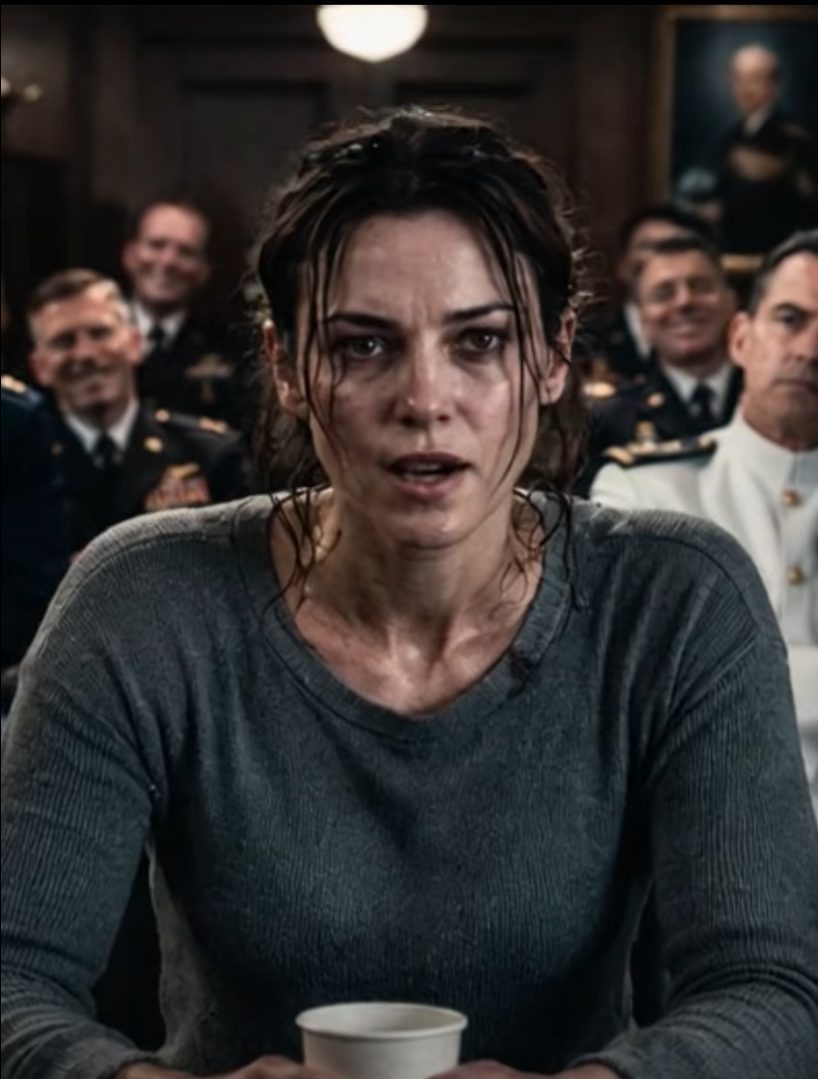
The first drop of water hit my cheek before I understood someone had thrown the cup.
It was cold – shockingly cold – and it slid down my jaw, soaked into the collar of my faded gray sweater, and disappeared beneath the fabric like a hand reaching for my scars. For one second, the courtroom went perfectly silent. Then someone in the back row laughed.
Not loudly. Not bravely.
Just enough.
A small, ugly sound from a man in dress whites who thought rank made cruelty elegant.
I did not wipe my face.
That bothered them more than anger would have.
Across the aisle, Captain Edward Hawkins leaned back in his chair, his white uniform immaculate, every ribbon polished like a medal won from someone else’s grave. He looked calm, almost bored, but I saw the flicker in his left eye. I had watched that same flicker once through a rifle scope, six hundred yards away, high above the valley in Kunar Province, while three men screamed over comms and Hawkins lifted off without them.
Lieutenant Commander Hayes, his defense counsel, smiled as if the water had proven his point.
“Miss Foster,” he said, “perhaps now we can return to reality.”
The officers behind him murmured.
Reality.
That was a dangerous word to use around someone like me.
I folded my hands on the table. They were steady. They always were. Even after fourteen surgeries, even after nerve grafts, even after waking up in a hospital bed with half my name blacked out in my own file, my hands had remained steady. The Navy had paid dearly to make them that way.
Hayes paced in front of me like a stage actor enjoying his final scene. “You expect this tribunal to believe you were a Tier-One designated marksman attached to an unacknowledged unit?”
“I do,” I said.
“You expect us to believe that you, dressed like this, with no visible rank, no military record available to this court, and no witnesses present to corroborate your claim, observed Captain Hawkins commit treason?”
“No,” I said softly.
Hayes stopped smiling.
“I expect you to believe the truth because it is the truth.”
A ripple moved through the gallery. Hawkins’s mouth tightened.
Hayes stepped closer. “You were listed as a logistics coordinator.”
“Yes.”
“A supply clerk.”
“That was my cover.”
His laugh cracked through the courtroom. “Your cover. How convenient.”
Behind me, someone whispered, “Ghost sniper.”
Another voice added, “She looks homeless.”
I stared at Hawkins.
He stared back.
For three years, I had dreamed of this room. Not the mahogany walls, not the flags, not the rows of polished shoes. I dreamed of his face when he finally realized one person had survived his lie.
Hayes lifted a folder. “Captain Hawkins has served this country with honor for twenty-two years.”
“So did the men he abandoned.”
His eyes sharpened. “Careful.”
“Why?” I asked. “Are the dead listening?”
The judge, Rear Admiral Voss, struck the gavel once. “Miss Foster.”
“Apologies, Admiral.”
But my eyes never left Hawkins.
Hayes moved in front of me, blocking my view. “Let us discuss what you claim happened.”
“Gladly.”
He opened the folder. “On October 17, 2021, Captain Hawkins ordered emergency extraction from Forward Ridge Line Four after hostile fire compromised the mission.”
“He ordered extraction before hostile fire reached us.”
“That is your claim.”
“That is what happened.”
“He saved thirty-two personnel.”
“He left three behind.”
Hayes leaned closer. “Names?”
My throat tightened for the first time.
Not because I had forgotten.
Because I had not.
“Staff Sergeant Owen Price. Petty Officer Miguel Alvarez. Corporal Daniel Keene.”
The names entered the courtroom like ghosts wearing blood.
For a moment, even the smug officers behind Hawkins shifted uncomfortably.
Then Hayes said, “All three died in enemy contact.”
“No,” I said. “They died waiting for a helicopter that turned away.”
Hawkins’s jaw flexed.
There it was.
A crack.
Hayes slapped the folder shut. “You have no proof.”
“I was the proof.”
“You were injured in a mortar attack.”
“I was hit after I stayed behind.”
“Again, convenient.”
“No,” I said. “Expensive.”
He blinked.
I raised my wet chin. “The government spent millions hiding what happened to me. You should ask why.”
The courtroom doors suddenly opened.
Not loudly. Not dramatically.
Just enough for every head to turn.
A man in a white admiral’s uniform stepped inside, and the air changed.
The Man Nobody Expected
I recognized him before most people in that room would have known to.
Vice Admiral Raymond Cobb. Retired. Sixty-three years old, built like a man who had never stopped doing the work, gray at the temples but not anywhere else. He had commanded Naval Special Warfare Command for six years before he put in his papers. He had also, in the autumn of 2021, signed the classified operational order that put me in Kunar Province.
He wasn’t supposed to be here.
I knew that because I had asked for him three times through my attorney, a tired woman named Donna Pruitt who had taken my case for a dollar and a bottle of good bourbon, and three times I had been told Cobb was unavailable. Traveling. Indisposed. Retired officers have no standing to testify in active tribunals without specific authorization.
He walked to the center of the room and stopped.
Rear Admiral Voss stared at him from the bench. “Admiral Cobb. This tribunal is in session.”
“I’m aware,” Cobb said. His voice was the same as I remembered it from two phone calls and one face-to-face meeting in a hangar outside Bagram in 2019. Flat. No performance in it at all.
Hayes had gone white around the collar.
Hawkins had not moved, but something behind his eyes had.
Cobb looked at Voss. “I’m requesting five minutes under SECDEF authorization 7714-Delta. You’ll find the paperwork with your clerk.”
Voss looked at his clerk, a young petty officer who was already holding a manila envelope and nodding like he’d just seen something fall from the sky.
The room waited.
Voss opened the envelope. Read it. Set it down with the careful movements of a man who has just been handed something heavier than it looks.
“You have five minutes, Admiral.”
Cobb turned. He didn’t look at Hayes. He didn’t look at Hawkins. He looked directly at me and said, “I’m sorry it took this long.”
The back of my neck went cold.
Not from the water. That had dried.
From the fact that someone had finally said it out loud in a room full of witnesses.
What I Carried Out of Kunar
There is a version of that day that lives in official documents. I’ve read it. Hawkins filed it himself, forty-eight hours after extraction, and it is a masterwork of omission. In his version, Forward Ridge Line Four was overrun by a coordinated enemy assault beginning at 1347 hours. In his version, the extraction was executed under fire, with full accounting of personnel, and the three KIAs were the result of enemy action sustained during the withdrawal.
Every word technically defensible. Every word a lie by arrangement.
Here is what happened.
At 1312 hours, Hawkins received intelligence that a second insurgent element was moving to cut off the ridge. That intelligence came from a source he did not trust, a local asset he had publicly dismissed twice that week. He made the call in under four minutes. Extraction, immediate, all personnel to the LZ.
At 1318, I was at my position, three hundred meters north of the main element, watching a tree line through a Schmidt and Bender scope. I heard the order over comms. I also saw, at that exact moment, Price and Alvarez moving to recover Keene, who had taken a round through the thigh twenty minutes earlier and couldn’t run.
I keyed my radio. Told Hawkins we had three personnel unable to reach the LZ in time.
He said, “Noted.”
That was the last word he said to me.
At 1329, I heard the helicopters.
At 1331, I heard them leave.
I stayed on that ridge for eleven hours. I watched the tree line. I kept Price and Alvarez and Keene alive through the first four hours. Then the mortar round found us, and after that I only kept two of them alive, and then one, and then I was alone in a shallow depression in the rock with a tourniquet on my left leg and Keene’s dog tags in my fist because he had asked me to hold them and I had said I would.
They found me at 0214 the next morning. A different unit. Different command entirely.
I woke up in Landstuhl three days later with my operational file reclassified and a logistics coordinator’s name on my wristband.
Donna Pruitt had spent eight months fighting just to get me into this room. Eight months of stonewalling, of document requests that came back redacted to the point of absurdity, of a DoD that kept insisting my records were either classified or nonexistent.
They had tried to make me a ghost.
The problem was I had been one before they tried, and I knew how to haunt.
Five Minutes
Cobb stood in the center of the room and spoke without notes.
He confirmed the operational order. He confirmed my unit, my designation, my position on October 17. He confirmed that he had received a post-action report from the recovery team that found me, a report that directly contradicted Hawkins’s filing, and that this report had been suppressed by two officers acting on Hawkins’s behalf, both of whom had since retired with full benefits.
Hayes was on his feet. “Admiral, the defense objects – “
“Sit down, Commander.” Voss didn’t raise his voice.
Hayes sat.
Cobb reached into his jacket and produced a single folded document. He handed it to the clerk without drama, the way you hand someone a receipt.
“Authenticated recording,” he said. “Cockpit comms, October 17, 2021, 1318 through 1334 hours. Chain of custody is documented in the exhibit notes.”
The room was very quiet.
I looked at Hawkins.
His face had gone the color of old concrete.
Because he knew what was on that recording. He had known it existed. He had believed, for three years, that it had been destroyed. I knew this because Donna Pruitt had a source inside the JAG office who had told her Hawkins’s legal team had spent considerable money and effort making sure of exactly that.
They had not been thorough enough.
Cobb looked at Voss. “I have nothing further.”
He turned to leave.
And then he stopped.
He turned back, and he looked at me, and he came to attention, and he saluted.
Full. Formal. The kind you give to someone whose rank you respect, not whose face you know.
I sat in my faded gray sweater with dried water on my jaw and I held it together because I had held it together on a ridge in Kunar for eleven hours and I was not going to stop now.
But my hands, for the first time in three years, were not entirely steady.
After the Gavel
The tribunal recessed at 2:47 in the afternoon.
They reconvened at 4:15.
I won’t walk through all of it. Donna can tell that part better than I can, and she’s writing her own account, and she deserves the space. What I’ll say is that the recording was exactly what Cobb said it was. Hawkins’s voice, clear as a winter morning, saying “Noted” when told three of his people couldn’t make the LZ. Then nothing. Then the sound of rotors.
Thirty-one seconds of silence on a cockpit recording is a long time.
The tribunal found sufficient cause to proceed to court-martial.
Hawkins was escorted out by two MPs who looked young enough to be his grandchildren. He did not look at me as he passed. I had expected something, some final flicker in that left eye. There was nothing. Just a man in a white uniform walking toward a door he hadn’t planned on.
Hayes gathered his papers without speaking.
The gallery emptied in pieces.
Donna put her hand on my shoulder and said, “Drink?”
“Yeah,” I said. “Somewhere that isn’t here.”
We walked out through a side door and into a parking lot that smelled like asphalt and October, and I stood in the cold for a minute with my face tilted up.
Owen Price was from Harrisburg, Pennsylvania. He had a daughter named Becca who would be seven now. I knew this because I had found his sister on Facebook two years ago and I had read everything she posted about that little girl and I had never said a word to either of them because I didn’t know yet if I would have anything worth saying.
Miguel Alvarez was from Laredo. His mother still left comments on a memorial page that a veteran’s group had set up. Short ones. Usually just his name.
Daniel Keene was from a town in eastern Oregon so small it doesn’t show up on most maps. He had wanted to open a fishing guide service when he got out. He talked about it on the ridge, in the dark, while I was keeping pressure on his leg and trying not to show him how bad the math was.
I have his dog tags.
They’re in a box in my apartment in Raleigh, inside a wool sock, inside a coffee can with a plastic lid. Not because I’ve forgotten them. Because I open that can sometimes and I need them to still be there.
They always are.
Donna handed me a cigarette she knew I wouldn’t smoke and lit one herself. “You okay?”
“Ask me in a year,” I said.
She nodded. That was the right answer and she knew it.
Somewhere across the parking lot, a door opened and closed. Voices. The ordinary sound of a day ending.
I put the unlit cigarette in my jacket pocket.
Keene had wanted to show me the river he grew up on. Told me the name of it twice so I’d remember. Said the cutthroat trout there were so thick in late summer you could practically walk on them, which was obviously a lie, but the way he said it made you want it to be true.
I still have the name of that river.
I’m going to find it.
—
If this one stayed with you, pass it along to someone who needs to read it.
For another incredible story of defiance, check out The Woman Who Dropped a Master Chief in Front of Four Hundred SEALs.



