
The Georgia clay didn’t just stain your boots; it seeped into your pores, heavy with pine, sweat, and the suffocating humidity of Fort Mercer. For six weeks, I had survived basic training by mastering the art of being invisible. At barely five-foot-two and weighing less than a standard-issue rucksack, I wasn’t a soldier anyone looked at twice.
That was exactly how I wanted it.
Every morning, before the bugle even thought about waking the rest of the barracks, I rolled my right sleeve up exactly three inches above the elbow. My left sleeve stayed buttoned down to the wrist, secured with a small, rusted safety pin hidden beneath the seam. An obsessive ritual.
That, and staring strictly at the third button of whoever stood in front of me. If you never meet their eyes, they can never see the ghosts lingering in yours.
Recruit Donnie Miller was a legacy. Six-foot-four, shoulders that blocked out the sun, a long line of infantrymen behind him, and an arrogance the drill sergeants mistook for leadership.
To him, my silence wasn’t submission. It was defiance.
He didn’t use his fists. The military had rules now. He used his mass. His shadow. His suffocating presence. During chow, he’d bump my tray so scalding coffee spilled across my knuckles. “Oops, didn’t see you down there, ghost.” During low-crawls, he’d kick storms of red dust into my face until I choked.
I took it all. Every insult. Every “accidental” shove. Every sabotaged bunk.
Because reacting meant questions. And questions meant answers I could never, ever give.
I let them think I was weak. A terrified little girl who’d made a mistake walking into a recruiter’s office.
It was better that way.
But the phantom itch beneath my left sleeve was getting worse.
It always flared when my heart rate spiked – a psychosomatic burn reminding me of a life built on classified coordinates, shattered glass, and the smell of burning jet fuel. A team I couldn’t save. Fort Mercer was supposed to be a fresh start. A blank slate disguised as a grunt.
Week six was the crucible.
We’d just finished a brutal twelve-mile ruck through the sweltering backwoods. Platoon 3 stood in ragged columns in the staging yard, chests heaving, packs still digging into our shoulders.
I stood perfectly still. Eyes on the third button in front of me. Breathing in counts of four. My thumb brushed the hidden safety pin at my wrist.
Miller was pacing near the back, flushed and furious. He’d struggled on the final hill while I’d simply put one foot in front of the other, an unbothered metronome.
He hated that.
“You think you’re something special, Vance?” His voice boomed across the dusty yard.
I didn’t move. I didn’t blink.
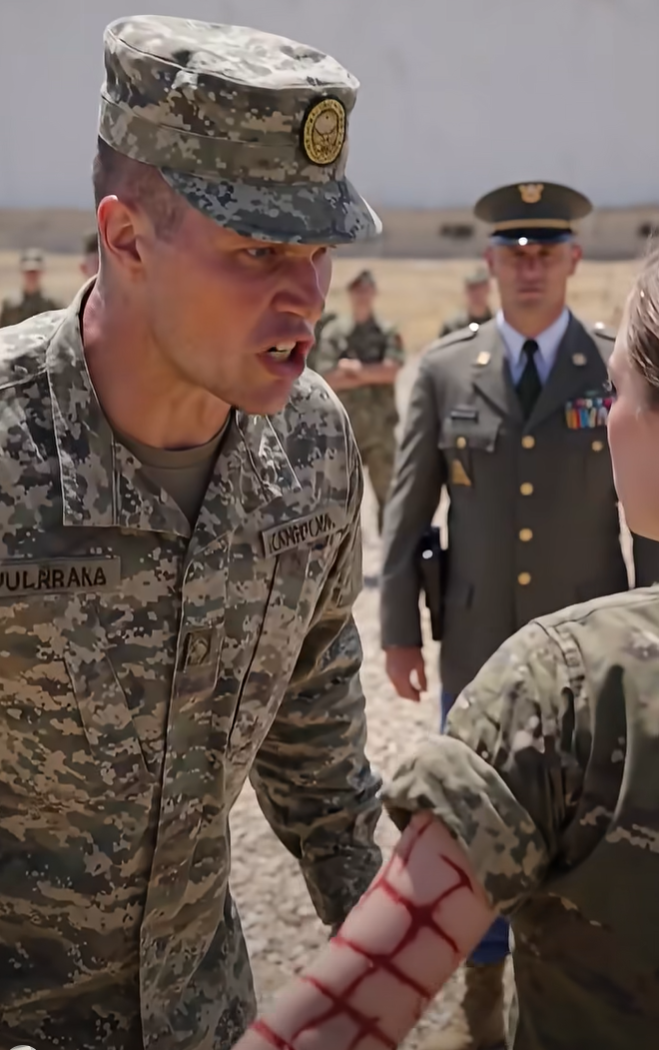
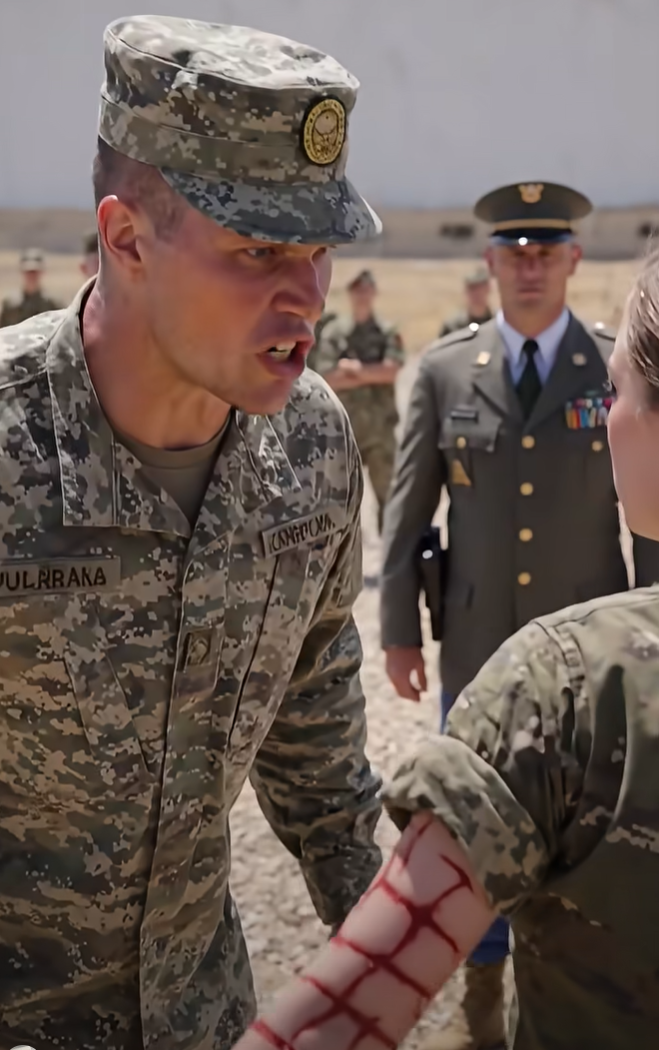
“HEY!” He closed the distance in three heavy strides. The recruits around us subtly stepped back, wanting no part of it. “I’m talking to you, you little mute. Six weeks of this act. You don’t belong here.”
He stepped squarely into my personal space, chest practically against my face, trying to physically dominate me into looking up.
I kept my gaze leveled at his chest rig.
“Look at me when I’m talking to you,” he snarled.
Silence. Just the wind kicking up red dirt.
Infuriated, Miller snapped. He didn’t punch me. He reached down with a massive, dirt-caked hand and grabbed my left wrist, intending to drag me out of the formation line.
“I said – “
He yanked.
My instinct, buried under months of suppression, flared faster than conscious thought. I planted my back foot and twisted my center of gravity to break his grip – a kinetic reflex drilled into me in a place that doesn’t appear on any map.
The rusted safety pin snapped.
A sharp, loud RIIIP echoed across the yard. The entire left sleeve of my OCP uniform tore open from the cuff all the way past the elbow, fluttering uselessly in the hot wind.
Miller stumbled back, a triumphant sneer starting to form.
It died instantly.
He looked down at my exposed arm. The blood drained from his face. He dropped his hand like he’d touched a hot stove and took a stumbling step backward, his mouth opening and closing without a sound.
The recruit next to him looked over. Gasped. A sharp, choked sound of pure horror.
Within seconds, the exhausted murmurs of the platoon died completely.
Fifty recruits stood frozen, eyes locked on my left arm.
It wasn’t just a scar. It was a roadmap. Deep, jagged keloid tissue wrapped around my forearm like brutalized barbed wire, weaving through the unmistakable, perfectly circular burn marks of a high-voltage interrogation matrix.
But worse than the scars was what was permanently branded into the center of the ruined flesh.
A jagged, pitch-black insignia. A scythe wrapped in chains.
The ghost mark.
Nobody moved. The air itself turned to ice despite the ninety-degree heat. Miller was trembling, staring at the tiny, quiet female recruit he’d been tormenting – suddenly realizing he’d been repeatedly kicking a sleeping dragon.
I stood perfectly still, breathing unchanged, the torn sleeve catching in the wind.
The false peace was gone. The camouflage was destroyed.
Footsteps crunched heavily on the gravel.
The crowd of terrified recruits parted like the Red Sea. Stepping through the gap was Colonel Briggs – the silver-haired base commander of Fort Mercer. A man who rarely left his command post. A veteran with eyes as cold as steel who had seen three different wars.
He walked slowly into the center of the formation. Stopped three feet from me. His cold eyes drifted from my face down to the torn, fluttering fabric of my sleeve.
He looked at the jagged scars.
He looked at the pitch-black scythe.
And then the legendary Colonel Briggs — a man who’d stared down dictators and warlords without flinching — did something that made every single recruit in that yard forget how to breathe.
He dropped to one knee in the red Georgia dirt.
His voice cracked when he finally spoke, loud enough for every recruit to hear. And what he called me wasn’t “Recruit Vance.”
It was a name nobody on that base was ever supposed to hear out loud again.
“Specter.”
A single word. A lifetime of secrets blown open by the Georgia wind. It was the codename I had carried through a dozen undeclared conflicts. The name my old team had called me.
The name of a dead woman.
A ripple of confusion went through the platoon. They didn’t understand the word. But they understood the posture of the man who said it.
A Colonel does not kneel to a recruit. Ever.
Colonel Briggs pushed himself up, his knees popping audibly. His face was a mask of unreadable emotion.
“Sergeant,” his voice was steel once more, cutting through the silence. “Dismiss the platoon. Confine them to the barracks. No one leaves. No one communicates off-base. Total information lockdown, effective now.”
“Sir!” The Drill Sergeant, who had been frozen in shock, snapped to life.
“Recruit Miller,” Briggs said, his eyes never leaving me. “You stay.”
He finally looked at Miller, and for the first time, I saw genuine fear on the big man’s face. It wasn’t the fear of getting a dressing down. It was the primal fear of having stumbled into a world of monsters and realizing you were the smallest one there.
Briggs turned back to me. “With me, Vance,” he said, using my cover name. The formality was a thin veil over the earthquake that had just happened.
I gave a short, sharp nod, my training taking over. I fell into step behind him, my torn sleeve fluttering like a surrender flag I didn’t feel.
We walked across the yard, the gravel crunching under our boots. I could feel fifty pairs of eyes on my back, and the a-thousand-yard stare of Donnie Miller, who was still standing there like a statue.
The Colonel’s office was spartan, all polished wood and military commendations in neat glass frames. It smelled of old paper and stale coffee.
He shut the door, the click of the lock echoing in the room. He didn’t tell me to stand at ease. He didn’t have to. The rigid rules of recruit versus commander no longer applied here.
“Sarah,” he said, his voice softer now. He used my real name. “What in God’s name are you doing in my basic training platoon?”
I didn’t answer. I just stood there, looking at a framed photo on his desk. A smiling young man with the Colonel’s eyes.
“They listed you as KIA,” he continued, walking over to a small cabinet. “Killed in action six months ago. Along with the rest of your team. We held a memorial. Not a real one, of course. Just a few of us who knew. We drank a toast to you. To Ghost Team Alpha.”
He pulled out a bottle of dark amber liquid and two glasses. Uncorked it. He poured two fingers in each.
“I never believed it,” he said, handing me a glass. “Not you. You were always too stubborn to die.”
My hand trembled as I took the glass. The ice clinked. “The intel was bad, sir.” My voice was rusty, unused to holding a real conversation.
“I know,” he said, taking a long sip. “Operation Nightingale was a catastrophe.”
The name of the mission hit me like a physical blow. The phantom itch on my arm flared into a fire. I saw the flash. Smelled the burning fuel. Heard the screams of my team.
“It was my call,” I whispered, shame choking me. “I led them into a trap.”
“No,” Briggs said, his voice firm, cutting through my guilt. “You were fed a lie, Sarah. You all were. We learned later the intelligence wasn’t just bad, it was deliberately compromised. Someone on our side sold you out.”
I stared at him, my mind struggling to process it. For six months, I had carried the weight of that failure. I had believed my mistake got everyone killed. That guilt is why I was here.
I had tried to erase Sarah, the failed team leader. I became Recruit Vance, a nobody, a ghost in the truest sense. I chose the harshest, most humbling path I could think of—basic training—to strip away my identity, to punish myself, to start from zero.
“Why are you here, sir?” I finally asked. “Fort Mercer is a training command. A place they send old soldiers to pasture. Not a place for the architect of the Specter Program.”
A flicker of pain crossed his face. He looked back at the photograph on his desk.
“That mission… Operation Nightingale,” he started, his voice thick. “It wasn’t just about recovering a stolen asset. The target you were sent to rescue… was my son. Robert.”
The glass nearly slipped from my hand. I looked at the smiling young man in the photo again. Robert Briggs. The CIA analyst we were supposed to extract. The one who had the intel that could stop a war. The man I watched die.
Or so I thought.
“He wasn’t just an analyst, Sarah,” Briggs continued, answering the question I couldn’t ask. “That was his cover. He was deep, trying to uncover the traitor who was selling our secrets. He knew they were closing in on him. He left a trail… a protocol only a Specter would understand. But they got to him before you could.”
I closed my eyes. The weight on my chest doubled. I hadn’t just lost my team. I had failed to save his son.
“I am so sorry, sir.” It was all I could say.
“Don’t be,” he said, and the intensity in his eyes startled me. “That’s why I’m here. That’s why I took this command. After the official channels declared him dead, I started my own investigation.”
He opened a locked drawer in his desk and pulled out a thin file. He slid it across the polished wood toward me.
“Two months ago, I got this. A whisper from an old contact. A rumor of a high-value prisoner being held in a black site in the Urals. A prisoner who fits my son’s description.”
He leaned forward, his hands flat on the desk. “The official channels won’t touch it. To them, Robert is dead, and Operation Nightingale is a closed book. But I know he’s alive. And the traitor… they’re still out there. Probably closer than we think.”
It all clicked into place. The reason he was here. The reason he looked at my arm not with horror, but with something else.
Hope.
“I was trying to find a way to get to you,” he said. “To pull you out of whatever hole you’d crawled into. And then, by some miracle, your name popped up on my enlistment roster. Recruit Vance. A woman with no past, no family, no digital footprint. A ghost.”
I opened the file. Inside was a satellite image of a grim, snow-covered compound. And a single, blurry photograph. A man being led between two guards. His head was down, but I recognized the set of his shoulders.
I’d studied his file for weeks before that final mission. It was Robert Briggs.
“I need a ghost, Sarah,” the Colonel said, his voice low and desperate. “Someone who is officially dead. Someone who can move through the shadows without a flag on their shoulder. I need someone to finish what Ghost Team Alpha started. I need you to go get my son.”
For the first time in six months, the phantom itch on my arm stopped. The fire was replaced by a cold, clear purpose.
This wasn’t about running anymore. It wasn’t about penance. It was about redemption. For my team. For Robert. For myself.
“What about Miller?” I asked, my voice steady now.
A grim smile touched Briggs’s lips. “Recruit Miller is about to receive the most intense, personalized education of his young life. He wanted to see a real soldier. Well, he’s going to be your new personal aide.”
My eyebrow arched. “My aide?”
“He’ll carry your pack,” Briggs said, the karmic justice sweet in his tone. “He’ll clean your weapon. He’ll fetch your coffee. He will be your shadow, and in doing so, he will learn the meaning of humility and respect. He will learn that the most dangerous people are often the ones you never see coming.”
I thought of Miller’s arrogant sneer. The thought of him being assigned to me was a more fitting punishment than any court-martial.
“Sir,” I said, closing the file. I slid it back across the desk. “I’m not Sarah anymore. And I’m not Recruit Vance.”
I looked him straight in the eye. “I’m Specter. And I have a mission to complete.”
Colonel Briggs nodded, a deep sense of relief washing over his features. “Welcome back, Specter.”
The next few days were a blur. I was officially removed from Platoon 3 due to a “training injury”. The story was that I had washed out.
My new reality was a windowless room in the bowels of the command building, filled with maps and surveillance feeds. And, as promised, my shadow was Donnie Miller.
He showed up the first day, pale and silent, his usual swagger completely gone. He wouldn’t meet my eye.
“Report,” I said, not looking up from a schematic of the Ural black site.
“Uh, Recruit… Ma’am… Miller reporting… for duty?” he stammered.
I pointed to a stack of gear in the corner. “My ruck has to be packed for arctic conditions. Weight is sixty pounds, not an ounce over. All non-essential items stripped. Re-waterproof every seam. I want it done in one hour.”
He just stared. “Yes, ma’am.”
For a week, I worked him to the bone. He ran my errands, transcribed my notes, and stood guard outside my door. He watched as generals and men in dark suits came and went, treating me with a deference that clearly broke his brain.
One night, I found him staring at a photo of my old team that I’d pinned to the wall.
“They were your friends?” he asked quietly.
“They were my family,” I replied.
He was silent for a long moment. “I’m sorry,” he said, finally looking at me. The arrogance was gone, replaced by a shame so profound it was almost pitiful. “For how I treated you. I was… an idiot.”
“Yes, you were,” I said simply. “But you’re learning.”
He had no idea how right he was. He was learning that strength wasn’t about size or a loud voice. He was learning that the uniform doesn’t make the soldier.
Two weeks after my sleeve ripped, I was standing on a foggy tarmac, a black, unmarked jet idling behind me. Colonel Briggs was there to see me off.
Miller stood a few paces back, holding my go-bag. He walked forward and held it out to me.
“Good luck, ma’am,” he said. The word ‘ma’am’ sounded different now. It held weight. It held respect.
I took the bag and simply nodded.
Briggs clapped a hand on my shoulder. “Bring him home, Specter.”
“Yes, sir,” I said. “We finish what we start.”
As I walked up the ramp into the jet, I felt no phantom itch. My scarred arm was just a part of me, a map of where I had been. It no longer defined me. The ghosts of my past were no longer haunting me. They were flying with me, my silent partners on one last mission.
The journey taught me that we are not defined by our failures, but by how we rise from them. Running from your past is a cage of your own making, but turning to face it, no matter how terrifying, is the only way to be truly free. True strength isn’t the absence of scars; it’s the courage to wear them as a testament to the battles you’ve survived.



