
A Tense Beginning No One Planned
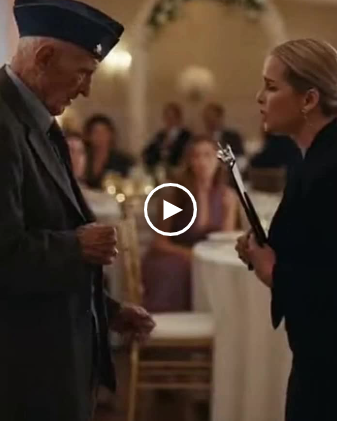
They told the old veteran to leave the wedding. He stood near the doorway, hat folded in his hands, shoulders straight despite the years. His jacket was neat but worn at the seams, the kind of coat that had seen more doorways and more long nights than any of the glimmering tuxedos in the room. He did not argue. He did not raise his voice. He simply waited, as if waiting were something he had learned to do a very long time ago.
The hall was bright and full of joy. Clinking glasses, laughter, the soft rustle of dresses passing by. Yet near the entrance, the air was tight and cool. Brenda, the planner with the clipboard, had a firm voice that carried. She said the guest list was final. She said he was not on it. She said rules were rules, and the head table was reserved for family.
Family. The word hung there, heavy and awkward, as if it did not know which way to fall. The veteran, Thomas, lowered his eyes and nodded, almost relieved to be told what to do. It was how he had lived most of his life. Follow orders. Make room for others. Slip out quietly when it seemed best for everyone else.
But this time, he was not alone by that door. Six men in dark suits stood nearby, men who walked like athletes but watched like sentries. Their hands were steady, their faces lined not by age but by experience. They noticed everything. They stepped closer to Thomas, not to surround him, but to stand with him.
The Empty Chair at the Head Table
One of those men, the youngest among them, cleared his throat and pointed across the room toward the glowing front of the hall. There, at the head table, sat an empty chair with a crisp white napkin folded like a little flag of welcome. The space felt intentional, a quiet pause on a line of music.
He pointed to that chair and spoke in a voice that was careful and respectful. He said the groom had invited the man by the door. He said the seat was not an oversight. And then he said the thing that cracked the air in two.
He said the groom had invited Thomas because Thomas was his father.
The room changed. It was like someone had opened a window during a storm. Sound fell away, then rushed back in a wave of whispers and soft astonishment. Brenda’s mouth opened, then closed again, as the color drained from her face. People turned in their seats to see the man by the door with the folded hat and the tired but steady eyes.
Thomas blinked, as if the world had been too far away for too long and had only now stepped into focus.
A Son’s Voice Finds Its Way Home
Before anyone else could speak, the groom himself appeared, breathing hard, bow tie loose, eyes bright with feeling. He slipped past Brenda’s clipboard, past the uncertainty, and went straight to the only place that mattered. He put his arms around the old man and held him like a promise kept late but still true.
“Dad,” he said, his voice breaking in the middle. “I didn’t think you’d come.”
For a moment Thomas did not move. He stood like a soldier standing a final watch, unsure if what he was seeing belonged to memory or to mercy. Then something inside him softened. Slowly, as if his bones needed permission, he raised his arms and returned the embrace. He closed his eyes. He breathed.
“I didn’t think I should,” he answered quietly. “Not after all that time. I didn’t want to ruin your day.”
“You didn’t ruin it,” the groom whispered. “You made my day.”
Applause began at the edges, a brave pair of hands willing to sound foolish if it meant giving courage to the rest. Then more hands joined, and the clapping rose like a tide, warm and unpolished, coming from somewhere deep and honest. It drowned out the music, the whispers, even Brenda’s sputtering shock.
What Was Left Unsaid for Years
When the room finally settled, Thomas searched his son’s face, as if trying to fit the man in front of him into the last clear picture he had of a boy. He spoke with the halting care of someone stepping over broken glass.
“You told me you didn’t want anything to do with me,” he said. “You were fourteen. You slammed the door. You said I was nothing but a ghost with medals.”
The groom nodded, eyes shining. “I was angry. I didn’t understand. Mom never told me why you vanished for months and came back looking through everything like it wasn’t there. I thought you didn’t want to be my dad.”
Thomas looked down. The guilt was plain and human and heavy. “I always wanted to be your father. I just didn’t know how. Not after the war. I didn’t know how to come back.”
What His Brothers-in-Arms Knew
The six men who had stood watch by the door stepped back to give the two space, then formed a quiet half-circle that felt less like a wall and more like a blessing. The youngest among them spoke again, addressing the groom with a gentle steadiness.
“Sir,” he said, “your father wasn’t perfect. None of us are. But when we were pinned down, he crawled back into fire to reach us. He carried us when we couldn’t walk. We are here because of him.”
An older man, hair silvered at the temples, lifted his chin. “The words ‘leave no man behind’ aren’t just printed on a patch,” he said. “Thomas lived them. Even when the order was to fall back. Even when he was already hurt. He stayed. He refused to let go.”
The room was still again. Even the clink of glass on glass paused, hanging in the air as if listening.
The groom drew a breath and wiped a tear from his cheek. “I didn’t know. No one told me,” he said. “Mom said you chose duty over family.”
Thomas nodded once. “I didn’t choose to go,” he said softly. “I was drafted. I tried to balance both, but the war took more than I understood. When I came back, the papers were already filed. I thought leaving it alone would be easier for you.”
“You were wrong,” the groom said, not with anger, but with a quiet sadness that asked to be healed rather than argued with.
A Chair Becomes a Place
The groom turned toward the front of the room and reached for the microphone the DJ had left on the stand. The guests leaned in, not out of curiosity, but because something meaningful was happening and they did not want to miss a word.
“Everyone,” he said, voice steadying as he spoke, “this man is the reason I’m standing here. Not only because he is my father by blood, but because the men who taught me honor and brotherhood all said the same thing about him. They told me to be proud of where I come from. Today, I finally understand why.”
He walked back to Thomas and took his hand as if taking it for the first time. “Dad,” he said, “will you sit with me at the head table? Not as a guest. As family.”
Thomas shook his head a little, overwhelmed. “I don’t deserve it,” he whispered, the words pulling at old knots of shame.
“You do,” his son said, not letting go. “You have carried the weight of other people’s lives. You’ve carried the weight of your own silence. Today, set it down. Sit with me. Just be here.”
The six men nodded. The guests nodded. Even those who did not know either man felt the rightness of it. Thomas lifted his eyes to his son and found a welcome there that did not ask him to earn a thing.
“All right,” he said, almost to himself, like a man who has been standing in the rain and suddenly feels the sun.
The Planner Fades, The Family Gathers
As the two of them walked toward the head table, Brenda slipped behind a column, clipboard hanging uselessly by her side. The rules that had seemed so important a few minutes earlier looked small next to the simple truth of a father and son walking side by side.
The bride stepped forward with a smile that reached her eyes. She hugged Thomas as if she had always known him, without a second of doubt or distance. “I’m so glad you came,” she whispered. “He needs you more than he ever says.”
The DJ, unsure how to score a moment like that, reached for a classic. Sinatra’s voice filled the hall, warm and familiar, like a favorite blanket pulled from a cedar chest. A few couples, older and younger, began to sway, hands finding hands, worries loosening their grip.
The six men took their seats nearby. Their eyes stayed alert, the way old habits refuse to retire, but their faces softened, as if they too had just set down something heavy.
Words for the Man Who Stayed
During the toasts, one of the men stood and asked, with a trace of formality that felt right, for permission to speak. The groom nodded, lifting his glass, and the room turned toward the voice that had started the shift an hour earlier.
“To Thomas,” the man said, raising his glass. “A hero when things were loud and dangerous. And, from what we have seen here today, a hero when it is quiet and hard. May we find the courage to face what we ran from and step back into the lives we thought were closed to us.”
The applause came again, but now it was fuller, grounded by understanding. It was not for one man alone. It was for the hope that sits beside every empty chair in every room where love is trying to make a way.
Learning to Breathe in the Same Room
Thomas tried to smile and found instead a tightness in his throat that whispered of long roads and long nights. His son put a hand on his shoulder, not to steer him, but to settle him. “You’re not alone anymore,” the groom said. “You never were, Dad. You just forgot how to come home. I will help you remember.”
What followed was not a spectacle. It was something gentler. Laughter began to replace the tension that had arrived at the door. Guests came forward, not in a rush, but one by one, offering a hand, a thank-you, a small story of their own father, brother, or neighbor who had gone away and come back changed. A few brought their children to shake the veteran’s hand and look into his eyes, as if to teach them that courage has a face and a heartbeat.
Thomas never made the moment about war. He rarely spoke of battles or maps or timelines. He spoke instead about the quiet things that last. He spoke of resilience, of the kind of brotherhood that shows up at your door and stays until morning, of mistakes that ask for another chance and receive it.
Why This Night Mattered
For many in the room, the evening touched on something they could feel but not name. It was the relief of watching a knot loosen that had been pulled tight for years. It was the reminder that age does not make us strangers to longing. That time can take, but it can also give back, sometimes all at once, in a sudden rush of clarity under warm lights and familiar music.
Some guests wiped their eyes, not because the story was sad, but because it was good in a way that costs something. They thought of calls not yet made and doors not yet knocked upon. They thought of their own empty chairs and what it would mean to fill them again.
A Seat at the Table, At Last
Near midnight, the newlyweds took to the floor for a final dance. The room was softer now, the kind of softness that comes after truth has been spoken. The music wrapped around them like a promise. The groom’s gaze drifted to the head table where Thomas sat, not stiff anymore, just still, hands resting, eyes taking it all in.
He watched his son and new daughter-in-law move together, not as an outsider, not from the shadows, but from a place earned by love and given by grace. And then the bride, with the ease of someone who understands how healing works, waved him over with a grin.
“Come on, Dad,” she called, her voice bright and warm. “It isn’t a real wedding until we all dance.”
There was a breath of hesitation, the reflex of an old hurt asking if it was truly safe. It lasted no more than a second. Thomas rose, setting nothing aside because there was nothing left to carry. He walked to the floor.
The groom met him there. The bride met him there. The six men stood from their table and stepped closer, not to watch, but to join. It became less a dance than a homecoming. Smiles broke in places that had been guarded for too long. Shoulders lowered. Jaws unclenched. The music was not just heard; it was believed.
Home, Spoken Out Loud
What happened under those string lights was simple, the way good things often are. A father and his son moved in time with a tune older than both of them. A bride welcomed the past without fear that it would steal from the future. Friends stood near, keeping watch the way friends do. And in the middle of it all, an old veteran stood not as a relic or a guest to be managed, but as family.
Thomas smiled, truly smiled, the kind of smile that uses the whole face and reaches places words cannot. He looked like a man who finally believed he belonged at the table, on the dance floor, and in the photographs that would be framed and placed by the front door.
It did not erase the lost years. It did not pretend that the hurt had never visited. But it did something nearly as precious. It named the truth that had been waiting in an empty chair. It said, as clearly as music and warm light can say anything, that it is never too late to be found and never too late to return.
What They Will Remember
Long after the last song faded and the lights dimmed, people would drive home and try to tell the story. They would mention the planner with the clipboard and how rules matter until love asks for room. They would describe the six men who stood like a half-moon, holding space for a reunion to unfold. They would recall the bride’s embrace, the groom’s steady hand, and the toasts that made it safe to hope.
But mostly, they would remember the look on a father’s face when his son said the word “Dad” like it still fit. They would remember that applause that rolled in waves, washing away what had collected at the doorway. And they would remember how a simple invitation to sit became a bridge over years of silence.
Before the night ended, a few last guests stopped by the head table to shake Thomas’s hand. He met every grip with a steady hold, every eye with a gentle nod. He did not promise he would be perfect from now on. He did not rewrite the past. He accepted what was given and offered what he had left, which turned out to be more than enough.
Belonging, Finally
When at last the music disappeared into the quiet and the chairs stood empty again, the truth remained. They had told the old veteran to leave the wedding. And then the people who mattered most told him to stay. They asked him to sit. They asked him to dance. They asked him, without conditions, to come home.
Under twinkling lights and tear-bright eyes, that is exactly what he did. He did not leave as a stranger, or a problem to be solved, or a name not found on a list. He left as what he had been all along, waiting for someone to speak it out loud. He left as family.



