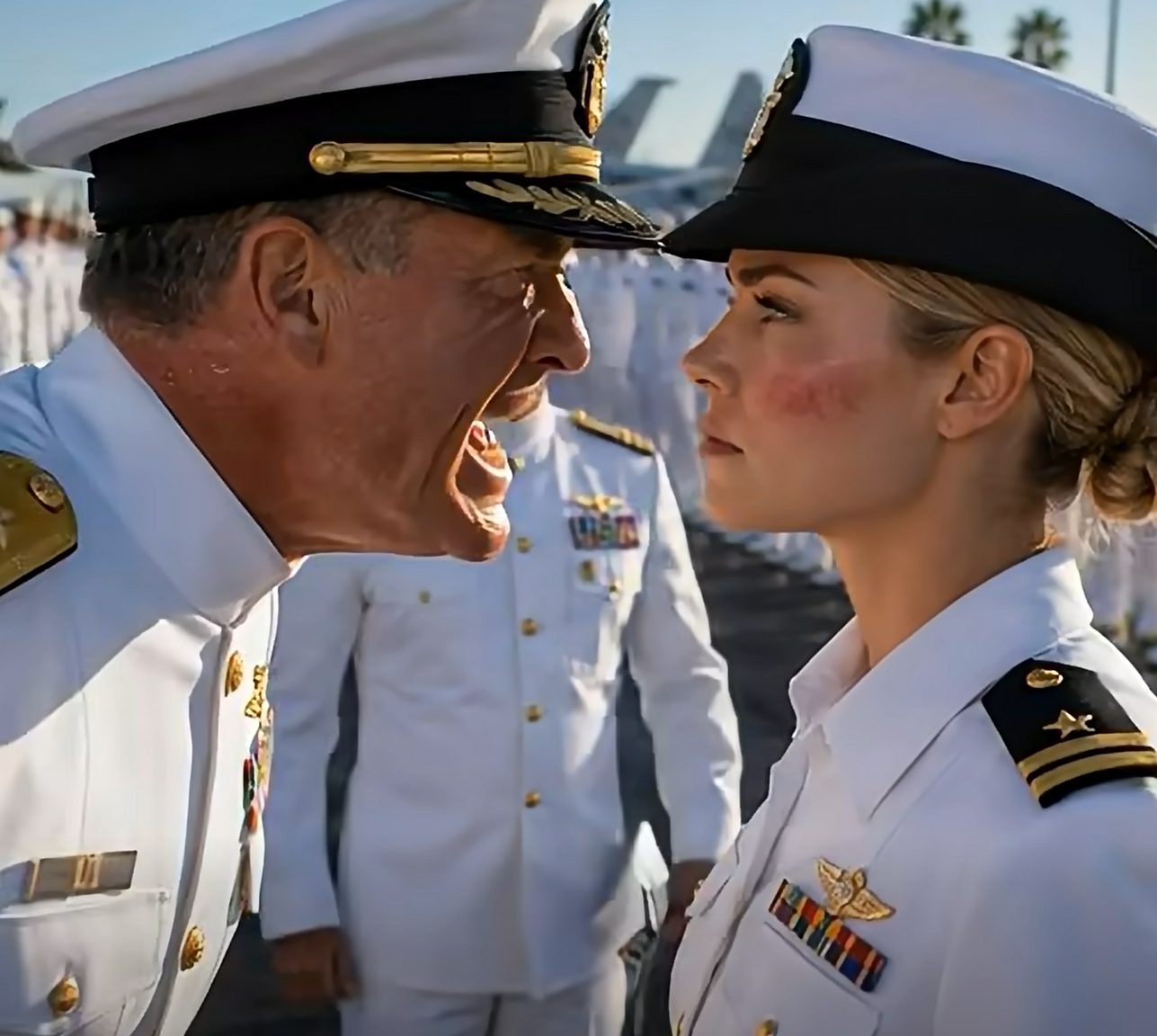
“Look at me, Lieutenant!” Admiral Nathaniel Graves roared. Then his hand crashed across my face with such brutal force that five thousand troops fell completely silent.
The sound of the slap cracked through the airfield like a gunshot.
For one impossible second, an entire military base forgot how to breathe.
A hard Pacific wind swept across the tarmac, carrying the sting of saltwater, jet fuel, and scorched rubber from a naval station that never truly slept. Endless rows of sailors, Marines, intelligence officers, logistics crews, and special warfare personnel stood frozen beneath the unforgiving California sun. Their white uniforms reflected sharply against the black pavement, making the entire formation look surreal, almost staged, like a flawless military portrait moments before disaster.
Lieutenant Hannah Carter never moved.
A deep crimson mark slowly spread across her cheek where Admiral Graves had struck her. Yet she never lifted a hand to touch the wound. She did not stumble backward. She did not flinch. She did not react at all.
And somehow, that frightened everyone even more.
Every person standing on Naval Amphibious Base Coronado understood exactly what they had witnessed. A powerful three-star admiral, newly promoted and swollen with authority, had just hit a subordinate officer in front of thousands of military personnel.
Veterans who had survived firefights in countries most civilians could not pronounce stood stiffly with locked jaws and burning eyes. Younger officers stared at the pavement, terrified that visible shock alone might destroy their careers. Somewhere near the front formation, Commander Ethan Moretti’s clipboard slipped from his shaking hands and slammed against the asphalt with a crack that sliced through the silence.
Nobody moved to pick it up.
Nobody dared move at all.
Admiral Graves stood rigid in front of Hannah, breathing heavily through his nose. The fury in his expression had not faded yet, but something else had begun creeping into his face.
Uncertainty.
Because Lieutenant Hannah Carter was staring directly at him.
Not angrily.
Not fearfully.
Not even with hatred.
Her gaze held something far worse.
It was the cold, measured focus of someone silently deciding whether another human being deserved mercy.
Far behind the formation, four DEVGRU operators stepped forward at the exact same moment.
Not far.
Barely noticeable.
But enough.
Enough for the men beside them to tense instantly. Enough for the atmosphere to shift in a way nobody could explain aloud. The operators were massive men with broad shoulders, scarred hands, and the stillness of predators. Their faces were darkened by years beneath foreign suns. Violence lived naturally in their posture.
When their boots scraped softly against the asphalt, dread rippled through the ranks behind them.
Hannah never looked back.
She moved only two fingers at her side.
A tiny gesture.
A silent order.
Stand down.
The four operators stopped immediately.
Every muscle in their bodies locked into place once more.
Admiral Graves never noticed.
He was too consumed trying to survive the eyes of the woman he had just hit.
The Man Who Confused Fear for Respect
The morning had begun as theater.
Everything about it had been carefully staged for Admiral Graves’s arrival. This was supposed to be his grand public introduction as the new senior authority overseeing a sweeping realignment of Navy operational command across the West Coast.
He had demanded a full base-wide muster before sunrise.
Five thousand personnel had been ordered onto the tarmac before dawn touched the horizon. Every uniform had to be perfectly pressed. Every ribbon aligned precisely. Every cover positioned at regulation angle. No sunglasses were permitted. No water bottles could remain visible. No slouching would be tolerated.
No exceptions.
Graves believed deeply in spectacle.
He believed fear created discipline more effectively than loyalty ever could. He believed troops functioned best when they were intimidated into obedience. Over three decades, he had built an extraordinary career inside Washington’s polished corridors of power, where survival depended less on courage and more on manipulation.
He knew which committees controlled funding.
He knew which senators demanded praise.
He knew which investigations could disappear beneath enough bureaucratic language.
To the American public, Admiral Nathaniel Graves was a decorated patriot draped in medals and honor. To many who had served beneath him, he was something colder.
A bureaucrat wearing stars.
A man who understood optics better than sacrifice.
Combat itself disgusted him. Not because it was dangerous, but because it was messy. Real war involved exhausted men, blood-soaked uniforms, impossible decisions, and consequences cameras could not sanitize. Graves preferred maps, polished conference rooms, strategic briefings, diplomatic receptions, and carefully staged photographs aboard carriers he had never truly fought from.
He loved order because order photographed beautifully.
He loved obedience because obedience required no imagination.
Most of all, he loved silence.
That immediate, fearful silence that spread whenever he entered a room.
That morning, he walked through the endless ranks of personnel as though inspecting government property instead of human beings. His polished shoes reflected the morning sunlight. His chest glittered with ribbons earned across a carefully cultivated career. Two junior officers followed several paces behind him, carrying tablets and folders while struggling to keep up with his pace.
The airfield had already become unbearable by seven in the morning.
Heat shimmered upward from the pavement in restless waves. Sweat collected beneath stiff collars and body armor. The scent of fuel drifted constantly from nearby aircraft operations. Somewhere in the distance, rotors thundered across the coastline.
Still, nobody moved.
Nobody spoke.
The entire base existed beneath tension stretched painfully tight.
The Woman He Could Not Read
Then Graves reached Lieutenant Hannah Carter.
At first glance, she looked perfectly composed. Her uniform was immaculate. Every ribbon sat precisely aligned. Blonde hair was secured tightly beneath regulation standards. Her posture remained flawless, sharp enough to satisfy any inspection.
But something about her unsettled him immediately.
Perhaps it was the stillness.
Perhaps it was the eyes.
Unlike everyone else standing on that tarmac, Hannah did not radiate fear. She did not fidget. She did not avoid eye contact. She stood motionless beneath the blazing sun with the calm composure of someone who had already endured worse things than powerful men.
Admiral Graves stopped directly in front of her.
The entire formation seemed to tighten.
“What unit?” he demanded sharply.
“Naval Special Warfare support division, sir,” Hannah answered calmly.
Her voice was controlled and steady.
That seemed to irritate him even more.
Graves stepped closer, studying her face with visible annoyance, searching for flaws he could expose publicly. Men like him required weakness. They fed on it.
“You think you’re special, Lieutenant?” he asked.
“No, sir.”
“You think those special warfare boys make you untouchable?”
“No, sir.”
Something dangerous flickered behind Graves’s eyes then. The kind of anger born when intimidation failed to produce submission. Around them, officers kept their eyes forward while silently listening to every word.
The Pacific wind whipped harder across the runway.
Far overhead, gulls circled against the bright morning sky.
Hannah remained perfectly still.
Graves suddenly leaned closer.
“Then look at me when I’m speaking to you.”
Hannah lifted her eyes fully to his.
That was the moment everything broke.
Nobody later could explain exactly what triggered him. Maybe it was her calmness. Maybe it was the unbearable realization that she was not afraid of him. Maybe powerful men simply become dangerous whenever they encounter someone they cannot control.
Whatever the reason, rage exploded across his face.
“Look at me, Lieutenant!”
His hand struck her before the final word even finished leaving his mouth.
The impact snapped across the airfield with horrifying force.
Several people visibly flinched.
One young Marine near the rear formation actually took half a step backward before freezing again in panic. Commander Moretti’s clipboard hit the pavement seconds later.
The sound echoed endlessly.
Then came silence.
Heavy.
Total.
Terrible.
Even the wind seemed to pause.
Hannah’s face turned slightly from the force of the blow before settling back into place. A bright red handprint slowly appeared against her skin beneath the brutal California sunlight.
Still, she did not touch her cheek.
She did not blink rapidly.
She did not step back.
Nothing in her expression changed.
That frightened the crowd more than the violence itself.
Because everyone there understood something instinctively.
People usually reacted to pain.
People reacted to humiliation.
But Hannah Carter stood motionless, staring into Admiral Graves’s eyes with an eerie calmness that made seasoned combat veterans uneasy.
Graves felt it too.
For the first time since arriving that morning, uncertainty slipped into his expression. The confidence draining from him happened gradually, almost invisibly, but those closest to him saw it clearly.
His breathing changed first.
Then his shoulders tightened.
Then came the smallest flicker of doubt in his eyes.
Because Hannah was looking at him like a woman measuring consequences.
Not emotional consequences.
Permanent ones.
Far behind the formation, the four DEVGRU operators shifted forward together with terrifying precision. Their movements were subtle enough that most personnel missed them entirely. But the men standing nearby noticed immediately.
One sailor swallowed hard.
Another stiffened visibly.
The atmosphere changed.
These were not ordinary operators. Violence clung to them naturally, resting beneath their silence like loaded weapons. Scars crossed their knuckles and forearms. Their expressions remained empty, but tension radiated from them like heat from a furnace.
Then Hannah moved her fingers once beside her leg.
Barely an inch.
Stand down.
The operators froze instantly.
No hesitation.
No argument.
Complete obedience.
Admiral Graves never saw the signal.
He was trapped inside Hannah Carter’s gaze, suddenly realizing that the woman standing before him might be far more dangerous than his rank had allowed him to imagine.
Earlier that morning, he had arrived believing this entire base existed beneath his control.
What Graves Did Not Know
What Admiral Graves did not know, could not have known, was that Hannah Carter had been running assets inside three separate ongoing classified operations for the better part of four years.
She did not advertise this.
That was rather the point.
Her official designation inside the Naval Special Warfare support structure was deliberately unremarkable. The paperwork described her role in language so deliberately dull that most senior officers never looked twice. Logistics coordination. Communication protocols. Inter-agency liaison support. The kind of language that produced yawns in Senate hearings and got buried in appendices nobody read.
Behind that language, Hannah had spent four years embedded with DEVGRU task elements operating across the Pacific theater. She had been in a basement in Cebu when a network her team had cultivated for eighteen months finally produced actionable intelligence. She had been on a satellite call at 3 a.m. when a raid in the southern Philippines went wrong and two operators needed extraction that was not on any official schedule.
She had made that extraction happen in forty minutes.
The four men behind her on the tarmac, the ones who had stepped forward when Graves’s hand connected with her face, had been on that extraction. Their names were not in any public record. Their faces did not appear in any ceremony photographs. But they knew exactly who Hannah Carter was.
They knew what she had done.
And they knew what she was capable of.
Graves had been briefed on Hannah’s unit the previous week. His aide, a young lieutenant commander named Doug Pruitt who wore his fear of Graves like a second uniform, had prepared a full dossier. Graves had skimmed the first page, seen the deliberately boring language, and moved on to the section about base housing upgrades and vehicle fleet allocation.
He had not read further.
This was, it would later be noted by several people familiar with the situation, a significant error in judgment.
The Silence That Followed
For a long moment after the slap, nothing happened.
The airfield held its collective breath. Five thousand people stood in the California sun waiting for something to break, something to move, some signal that the world still operated according to rules they recognized.
Hannah provided none.
She simply kept looking at Graves.
Commander Moretti, who had served twenty-two years and spent three of them deployed to places where the rules about what was and was not permissible had been written in blood, later said he had never felt fear like that on a domestic installation. Not the fear of the slap itself. The fear of what came after it. The terrible, suspended quality of the silence. The way Hannah’s face told him absolutely nothing.
“She looked,” Moretti said to his wife that night, still holding his third glass of bourbon, “like she was doing math.”
He was not wrong.
Hannah was calculating.
Not whether to respond. That question had already answered itself inside her the moment Graves’s hand left her face. The calculation was about sequence. About which phone call happened first and which happened second and what the gap between them needed to be. About which of three people currently in Washington needed to hear her voice before Graves’s version of events could take root.
She had those three numbers memorized.
She had memorized them the day she took the assignment, the same way she memorized emergency extraction coordinates and the satellite windows for secure communication. Because Hannah had worked around enough powerful men to understand something they rarely understood about themselves.
Their rank was only as durable as the silence of the people beneath them.
And she had never been particularly good at silence.
The Phone Call He Didn’t Expect
Graves dismissed the formation twelve minutes later.
He did not acknowledge what had happened. He offered no explanation. He turned away from Hannah as though she had ceased to exist and resumed his inspection with the mechanical confidence of a man who had spent decades making problems disappear by simply refusing to look at them.
His aide Pruitt fell into step beside him, face white, eyes forward.
“Sir,” Pruitt said, very quietly.
“Not now.”
“Sir, I really think – “
“I said not now, Commander.”
Pruitt shut his mouth.
The formation broke apart slowly, personnel dispersing across the tarmac in clusters, conversations beginning in low urgent voices the moment they calculated themselves out of earshot. Nobody laughed. Nobody made the kind of dark jokes that usually followed tense moments on military installations. People just moved away quickly, like they were leaving the scene of an accident they didn’t want to be asked about later.
Hannah walked directly to her office.
It was a small room in a building that didn’t appear on the base map distributed to visiting dignitaries. The door had a standard lock and a second lock that was not standard at all. Inside, a desk, two secure terminals, and a whiteboard covered in notations that would have meant nothing to anyone without the right context.
She sat down.
She did not touch her cheek, even alone.
She picked up the phone and dialed the first number.
It rang twice.
“Carter,” said the voice on the other end.
“I need four minutes,” she said.
She got six.
By the time she dialed the second number, the first call had already produced a result she could hear in the quality of the line, the slight shift in background noise that meant someone on the other end had moved to a more private location and was now giving her their full attention.
The third call lasted eleven minutes.
When she hung up, she sat for a moment with her hand still resting on the receiver.
Outside her window, a Navy helicopter crossed the coastline and banked south over the water, its rotors cutting hard against the wind. The California sun was fully up now, pressing white and flat against everything.
She finally touched her cheek.
The skin was hot and slightly raised along the edge of the mark. She pressed two fingers against it for a moment, not gently, just to feel the dimension of it. Then she took her hand away and opened her laptop.
She had a report to write.
She preferred to have the first draft finished before Graves’s version of events started its own journey up the chain.
She typed the date, the time, the location, and her name.
Then she wrote exactly what had happened.
Every word of it.
What Happened Next
Admiral Nathaniel Graves was placed on administrative leave pending investigation eleven days later.
The announcement was brief and used the kind of careful neutral language that meant the people writing it already knew how it ended. There was no press conference. No statement from Graves himself. His aide Pruitt, when reached by a reporter from a naval affairs publication who had picked up a rumor from a source he would not identify, said only that the admiral had no comment at this time.
The investigation, when it concluded, was not public.
These things rarely were.
But the outcome was not a mystery to anyone who had been standing on that tarmac. Several of them were contacted by investigators. Several gave statements. Commander Moretti, it was later said by people who knew him, told the truth so completely and so precisely that the investigator interviewing him asked him twice if he was sure about certain details.
He was sure.
Graves was not court-martialed. He was given the kind of exit that powerful men with enough connections and enough carefully cultivated relationships tended to receive: a retirement package, a letter with language that could be read two ways depending on who was reading it, and a very clear understanding that the retirement was not optional.
He was gone from Coronado within three weeks of the incident.
Hannah was still there.
Still in the same small office. Still on the same assignment. Still the person certain operators called when something needed to happen that wasn’t on any official schedule.
The four men who had stepped forward on the tarmac never mentioned it to her directly. That wasn’t how they operated. But about two weeks after Graves left the base, she came back from a morning run to find a cup of coffee sitting outside her office door.
Black. No sugar.
Exactly how she took it.
No note.
She picked it up, unlocked her door, and went to work.
—
If this one got under your skin, pass it along to someone who needs to read it.
If you’re looking for more gripping tales of unexpected encounters, you won’t want to miss My General Just Whispered My Name at a Military Firing Range. I’ve Been Dead for Eight Years. and He Put His Hand on the Wrong “Nobody”.