
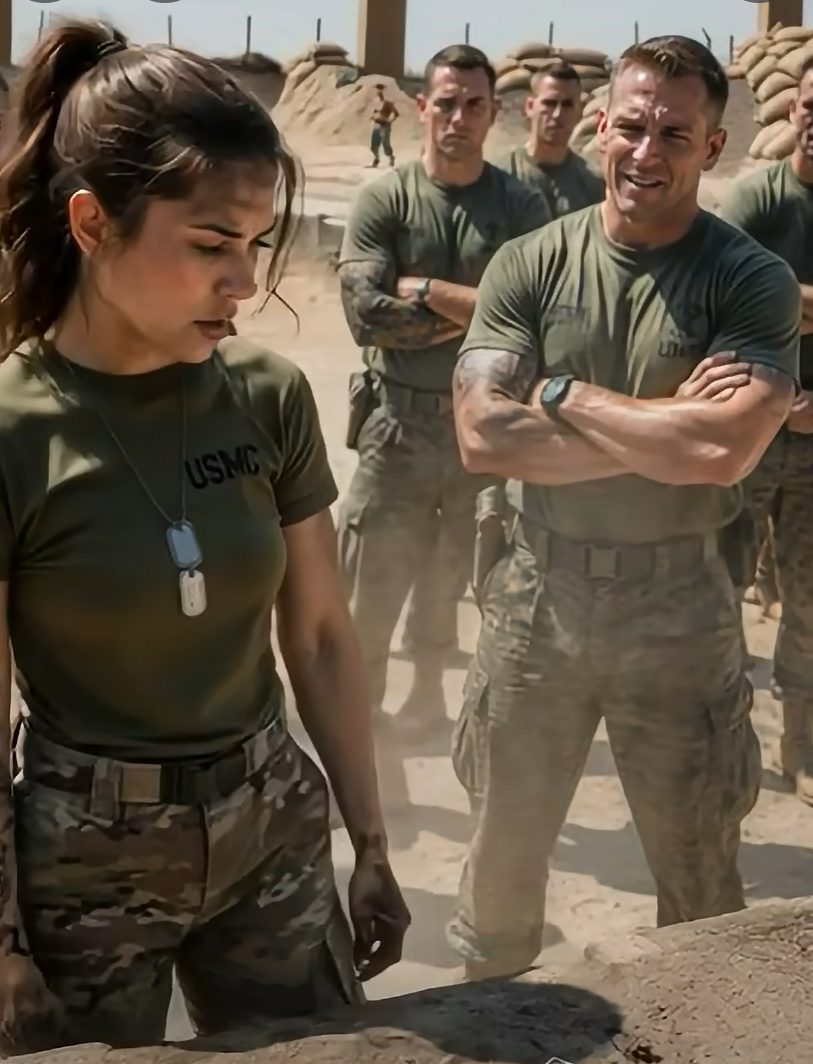
The Arizona sun scorched Fort Ironwood like a punishment from heaven. Dust and the smell of gunpowder hung thick in the air. On the firing range, hundreds of soldiers stood frozen like statues. Even the wind seemed to stop blowing.
Major General Marcus Hargrove stared at the tattoo across my back, his face turning pale as if he had just seen a ghost rise from the grave.
“That’s impossible…” he muttered, his voice trembling slightly.
I slowly turned around, letting the symbol show clearly under the blazing sunlight: a black raven trapped inside a sniper’s crosshair – the mark of Wraith Unit Seven.
A unit the Army had erased from existence eight years ago.
Including me.
The young lieutenant standing beside the general forced out an awkward laugh.
“Sir… do you know this guy?”
Hargrove didn’t answer. His eyes remained locked on me, as though he was trying to convince himself the man standing before him wasn’t a ghost from the past.
“Rowan…” he whispered.
Hearing my real name again felt strange, almost unfamiliar after so many years.
Across the range, rifles slowly lowered. The murmuring stopped. Every eye was fixed on us.
I bent down, picked up the rifle receiver from the ground, and calmly brushed the dust off the metal.
“So you still remember your dead soldiers, General,” I said evenly. “That’s comforting.”
A colonel stepped forward.
“Can somebody explain what the hell is going on here?”
Hargrove’s jaw tightened.
“You were declared killed in action.”
I looked straight into his eyes.
“No. I was betrayed… and left behind to die.”
The entire range fell into a crushing silence.
Hargrove took one slow step closer, lowering his voice.
“You don’t know what really happened that night.”
A cold smile spread across my face.
“Then tell me, General…”
What They Buried Wasn’t a Body
The thing about being declared dead is that the paperwork is cleaner than the truth.
No casket. No remains. Just a file stamped KIA and a date: November 14th, eight years ago, somewhere in a valley outside Kandahar that doesn’t appear on any map you’d find in a public archive.
I know because I’ve looked.
Wraith Unit Seven was six men. Specialists, all of us, pulled from different branches under a program that officially never ran. We didn’t wear unit patches. We didn’t file after-action reports through normal channels. We existed in the space between what the military does and what it admits to doing.
Hargrove built us. Recruited us personally. I remember him shaking my hand in a windowless room at Fort Bragg, telling me I was exactly the kind of asset the country needed but could never publicly thank.
Asset.
That word stuck with me for eight years.
The six of us trained for fourteen months before our first real deployment. Sully – real name Dennis Culbertson, from Akron, built like a refrigerator and laughed at everything – he called us the most expensive ghosts in American history. He wasn’t wrong. Our operation budget ran through three different shell contractors. Even we didn’t know where the money originated.
The valley job was supposed to be a four-hour extraction. Get in, pull a source who’d gone dark, get out. Standard.
Nothing about it was standard.
The Night I Stopped Existing
We dropped in at 0200.
By 0230, I knew something was wrong. The extraction point had been compromised, but the abort signal never came. Sully was on comms, trying to raise command. Static. Then a voice, calm and deliberate, telling us to hold position.
We held position for forty minutes while the valley filled up around us.
I still don’t know how many there were. Enough. More than enough for six men who suddenly had no air support, no QRF, and a radio channel that had gone cold.
Sully went first. Then Reeves. Then Park and Torres within about ninety seconds of each other.
That left me and a guy we called Doyle – Frank Doyle, Boston, the quietest person I’ve ever met in a military uniform – pinned behind a collapsed mud wall while the world tried very hard to end us.
Doyle took a round through the shoulder that dropped him. I dragged him behind what was left of the wall and tried to raise anyone. Anything.
The radio came back to life exactly once. One transmission. A voice I recognized.
Hargrove’s.
“Rowan. The operation is being closed. You understand what I’m telling you.”
Not a question.
I understood. We were the operation. And the operation was being closed.
I didn’t answer him. I pulled Doyle to his feet and we moved.
Three Kilometers Through Nothing
I won’t walk through all of it. Some of it I don’t remember cleanly and some of it I remember too well.
What I’ll say is this: Doyle and I made it to a road by dawn. A truck driver named something I couldn’t pronounce, heading toward the Pakistani border, didn’t ask a single question. He just drove. Doyle’s shoulder had stopped bleeding but his color was bad. I kept checking his pulse every twenty minutes like that was going to change anything.
We crossed into Pakistan on foot. Then a week of moving through channels that don’t exist, through people who deal in debts and favors and who you know. I had a name, given to me years earlier by a CIA officer who’d said, casually, the way you might mention a good restaurant, “If you’re ever completely burned, call this number.”
I called it.
It took four days for anyone to answer.
Doyle made it. He’s alive somewhere, under a different name, in a city I won’t name. We haven’t spoken in three years. Not because anything happened between us. Just because staying gone is easier when you stay gone completely.
I came back to the States six months later, through a border crossing in Texas, with a name that wasn’t mine and a background that a contractor in El Paso had built for three thousand dollars cash. James Cobb. Thirty-four years old. No military record. Born in Lubbock.
James Cobb got a job in construction. Then security work. Then private contracting, the legal kind, protecting corporate assets in places corporations don’t like to admit they operate.
James Cobb was fine. Unremarkable. Invisible.
But I kept the tattoo.
Why I Came Back
I could tell you I came back for justice. That sounds right. It sounds like something a man should say.
The truth is messier.
Six weeks ago, I saw Hargrove’s name in a trade publication. He was being considered for a civilian defense advisory position. Major General Marcus Hargrove, decorated career, distinguished service, the kind of profile that makes a man sound like he’s made of marble.
I read it twice.
Then I read it a third time.
And I thought about a radio transmission in a valley outside Kandahar. The operation is being closed.
I thought about Sully. About Reeves. About Park and Torres who were twenty-six and twenty-eight years old respectively and who had families that got folded-flag funerals and no real explanation.
I’m not a good man. I want to be clear about that. I’ve done things in the years since that I won’t list here, things that kept me alive and solvent and that I don’t lose sleep over in the way I probably should. I’m not the hero of this story. I’m not sure there is one.
But I know how to get onto a military base. I know how to get assigned to a range qualification session as a civilian contractor. And I know that Hargrove does an annual inspection of Fort Ironwood every spring, because his nephew is stationed here and because some men are creatures of habit even when habit is dangerous.
I planned this for six weeks.
I took off my shirt on that range because I wanted him to see the tattoo before he saw my face. I wanted that half-second where his brain knew what his eyes were telling him but couldn’t process it yet. That half-second where Marcus Hargrove, Major General, advisor to committees, man of marble, looked like he might fall down.
I wanted that.
I got it.
What He Said
The colonel was still waiting for an explanation. Two MPs had appeared from somewhere. The young lieutenant looked like he was doing math he couldn’t finish.
Hargrove held up one hand without looking away from me.
“Give us the range.”
“Sir, protocol requires – “
“Clear. The. Range.”
They moved. Slowly, then faster. Even the colonel went, though he stopped at the edge and turned back twice.
Then it was just Hargrove and me, standing in the Arizona heat with the smell of spent brass in the air.
He looked older. Not worse, exactly. Just older. The kind of old that comes from carrying something.
Good.
“There were things above my level,” he said. “The source you were extracting – he wasn’t just a source. He was an exchange. He was being traded back to people we weren’t supposed to be negotiating with, through channels that weren’t supposed to exist.”
“And we were in the way.”
“You were witnesses. The extraction was never going to happen. The order came from people I couldn’t refuse and couldn’t name and I – ” He stopped. His jaw worked. “I want you to know I didn’t think you’d all die.”
I looked at him for a long time.
“Sully had three kids.”
Hargrove didn’t say anything.
“Torres was twenty-six. You recruited him out of Ranger school. You told him he was going to do things that mattered.”
Still nothing.
“Reeves had a sister who spent two years trying to get his remains repatriated. Did you know that? She wrote letters. Filed requests. Got told there were no remains to recover.” I paused. “You made her write those letters. That was your work.”
His face did something complicated.
“Rowan. What do you want?”
And there it was. The question I’d driven across three states to hear him ask.
What did I want?
I wanted Sully back. I wanted Torres to have gotten to be twenty-seven. I wanted Frank Doyle to be able to use his real name. I wanted eight years back and the life I’d built under a name that wasn’t mine dismantled and replaced with something that was actually mine.
I couldn’t have any of that.
“I want the names,” I said. “The people above your level. The ones you couldn’t refuse.”
Hargrove went very still.
“You don’t understand what you’re asking.”
“I understand exactly what I’m asking.”
“Those people – ” He glanced toward the edge of the range, where the colonel was still watching from a distance. He lowered his voice to something barely above a breath. “Those people will kill you. Properly this time. No valley, no ambiguity. They will end you.”
I picked up the rifle receiver again. Turned it over in my hands.
“General,” I said. “I’ve been dead for eight years.”
He stared at me.
“I’m very hard to kill twice.”
The sun was directly overhead by then, no shadows anywhere, everything flat and bright and bleached. Hargrove reached into his jacket pocket and I watched his hand the way I watch all hands, the way eight years of being James Cobb hadn’t trained out of me. But he pulled out a card. Plain white. A phone number handwritten on the back.
He held it out.
“Twenty-four hours,” he said. “Give me twenty-four hours and I’ll give you what you’re asking for. All of it. But Rowan.” He waited until I took the card. “When you pull that thread, be ready for what unravels.”
I pocketed the card.
Walked off the range.
Didn’t look back.
—
If this one got under your skin, send it to someone who needs to read it.
If you’re still in the mood for some intense military encounters, you might enjoy reading about how My Admiral Put His Hand on My Chair. He Had No Idea Who I Was. or the story about how He Put His Hand on the Wrong “Nobody”.



