
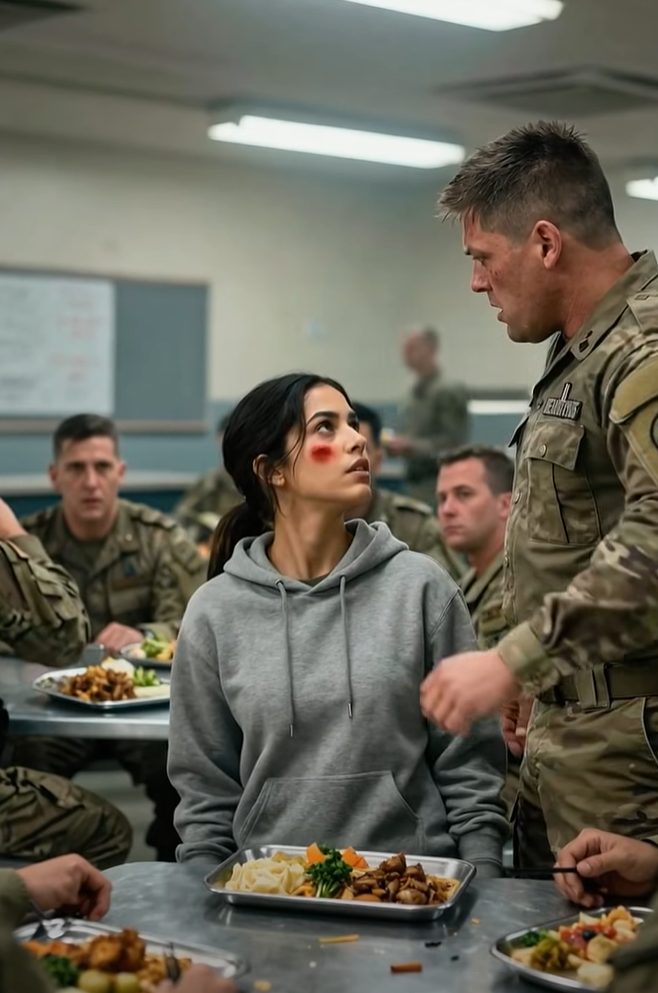
The Staff Sergeant thought he was just putting a pathetic nobody in her place. He had no idea he had just struck an undercover NCIS operative. I didn’t flinch when his hand hit my face. I didn’t cry, didn’t step back, didn’t give him the reaction he was craving. Instead, I stood up slowly, locked eyes with him, and whispered five words that sealed his career’s fate. Moments later, agents moved in from every corner. His phone lit up with a federal warrant. But what the footage revealed next was far darker than simple assault.
The lunch rush at Camp Harrison was loud and messy – trays clanging, boots scraping, a dozen conversations running into each other all at once. The kind of noise you stop hearing after a while. But in a matter of seconds, every sound in that room would die. My table, the one I’d chosen near the window, was about to become the center of something nobody there would ever be able to shake from their memory.
Staff Sergeant Derek Vance walked in like the place already belonged to him. It wasn’t confidence – I’ve been around confident people my whole career, and this wasn’t that. This was something uglier. The kind of attitude that grows in men who’ve never once been held accountable. Around the base, his reputation preceded him. He had a pattern: find someone he figured wouldn’t push back. Women, mostly. People he’d already decided were beneath him before they’d said a single word.
I remember thinking, sitting there with my lukewarm coffee and my cover story, that men like Vance exist everywhere. They just find different uniforms to hide behind.
How I Got There
I’d been on Camp Harrison for eleven days.
My cover was tight. Civilian contractor, logistics support, name badge that said Karen Holt, a company polo that was one size too big and smelled faintly of the previous owner’s cologne. I’d been building the role since late February, eating in the same cafeteria, nodding at the same faces, making myself forgettable in the specific way you have to when the job requires it.
The assignment wasn’t originally about Vance.
We were there because of missing equipment. A pattern of inventory discrepancies that went back fourteen months, small enough in isolation, big enough in aggregate that someone at the Pentagon level started asking uncomfortable questions. Three separate units. Supplies logged in, never logged out, and then gone. The kind of gone that doesn’t happen by accident.
My partner, a guy I’ll call Ray, was working the supply chain angle from the outside. I was the inside. Eleven days of bad coffee and listening.
Vance had come up twice in preliminary interviews. Both times from women who declined to put anything on record. Both times with that specific hesitation I’ve learned to recognize, the pause that isn’t uncertainty, it’s calculation. How much will it cost me to say this out loud.
He wasn’t my primary target. But he was on the board.
The Moment It Turned
He came in with two junior enlisted guys, both of them walking a half-step behind him the way people do around someone they’re slightly afraid of. He got his food, scanned the room, and picked a path toward the back that took him directly past my table.
I didn’t look up.
That was the cover. Karen Holt didn’t make eye contact with people she didn’t know. Karen Holt ate her food and scrolled her phone and kept to herself. I was doing exactly that when his tray caught the edge of mine. Not by accident. I’d seen him clock me from across the room. He wanted an interaction.
Coffee went sideways. Hit my sleeve.
I looked up then, the way Karen Holt would, startled, apologetic even though it wasn’t her fault.
He stared down at me for a moment. Then he said something I’m not going to repeat here, but the short version is that he implied I had no business sitting at a table near the window, that the window tables were for people who mattered, and that I should move.
I said I was fine where I was.
That was it. That was the whole provocation. Four words.
His hand came out fast. Open palm, side of my face, the kind of slap that’s meant to humiliate more than hurt. The two guys behind him went very still. The table next to us went quiet. Then the table next to that one.
I didn’t move.
I sat with it for two full seconds. Let him think he’d gotten what he wanted. Then I stood up, slowly, and I looked at him the way I actually look at people, not the way Karen Holt does.
And I said: “That was a federal offense.”
Not loud. Barely above a murmur. I didn’t need volume.
What Five Words Does to a Man Like That
He laughed. Of course he did.
For about four seconds, Derek Vance thought this was still the funniest thing that had happened to him all week. He looked back at his guys. One of them was already not laughing. The other one was looking at something over Vance’s shoulder.
Ray came in from the east entrance. Two more agents came in from the main doors. Another one materialized from the kitchen corridor, which I mention only because Vance’s face when he saw that one was something I’ll carry with me.
They don’t come from the kitchen. That’s not where people come from.
His phone buzzed in his pocket. He pulled it out the way you do when you’re looking for an exit. The screen showed a notification he didn’t understand at first, and then did. Federal warrant, his name spelled correctly, date and time of issue: forty minutes prior.
We’d had the warrant before he ever walked into that cafeteria.
He put the phone down on the table. Very carefully. Like it had become something fragile.
“You’re going to want to sit down,” Ray told him. Not unkind about it. Ray’s good at not being unkind about things.
Vance sat down.
What the Footage Showed
Here’s the part that changed the shape of the whole investigation.
The slap was on camera. Three angles, actually, because the cafeteria at Camp Harrison has coverage that most people don’t think about when they’re moving through it. The assault was clean, documented, done. That charge was the least of what was coming for him.
But the footage we pulled from the supply warehouse, the stuff Ray had been working for three weeks, showed Vance in that building four times in a two-month window. Each visit after hours. Each visit with a different junior enlisted soldier, never the same one twice. The soldiers weren’t carrying anything in. They were carrying things out.
The inventory discrepancies we’d been tracking? Vance wasn’t the architect. But he was the door. He knew who had access, who owed him favors, who was afraid enough of him to move equipment and keep their mouths shut. He’d been running it like a tax. You want to stay off my radar, you do this one thing.
Two of the women who’d declined to go on record in preliminary interviews, we went back to them after the warrant. Different conversation now. One of them had been carrying boxes out of that warehouse for eight months. She’d been nineteen when it started.
Nineteen.
She cried in the interview room, and it wasn’t the kind of crying that’s about relief. It was the other kind. The kind that’s been waiting a long time.
The Charges
Assault on a federal officer. That one was obvious.
But the list didn’t stop there. Theft of government property. Conspiracy. Coercion. There were conversations between Vance and at least one other mid-level NCO on the base, pulled from his phone after the warrant, that added an obstruction charge on top of everything else.
His lawyer, a guy who’d clearly done some military work before, came in trying to frame the slap as an isolated incident. Momentary lapse. Stress. The standard architecture. He stopped using that framing around the second hour of the first interview, when he got a better look at what we actually had.
Vance didn’t say much after that. Smart enough to shut up, finally. Couple decades too late, but still.
The two junior guys who’d been with him in the cafeteria both cooperated fully within forty-eight hours. One of them had been in the warehouse. He was twenty-two. He gave us three additional names.
What Stays With You
I’ve been doing this work for going on nine years. I’ve been in rooms with people who’ve done things that make a slap in a cafeteria feel like nothing. I’ve built covers that lasted months. I’ve sat across from men who were genuinely dangerous and smiled at them and eaten their food and let them believe I was exactly what I appeared to be.
The work doesn’t always get to me.
But that nineteen-year-old in the interview room. The way she kept apologizing, like she was the one who’d done something wrong. The way she said he told me it was just how things worked here, like she’d spent eight months trying to decide if that was true.
That one got in.
Vance’s career ended the day he walked into that cafeteria. The federal charges were filed, the court-martial proceedings followed, and the two other NCOs whose names came up in his phone faced their own proceedings separately. The equipment, most of it, was recovered or accounted for.
The girl who’d been nineteen when it started got a different kind of outcome. I don’t know what she’s doing now. I hope she’s somewhere that doesn’t feel like that room.
I still have the polo shirt. The one that said Karen Holt. It’s in a box somewhere with a few other things from other assignments, the kind of artifacts you accumulate without meaning to.
I don’t know why I kept it. I just did.
—
If this one hit you somewhere, pass it on. Someone you know needs to read it.
If you enjoyed this story, you might also like hearing about My Admiral Put His Hand on My Chair. He Had No Idea Who I Was., or even The Day an Arrogant Marine Knocked My Lunch to the Floor. And for another tale of unexpected reveals, check out I Watched Three Soldiers Mock Her. Then She Put Her Gear On.



