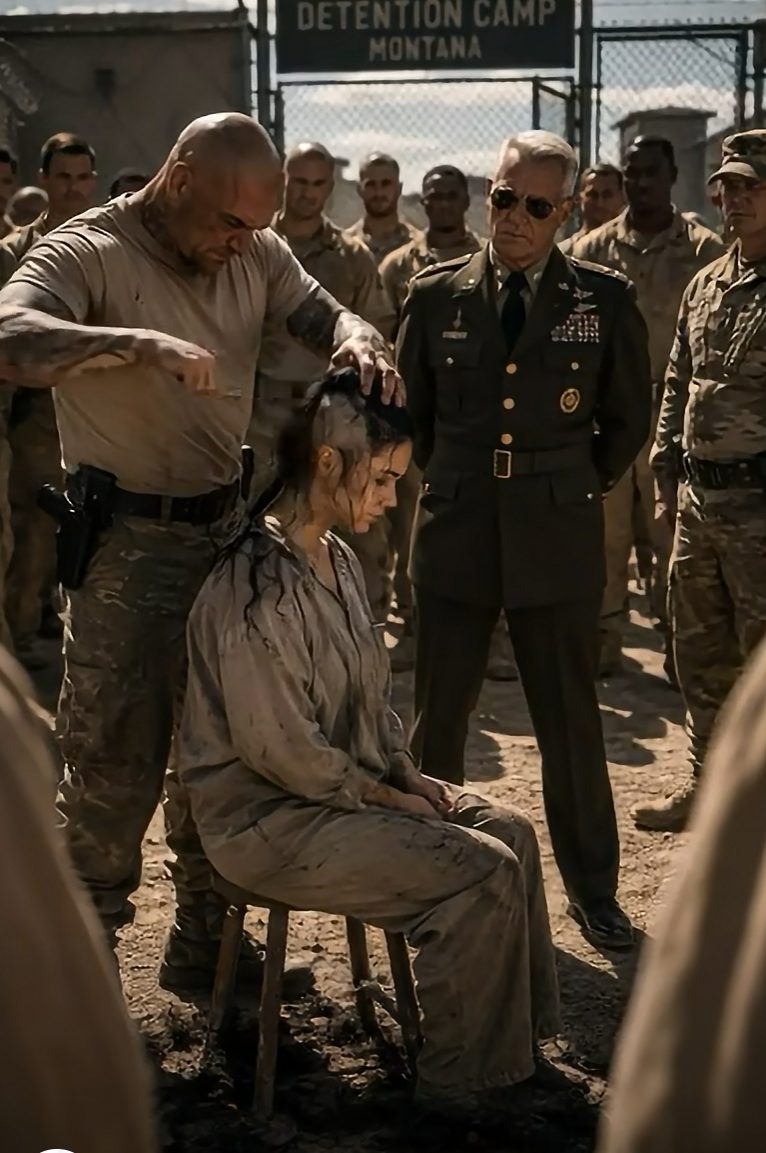
The first lock of hair fell like something final. Heavy. Irreversible. It landed near her knees, dark strands against dry Montana dust, and no one dared move to pick it up. Around her, the camp stood frozen in a loose circle – guards, staff, and broken residents who had learned long ago that silence was safer than sympathy.
But she didn’t cry. Didn’t plead. Didn’t even blink.
Count them, she thought. Count every face.
Colonel Victor Dunn noticed her stillness immediately. Because in Camp Birch, people always reacted. Pain forced truth out of them. Fear stripped them down faster than any blade. But her? She gave nothing. And that made him uneasy.
Hendricks pressed her head forward with a rough grip, the scissors working fast now, impatient, angry. “Hold still,” he muttered, his voice thick with contempt.
She didn’t respond. Not even when a small cut opened along her scalp. Not even when blood mixed with sweat and dust. The blood was warm. Warmer than she expected. She filed that away too.
Dunn stepped closer, boots grinding against the dirt, eyes fixed on her face.
“Look at me.”
She didn’t.
“I said – look at me.”
Slowly, she raised her eyes. And something shifted. Not defiance. Not fear. Something far more dangerous. Recognition. As if she had already decided exactly who he was and found him lacking.
“What’s your name?” Dunn demanded.
Her lips parted slightly. “Does it matter?”
Soft words. But they landed harder than any scream. Behind Dunn, someone shifted nervously. Even Hendricks paused, scissors hovering mid-air.
This wasn’t how it was supposed to go.
“You’re nobody here,” Hendricks snapped, stepping forward again, trying to reclaim the moment. “Less than nobody.”
She turned her head just enough to meet his gaze.
And smiled.
Small. Controlled. The kind of smile that had no business existing in a place like this – the kind that suggested she had been saving it specifically for him.
“Thank you,” she said quietly. “I wasn’t sure which one you were.”
The air snapped tight. Hendricks’s jaw clenched. His grip tightened. For a moment it looked like he might do something far worse than shave her head.
“Finish it,” Dunn ordered sharply.
She had already looked away.
What Camp Birch Was Built to Break
The camp had been running for eleven months before she arrived. Dunn had set it up in early spring, back when the ground was still half-frozen and the nearest town was forty miles of bad road away. He’d picked the site deliberately. Distance was part of the program. Distance, isolation, and the particular kind of cold that settled into your bones around three in the morning and made you believe, really believe, that no one was coming.
He’d had seventy-three residents through the gates since March. Seventy-two of them had broken inside six weeks.
The one who hadn’t, they’d sent home in a body bag and logged it as a cardiac event.
Camp Birch wasn’t on any government registry. It wasn’t licensed, inspected, or acknowledged. It existed in the gap between what parents were willing to do and what the law technically prohibited, and Dunn had spent years learning exactly where that gap was and how wide it stretched. He charged forty-two thousand dollars for a three-month program. He had a waiting list.
The staff called the residents by numbers. No names. That was policy, and the policy had a logic to it: strip the name, strip the self, and what’s left is something you can reshape. Dunn had read enough about cult methodology, military conditioning, and behavior modification that he could cite the theory fluently. He believed in it the way a carpenter believes in a hammer. Not emotionally. Just practically.
She had been assigned the number 31. Thirty-first intake of the calendar year.
She had not used it once.
The File Dunn Read Three Times
Her parents had sent a folder with her. Most parents did. Photographs, school records, therapy notes, a cover letter explaining what had gone wrong and what they needed fixed. Dunn read them all, once, then filed them. They were rarely useful. Parents almost never understood what they’d actually brought him.
Her folder was different.
She was seventeen. Her name was in the paperwork but he’d stopped using it after the first read-through because it felt strange to use it, like holding something that didn’t belong to him. Her parents had written that she was “oppositional,” “manipulative,” and “resistant to authority.” Standard language. Every parent used some version of it.
But her therapist’s notes were something else.
Patient demonstrates unusual capacity for patience under stress. Does not respond to social pressure in typical ways. Maintains internal locus of control even when external environment is designed to destabilize. Recommend against residential placement.
That last line was underlined. Dunn didn’t know if the therapist had underlined it or if her parents had, and he’d decided it didn’t matter.
What mattered was that she’d been here four days and he hadn’t gotten a single real reaction out of her. Not during intake. Not during the first group session where Hendricks ran what he called “accountability hour” but was really just sustained humiliation in a circle. Not during the food restriction period, which usually cracked people by day two.
And not during the haircut.
He sat in his office that night, the folder open on the desk, and read the therapist’s notes a third time. Outside, the Montana dark was total. No moon. Just the sound of wind against prefab walls and, somewhere across the compound, a kid crying quietly into a pillow.
Dunn closed the folder.
He had a feeling he’d made a mistake. He didn’t know what kind yet.
Thirty-One
She shared a cabin with five other girls. Three of them had been there longer than two months and had the particular hollowed-out look that Dunn’s program produced efficiently: eyes that tracked movement without curiosity, voices that stayed flat and agreeable. The other two were newer. Still had some color in their faces.
Her bunk was the top one, far corner. She’d claimed it on day one without asking, which technically violated protocol, and Hendricks had written it up. She’d read the write-up when he handed it to her, nodded once, and folded it into her pillowcase.
That night, after lights-out, one of the newer girls whispered across the dark.
“What did you say to him? At the haircut thing?”
A pause. Long enough that the girl probably thought she wasn’t going to answer.
“I told him thank you.”
“For what?”
“For showing me which one he was.”
Another pause. “I don’t understand.”
“You will.”
That was all. The cabin went quiet. But two of the hollowed-out girls were awake, staring at the ceiling, and something had moved behind their eyes. Something small. Not hope exactly. More like the memory of what hope used to feel like, back before Dunn and Hendricks and accountability hour had gotten to them.
She lay on her back and looked at the ceiling and counted.
Days. Faces. Routines. The time between the guard’s last check and the first gray light. The distance from the cabin to the main gate. The number of steps from the main gate to the access road. She’d walked that road in once, wrists zip-tied, and she’d counted every step.
She had a good memory for numbers. Always had.
What Hendricks Didn’t Know About Her
His name was Gary Hendricks. Forty-four years old. He’d done two years at a private military school in Georgia before washing out of an officer candidate program, and he’d spent the years since working at facilities like this one, moving when things got complicated, which they did every few years. He had a way of standing too close and a habit of touching people on the shoulder that lasted just a fraction of a second too long. He thought this made him intimidating.
He didn’t know that she’d spent three years training in Brazilian jiu-jitsu before her parents had decided that was part of the problem. He didn’t know that her coach, a stocky woman named Renata who’d competed internationally until her knee gave out, had told her parents at the end of year two: your daughter has a gift for reading people’s bodies before they know what their bodies are about to do.
He didn’t know any of this because her parents hadn’t put it in the folder. Her parents thought the martial arts stuff was a symptom.
She thought about Renata sometimes. Renata, who used to say: the opponent who scares you is the one who’s already decided they’re willing to lose something.
She had decided, the moment the van pulled through the gate, that she was willing to lose quite a lot.
The Thing That Happened on Day Nine
Dunn ran group sessions every morning at seven. He sat at the front of a room that smelled like industrial cleaner and bodies, and he talked about accountability and choices and the people who loved the residents enough to send them here. It was the same script every day, more or less. The repetition was intentional.
On day nine, he pointed at her.
“Thirty-one. Tell the group one thing you’re grateful for.”
Standard exercise. People usually said something small and safe. Grateful for the food. Grateful for the structure. Grateful for this opportunity.
She looked at him. “I’m grateful for Gary.”
Dunn blinked. Hendricks, standing near the door, went very still.
“Gary’s helped me understand a lot,” she said. Her voice was completely even. “About what kind of person I want to be.”
No one in the room moved. The two newer girls from her cabin were watching her with something close to terror. The hollowed-out ones were watching Hendricks.
Hendricks’s face had gone the color of old brick.
“That’s enough,” Dunn said.
“You asked.”
“I said that’s enough.”
She nodded. Folded her hands in her lap. Looked at the middle distance.
After the session, Dunn pulled Hendricks aside. She watched them through the window of the main building, standing in the dirt, Dunn’s head bent toward Hendricks’s ear. She couldn’t hear them. She didn’t need to. She’d already seen what she needed to see: Hendricks’s hands, loose at his sides, and the way Dunn kept his own body angled slightly away.
They were not as unified as they wanted everyone to believe.
She’d suspected it. Now she knew.
What She’d Been Counting Toward
On day eleven, a woman named Marlene Fischer arrived for what Dunn called a “family consultation visit.” She was the aunt of one of the hollowed-out girls, a woman in her late fifties who drove a truck with a cracked windshield and a child safety seat in the back that clearly hadn’t been used in years. She wasn’t supposed to see anything except the conference room and the approved outdoor recreation area.
She saw a lot more than that, because she took a wrong turn looking for the bathroom and ended up in the main cabin corridor at the exact moment a guard named Pete was running accountability hour on a thirteen-year-old boy who was crying so hard he couldn’t stand up straight.
Marlene Fischer stood in that corridor for four seconds.
Then she walked back to the conference room, sat down across from Dunn, and spent forty minutes asking questions in the careful, neutral voice of someone who has already decided what they’re going to do when they leave.
She was in the parking lot, keys in her hand, when she felt someone beside her.
She turned. It was the girl with the close-cropped hair and the small cut still visible along her scalp.
“You’re going to call someone,” the girl said. Not a question.
Marlene Fischer looked at her for a moment. “I’m going to call a lot of someones.”
The girl reached into the waistband of her camp-issued sweatpants and pulled out a folded piece of paper. She’d been working on it for three days, writing in the margins of a Bible they’d given her at intake, tearing the pages out in sections small enough to hide. Names. Dates. Specific incidents. The number of the access road. The names of every staff member she’d catalogued.
“Take this with you,” she said.
Marlene Fischer took it. She looked down at it, then back up.
“What’s your name?”
The girl almost smiled. The same small, controlled thing she’d aimed at Hendricks on day one.
“Does it matter?”
Marlene Fischer tucked the paper into her bra and got in her truck.
The girl walked back toward the cabins without hurrying. Pete was watching from the main building. She looked right at him. He looked away first.
She counted that too.
—
If this one got under your skin, pass it along to someone who needs to read it.
For more stories of incredible women making their mark, check out They Called Her a Ghost in a Courtroom Full of Heroes. Then the Admiral Saluted the Woman They Tried to Erase. and The Woman Who Dropped a Master Chief in Front of Four Hundred SEALs.