
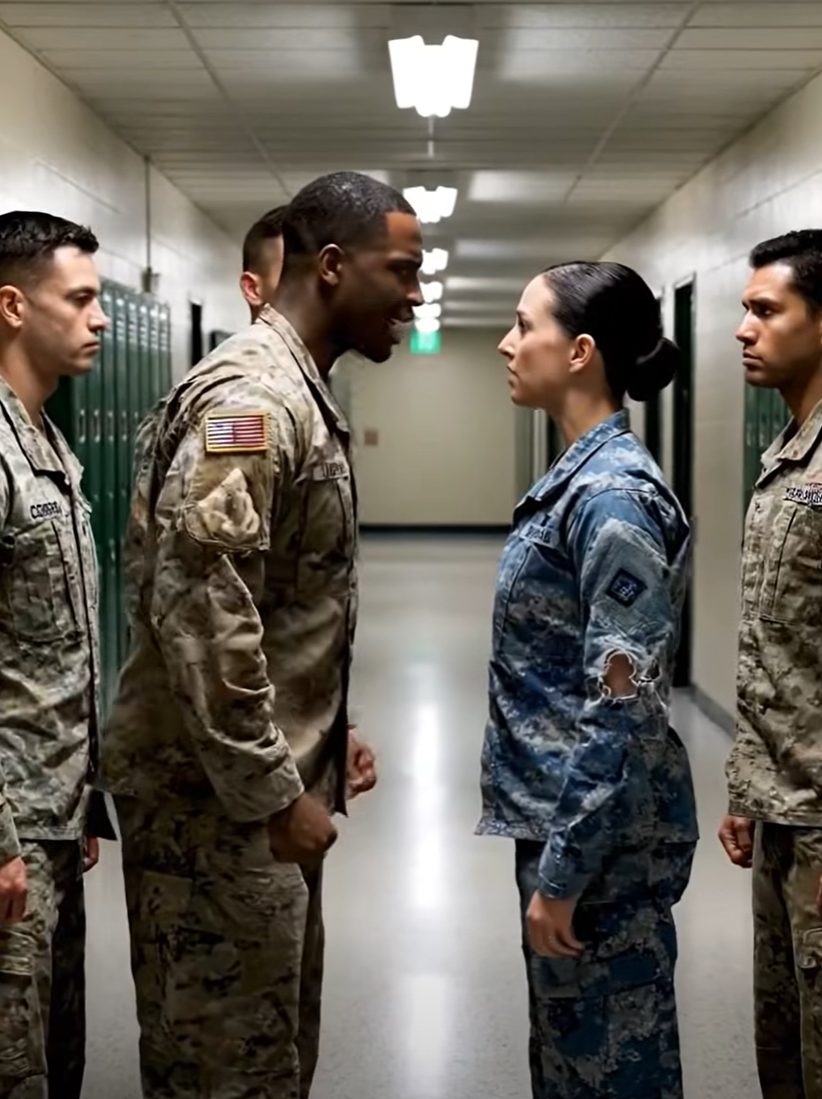
The corridor outside the barracks at West Mesa Training Annex smelled like bleach and sunbaked concrete. Recruits moved in distant clusters, boots echoing, instructors shouting cadence downrange. Most people didn’t notice the woman walking alone with a small clipboard and a plain utility uniform – slightly faded, no visible rank on the collar, sleeves rolled tight like she didn’t have time for comfort.
That was the point.
Lt. Commander Taryn Cole kept her head level and her pace normal. She wasn’t here to be recognized. She was here because this base had a pattern – harassment complaints that vanished, victims transferred, and a trio of “enforcers” who always seemed to skate clean.
Three Marines leaned near the lockers like they owned the hallway: Sgt. Mason Rudd, Cpl. Travis Keel, and LCpl. Brody Lane. They had the casual arrogance of men protected by silence.
Rudd stepped into Taryn’s path. “Hey.” His eyes dragged over her uniform the way some men look at things they’ve already decided belong to them. “Inspection.”
Taryn stopped. “You don’t have the authority for that.”
“Authority.” Keel laughed through his nose. “Look at her. She’s got a clipboard.”
Lane pulled a small knife from his pocket and flipped it open like it was nothing – like it was a habit. “Wrong place to be playing dress-up, sweetheart.”
Rudd reached out and tugged her sleeve. Fabric tore slightly. Keel grabbed the hem of her blouse and yanked it hard enough to jerk her shoulder. Lane brought the blade in slow and deliberate, slicing a clean line through the edge of her uniform. Unhurried. Theatrical. The kind of cruelty that’s been practiced.
They’ve done this before, Taryn thought. More than once.
She didn’t shout. She didn’t flinch.
She moved.
One smooth step, her body turning sideways to remove the target. Her hand trapped Rudd’s wrist, rotating it into a controlled lock that forced him onto his toes. With her other hand she hooked Lane’s knife hand, stripped the blade free, and kicked it down the corridor with a sharp metallic scrape. Keel lunged – Taryn pivoted, used his momentum, and sent him to the floor with a clean sweep.
Three seconds. Maybe four.
The laughing had stopped.
What Nobody Talks About Before an Assignment Like This
She’d been briefed in a beige office at 0630 on a Tuesday, three weeks before she set foot at West Mesa. Her CO, Captain Delores Marsh, slid a manila folder across the desk without preamble. Twelve complaints over fourteen months. Seven complainants subsequently reassigned to other installations. Two formal investigations opened and quietly closed. One medical discharge that nobody could explain on paper.
Taryn had read the folder twice through, then set it down.
“How protected are they?” she’d asked.
Marsh had looked at her the way people look when they don’t want to say the number out loud. “Rudd’s got a cousin in base administration. Keel’s father is retired CWO. Lane’s just…” She’d paused. “Lane’s the one who does the cutting.”
That last word had landed flat in the room.
Taryn had taken the assignment home in her head that night, turned it over while she made dinner, while she ran six miles in the dark at 0445 the next morning. She wasn’t afraid of Rudd or Keel or Lane. She’d trained with men twice their size in conditions that would’ve put all three in the hospital. What she was afraid of, if she was honest, was the machinery behind them. The paperwork that disappeared. The women who’d been shuffled sideways into nowhere postings and told to be grateful they still had a career.
That was the harder enemy. Always had been.
She’d spent two weeks on base before the hallway. Watching. Talking to people. Eating in the mess at the same table as the junior enlisted, listening to the specific silences that opened up whenever Rudd’s name came into conversation. She’d counted three women who changed their routes through the barracks. One corporal who’d started taking a longer path to the motor pool just to avoid a particular corridor. A PFC named Cynthia Dodd who ate alone every day at the far end of the mess and looked at the door every time it opened.
Taryn had sat across from Cynthia on a Thursday morning with two cups of bad coffee and said nothing for almost five minutes. Just sat there.
Cynthia had looked at her finally. “You’re not from here.”
“No.”
“You’re not going to be here long either.”
Taryn had wrapped both hands around her cup. “Long enough.”
The Three Seconds Nobody Saw Coming
Back in the corridor, Rudd was still on his toes, wrist locked, face cycling through confusion toward something uglier. Keel was on the floor with his cheek against cold concrete, breathing hard. Lane was staring at his empty hand like it had betrayed him personally.
None of them had yelled. Interesting.
Men who rely on the threat of violence, Taryn had learned a long time ago, are often quieter than expected when the violence goes the other direction. They don’t have the reflex for it. They’ve been the ones doing the surprising for so long that getting surprised turns them stupid.
She released Rudd’s wrist slowly, deliberately, like she was setting down something fragile.
He took two steps back and rubbed his hand. His face had gone through the confusion and landed somewhere that wanted to be anger but wasn’t quite getting there.
“You’re going to want to think carefully,” Taryn said, “about what comes out of your mouth next.”
Lane tried anyway. “You just assaulted – “
“I have a clipboard,” she said. “And you have a knife you just used to cut a servicewoman’s uniform in a secure corridor. So.” She looked at him. Just looked. “Think carefully.”
Keel got up off the floor slowly, the way people do when they’re trying to look like they meant to be down there. He brushed his sleeve. Didn’t meet her eyes.
She reached into the breast pocket of the torn uniform and pulled out a small laminated card. Set it on the ledge of the nearest locker where all three of them could read it.
Her name. Her rank. Her office.
Not the faded utility uniform rank. The real one.
Rudd read it first. She watched the color change in his face, starting at the collar and moving up.
The Part That Actually Mattered
The formal proceedings took eleven days.
Taryn wasn’t the one who ran them. That wasn’t her job. Her job had been to document, to witness, and to give the women who’d been transferred and reassigned and shuffled sideways a reason to pick up a phone. She’d spent the two weeks on base not just watching Rudd and Keel and Lane. She’d been collecting names. Contact information. Carefully worded conversations with women who’d stopped expecting anyone to follow through.
Cynthia Dodd testified on day four. She’d driven six hours from her current posting to do it. She sat in a chair in a room that smelled like recycled air and said what had happened to her in a voice that barely shook. Taryn sat in the back and didn’t look at her face. She looked at her hands. Cynthia’s hands were completely still on the table in front of her.
That was the thing Taryn kept coming back to later. Those still hands.
Two other women came forward during the proceedings. One of them, a former Lance Corporal named Priya Sehgal, had left the service eight months earlier. She’d told herself she was done. She’d built a life in Portland with a roommate and a job at a shipping company and a very deliberate distance from anything that reminded her of West Mesa. She came back anyway. Drove down in a car with a cracked windshield, stayed in a motel off the highway, and sat in that same room and said what she needed to say.
Rudd’s cousin in base administration turned out to be less useful than advertised when the complaints were coming from a Lt. Commander’s office rather than junior enlisted. Keel’s father called someone who called someone, and that someone apparently did the math and decided not to pick up. Lane’s lawyer tried an argument about the knife being a personal item and a misunderstanding.
The knife had a three-inch blade and Taryn’s uniform fiber on it.
The argument did not survive contact with evidence.
What Taryn Did After
She wrote her report in a rental car outside a gas station off the highway, laptop balanced on the steering wheel, engine running for the heat. It was 11 PM. She’d been awake since 0400. The torn uniform was in a paper bag in the back seat, tagged and documented.
She ate a gas station sandwich and drank coffee from a styrofoam cup that was too hot and then too cold. She finished the report at 12:40 AM and sent it. Then she sat there for a while with the engine running and the parking lot lights making everything look orange and flat.
She thought about Cynthia Dodd’s hands on that table.
She thought about Priya Sehgal driving down from Portland with a cracked windshield.
She thought about the seven women who’d been reassigned. The ones she hadn’t reached. The ones who’d looked at the pattern of what happened to people who complained and made a calculation that any reasonable person would make and stayed quiet and moved on. She thought about how you can’t blame someone for that calculation. She’d made versions of it herself, early on, in rooms that felt smaller than they were.
Her phone buzzed. A message from Captain Marsh. Two words.
Good work.
Taryn looked at it for a second. Then she put the car in drive.
The Detail Nobody Asks About
Three months later, she ran into Cynthia Dodd at a base in Virginia. Completely by accident. Different assignment, different reason to be there. Cynthia was in the mess line and Taryn almost didn’t recognize her at first because she was laughing at something the woman next to her had said, head back, completely unguarded.
Taryn got her food and found a table and ate facing the other direction.
She didn’t go over. Didn’t introduce herself or remind Cynthia who she was. That wasn’t the point. The point was the laughing. The completely unguarded laughing.
She ate her food and left.
The torn uniform is still in an evidence locker somewhere, in a paper bag with a tag on it. Taryn has a replacement. It fits the same. She keeps the sleeves rolled tight.
—
If this one stayed with you, pass it along to someone who’d get it.
For more tales of unexpected badassery, check out how the old man in the faded jacket stepped to the line and made Fort Bragg go silent, or when she asked “May I take a turn?” and the SEALs went quiet. You might also enjoy hearing about the wrong woman I shoved out of the mess hall line.



