
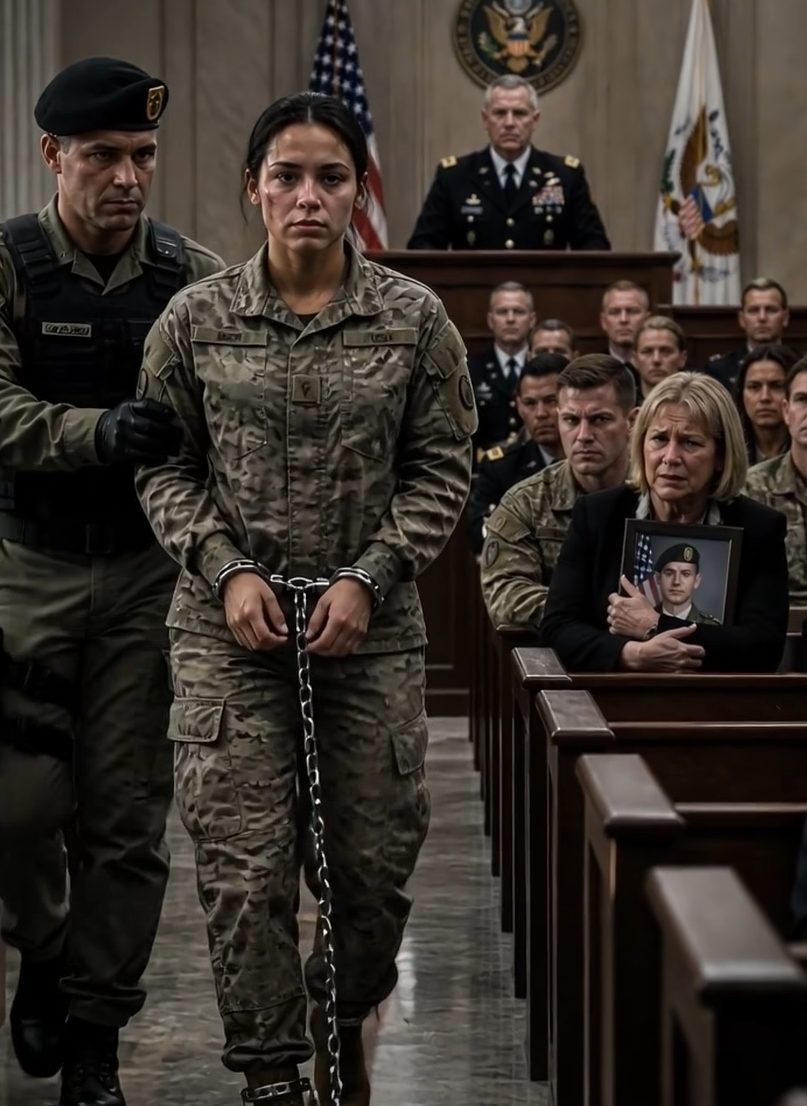
They Dragged Me Into Court In Chains And Called Me A Traitor. Then The Doors Opened, And The General’s Face Went Pale.
Everyone Thought I Had Abandoned Three Soldiers To Die. No One Knew I Had Been Carrying The Truth In Silence For Eighteen Months.
“Bring the traitor forward,” Major General Blackwood ordered, and the words didn’t just echo through the Fort Bragg courtroom – they buried me before the trial even began. The chains around my wrists bit into my skin as I walked, but metal was not the heaviest thing I carried. The real weight was three dead soldiers’ names pinned to my chest like another set of irons. Michael Walsh. Eric Johansson. Tommy Dawson.
Every scrape of chain against the polished floor sounded louder than it should have, like the room wanted each step to become evidence. More than two hundred people sat waiting, but not for truth. They wanted confirmation. They wanted a villain. And I had been delivered to them.
A widow sat in the front row, clutching a photograph so tightly the edges bent beneath her fingers. Behind her, a young soldier stared at me with a jaw locked so hard it looked painful. His grief had found a target. His anger had found a face. Mine.
In rooms like that, truth never walks in first. Presentation does. Blackwood stood tall, decorated, controlled, and already certain. He didn’t look like a man searching for answers. He looked like a man protecting a story.
“Look at her,” Colonel Harding said coldly, his voice carrying just enough contempt for every row to hear. “This is what cowardice looks like.” A murmur passed through the courtroom, soft but sharp. That was the version they had been fed. A woman in Syria abandons her post. Radios go silent. Three Americans die. Simple. Clean. Convenient.
Simple stories make people feel safe. But I had lived inside that story for eighteen months, and there was nothing clean about it. Eighteen months of hearing their names spoken like accusations. Eighteen months of being called weak by people who had never stood where I stood that night. Eighteen months of silence mistaken for guilt.
Judge Morrison called the court to order, weary and distant, like this was just another long day in a building built to swallow people. My defense attorney, Captain Silas Brennan, sat beside me with a stack of files too thin to save anyone. He had asked for records. Asked for footage. Asked why half the truth had been buried beneath black ink. Every answer had been another door slammed shut.
When the judge asked for my plea, I said nothing. The silence stretched, heavy and dangerous. Silas stood anyway, his voice firm despite the fear in his eyes. “Not guilty, Your Honor.” The room reacted instantly – a sharp breath, chairs scraping, a whisper from somewhere behind me: “How dare she.”
I didn’t move. Sometimes silence is the last order left to obey. The prosecution opened with precision, laying out their version like clean instruments on a steel tray. A communications sergeant claimed my station had been empty. Another officer described the ambush in clipped, sterile language. Loss of contact. No warning. Casualties confirmed.
The widow covered her mouth. The young soldier stared harder. And I stood there, letting their grief keep choosing me because I had been trained to hold position even when the fire came from every side.
During recess, the holding room smelled like bleach, old metal, and defeat. Silas leaned over the table, voice low and urgent. “They’re going to bury you,” he said. “Tell me what I’m missing.” I studied him carefully. Tired. Outmatched. But still trying.
“Do you believe in the chain of command, Captain?” I asked. He blinked. “Of course.” I leaned closer, letting the chains shift softly against the table. “Then believe this. Not everything important arrives in a file.”
Before he could answer, the door opened. Brick Lawson grabbed my arm and hauled me up like I was already guilty. “Look at me when I’m talking to you,” he muttered. I turned my head slowly and met his eyes. “I heard you the first time.” It was the first thing I had said all day, and it startled him badly enough to loosen his grip.
Back in the courtroom, something had shifted – not enough to name, but enough to feel. Under cross-examination, cracks began to show. One witness admitted he had not fully checked my station. A signal officer confirmed encrypted transmissions had been detected that night. Not from my position. From command.
The room did not react with grief this time. It reacted with confusion. At the prosecution table, papers began moving too carefully. When Silas demanded full records, the answer came fast and cold: classified. The word landed like a locked door. Cowards don’t come wrapped in presidential-level secrecy. Scapegoats don’t come with sealed files.
That was when I reached for the paper on the table. Slowly, I flattened it once. Then folded it. One crease. Then another. The courtroom watched without understanding until the shape became unmistakable. A perfect white triangle. A folded flag.
Silas saw it first. Recognition struck him across the face. People don’t fold like that by accident – not under pressure, not in chains, not in a room waiting to destroy them. The widow lowered her photograph. The young soldier’s glare weakened. Doubt entered quietly, and once it entered, it could not be ordered out.
Then the back doors burst open. Not softly. Not politely. Metal slammed against metal, cutting through the courtroom like a blade. Colonel Harding froze mid-sentence. Judge Morrison looked up sharply. But Blackwood’s face changed first.
And that was when I knew. The moment they had not rehearsed had finally arrived. I lifted my eyes from the folded triangle. Some humiliations are designed to destroy you. Others are designed to hold the truth until the right door opens.
At Fort Bragg that afternoon, everyone in that courtroom was about to learn the difference.
What Walked Through Those Doors
There were three of them.
Civilian clothes. No insignia. But they moved the way people move when rank has become a formality they no longer need to display. The one in front was maybe sixty, grey suit, briefcase worn at the corners. Behind him, a woman in her forties with a laptop bag and a face that gave nothing away. And behind her, a man I recognized.
Staff Sergeant Dale Pruitt. Who had been listed as killed in action fourteen months ago.
The courtroom did not process it immediately. Brains don’t. The widow turned first, because grief has its own radar, and she knew his face the way you know a face you’ve studied in photographs for a year trying to understand how it got taken from you. She made a sound I won’t describe. The kind that comes before crying, before language, before anything organized.
Blackwood had gone completely still.
Not the stillness of a man surprised. The stillness of a man who has just watched the only exit close.
Judge Morrison was already standing. “This court will come to order.” His voice had lost its weariness. He looked at the grey-suited man, who was already walking toward the bench with the unhurried confidence of someone who had called ahead. “Sir, identify yourself for the record.”
“Raymond Coyle, Office of the Inspector General, Department of Defense.” He set the briefcase on the railing and clicked it open. “We have materials relevant to the proceedings. I apologize for the timing. We could not move sooner.”
He did not apologize to me. Nobody apologized to me.
What Syria Actually Looked Like
I want to tell you what that night was, because the prosecution had given everyone a clean version and clean versions are how they keep the real one buried.
It was October. The kind of cold that comes fast in northern Syria, the kind nobody briefed you on because the intelligence packets focused on heat. Our forward position was a converted grain storage facility outside a village I won’t name, operating under a signals intelligence directive that had been classified three tiers above my rank to even acknowledge.
My job was intercept and relay. I was not supposed to be there in any official capacity. On paper, I was attached to a logistics unit forty miles south.
That was the first layer.
The second layer was Blackwood’s operation. A secondary mission running parallel to ours, using the same communication frequencies, which anyone with six weeks of signals training would tell you is how you get people killed. I had flagged it. In writing. Twice. The second memo had come back to me with a single line of response, typed on plain paper, no letterhead: Continue your assignment and do not transmit outside your designated window.
Signed by no one.
The ambush came at 2:47 in the morning. I know the time because I was looking at my watch when the first contact report came through, not from Walsh or Johansson or Dawson’s unit, but from Blackwood’s parallel team. They had been using our frequency. They had drawn the response that was meant for them directly onto us.
I transmitted a warning. I transmitted it twice. What the prosecution’s communications sergeant had not mentioned, what the classified records buried, was that my transmission had been jammed. Not by the enemy. The jamming signature was American-made. The frequency block was the kind used to maintain operational security on a mission that was never supposed to exist.
I left my station because the jamming was coming from inside the facility. Someone in that building had cut us off deliberately, and I needed to find out who before the whole position went dark.
I found Dale Pruitt instead. Bleeding out in a supply corridor with a story that would have ended careers. He told me things in that corridor that I spent eighteen months not being allowed to repeat.
What Eighteen Months of Silence Costs
People think silence is passive. They think it’s the absence of something.
It isn’t. Silence is work. Carrying a secret that size is physical, the same way a fracture is physical. You feel it every time weight gets applied.
I had been told, very clearly, by Raymond Coyle’s predecessor – a man named Hartfield who retired six months into my ordeal and whose name appeared in none of the documents – that speaking would result in the deaths of two people still operating in the field. Names I knew. People I had worked with.
So I held it.
I sat through the formal investigation and held it. I sat through the preliminary hearings and held it. I watched my service record get quietly dismantled, commendation by commendation, and held it. I listened to Blackwood brief congressional staffers on the tragedy of the Syria ambush, the failure of a signals operator who had abandoned her post, and I held it until my back teeth ached.
The widow’s name was Carol Walsh. I knew that. I knew her daughter was seven years old and had her father’s ears and had started refusing to eat dinner because Michael used to make dinner and now nobody did it the same way. I knew that because I had read everything written about the three of them, every obituary, every memorial post, because I owed them that much. I owed them my attention even if I could not yet give them the truth.
Silas had been the first person in eighteen months to ask me a direct question and actually wait for the answer. Most people had already decided. He hadn’t. That was why I stayed quiet with him instead of shutting down entirely. Quiet is different from closed.
The folded triangle had been a message for him. He’d figured it out in about four seconds, which told me he was faster than his thin file stack suggested.
What Raymond Coyle Laid On That Table
The briefcase held eleven documents and a hard drive.
Coyle walked the judge through them in a voice that was almost boring, the way people get when they’ve been delivering catastrophic information long enough that the delivery itself becomes routine. Signals intercept logs showing the jamming event. Internal memos from Blackwood’s parallel operation. A field medical report on Dale Pruitt, filed under a cover identity, dated the night of the ambush.
And Pruitt’s own sworn statement, recorded fourteen months ago, three weeks after he’d been pulled out of Syria and placed in a program that officially did not exist.
Dale was sitting in the gallery now. Carol Walsh had not stopped looking at him. She wasn’t crying anymore. Her face had gone somewhere past crying, into a country without a name.
Blackwood’s attorney stood up three times during Coyle’s presentation. The judge sat him down all three times with the same two words. Sit down.
Colonel Harding had stopped taking notes. His pen was on the table and his hands were in his lap and he was staring at the middle distance the way people stare when they’re doing rapid calculations about their own future.
The young soldier behind the widow – I learned later his name was Garrett Johansson, Eric’s younger brother, twenty-two years old, had enlisted specifically because of what happened to Eric – he put his face in his hands. Not from grief. From something more complicated. The kind of feeling that comes when the story you’ve been living inside turns out to have different walls than you thought.
I watched all of it from the defense table. The chains were still on my wrists. Nobody had thought to remove them.
What Blackwood’s Face Did
He didn’t break. I want to be honest about that, because I had imagined this moment differently during the eighteen months I’d been carrying it.
I had imagined collapse. Confession. Some visible crumbling.
What I got was a man in his sixties, forty years of uniform behind him, sitting very straight and going somewhere behind his eyes that nobody in that room could follow him. His jaw stayed set. His hands stayed flat on the table. He looked at the documents Coyle had produced and he looked at Dale Pruitt and he looked, once, at me.
It was the look of a man who had been certain the door was locked.
Judge Morrison called a recess at 3:14 in the afternoon. The bailiff started toward me to take me back to holding, and Silas stood up fast. “Your Honor, given the materials just entered into evidence, I’d like to request that my client’s restraints be removed pending further proceedings.”
Morrison looked at the chains. Then at Coyle. Then at Blackwood’s attorney, who said nothing, because there was nothing useful left to say.
“Remove them,” the judge said.
The bailiff had a key. It took him maybe fifteen seconds. The chains came off my wrists and I set them on the table in front of me and I did not rub where they’d been, even though the skin was raw and I wanted to. I just put my hands flat on the table the same way I’d held them for eighteen months.
Still.
Waiting.
Carol Walsh was looking at me from the front row. Her photograph was in her lap now, face up, Michael Walsh smiling at nothing in particular. She didn’t say anything. Neither did I. But she nodded, once, a small tight motion, and I held it in my chest where the names had been.
Outside the windows of the Fort Bragg courtroom, it was an ordinary Tuesday in November. Someone was mowing something. A car alarm went off briefly and stopped. The world outside had no idea what was happening in here, and it didn’t need to. Some truths are only ever witnessed by the people who were there for the lie.
Garrett Johansson was still sitting with his face in his hands when the recess ended.
He was twenty-two years old and his brother was still dead and nothing that happened in that room was going to change that. The documents didn’t change that. Pruitt being alive didn’t change that. The truth, when it finally comes, doesn’t undo anything. It just stops the wrong person from carrying what was never theirs to carry.
I picked up the folded triangle from the table and held it for a moment.
Then I set it down in front of Carol Walsh on my way out of the room.
—
If this one hit you somewhere real, pass it to someone who needs it.
If you’re looking for more stories about unexpected turns of events, you might enjoy reading about the woman who had already buried more secrets than a general’s career could survive or the time a sergeant shoved someone before realizing what was on her shoulder. And for a tale of quiet influence, check out how a waitress serving coffee was the real reason a unit’s patch existed.



