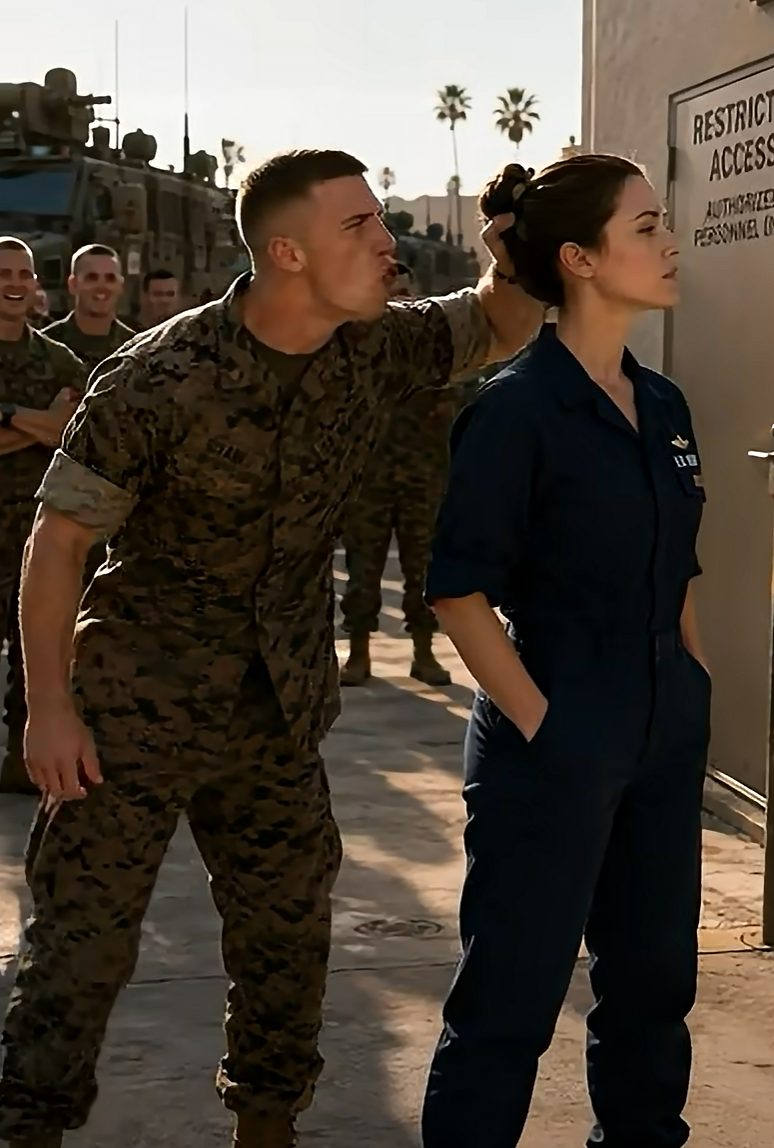
“Do you have any idea who I am?” the young corporal sneered, his fingers twisting into the tight bun at the back of my head.
The world didn’t slow down – it sharpened. Every sound became precise. Boots scuffing concrete somewhere behind him. A truck engine idling low. The faint metallic rattle of a loose sign shifting in the breeze. And right in front of me, his breath – too close, too confident, too sure of itself. My blood ran cold. Not from fear. From the sheer, catastrophic audacity of it.
I stood still outside the tactical access building at Camp Pendleton, the sun cutting clean shadows across the pavement. My posture remained neutral, my face unreadable. I wore standard Navy utilities – nothing flashy, nothing that demanded attention. The kind of uniform designed to blend in, not stand out. Which is exactly why he’d misjudged me.
Corporal Derek Shaw – twenty-three, broad-shouldered, the kind of physique that came from hours in a gym and just enough authority to think it meant something more – had already decided who I was before he ever opened his mouth. “Navy admin’s that way, sweetheart,” he’d snapped earlier, stepping into my space like it belonged to him. His tone had carried that casual edge of dismissal, sharpened just enough to cut. “They only let you on base because of your daddy’s name. This area’s restricted to tactical personnel.” I hadn’t moved then.
I didn’t move now.
Because I knew something he didn’t. And real authority doesn’t rush to defend itself.
What He Saw
What Corporal Shaw saw when he looked at me: a woman, five-four, slight build, dark hair pinned back, no rank insignia that registered to him as significant. Navy utilities, not Marine green. Wrong branch. Wrong building. Wrong place.
What he didn’t see: fourteen years. Three combat deployments. A Naval Special Warfare designation that most people on this base didn’t know existed and wouldn’t recognize if they read it off a form.
I’m not supposed to talk about specifics. I won’t. But I will say that the building I was standing outside of – the one Shaw had appointed himself guardian of – was a building I had been inside more times than I could count. I had a meeting in forty minutes with people three pay grades above Shaw’s ceiling.
He didn’t know any of that. He’d looked at me and done the math he always did, fast and sloppy, and come up with: female, Navy, lost.
The “sweetheart” had been the first mistake. I’d let it go. Some hills aren’t worth taking, and I’d learned a long time ago to pick the ones that mattered.
The hand in my hair was a different category of mistake entirely.
The Moment
His fingers hadn’t fully closed when I moved.
Not fast. Controlled. The kind of movement that doesn’t look like anything until it’s already finished. I turned into his grip instead of away from it, which confused him for exactly the half-second I needed. His wrist came up, then out, then he was looking at the sky and I was still standing where I’d been, more or less, his arm at an angle that suggested he should hold very still.
He held very still.
Three seconds of silence. The truck engine idling. Boots somewhere. The sign.
I released his wrist and stepped back. Not because I was done. Because I was.
“I’d like you to think carefully about your next move,” I said.
Shaw straightened up. His face had gone through about four different expressions in the past ten seconds and had landed on something between fury and the early stages of recalculation. He was big. He was embarrassed. Those two things together are where bad decisions come from, and I watched him work through it.
He chose wrong.
“Do You Know Who I Am?”
“Do you have any idea who I am?” he said again, louder this time, because there were two other Marines who’d drifted over from the checkpoint and he needed them to see something other than what they’d just seen.
I looked at him. Actually looked, the way you look at something you’re assessing rather than reacting to.
“Corporal Derek Shaw,” I said. “Echo Company, 1st Battalion. You’ve been at Pendleton eight months. Before that, Twentynine Palms. You have a commendation from your CO for something that happened in a training exercise last spring, which I’m sure felt significant at the time.”
He blinked.
“You asked if I know who you are,” I said. “I’m telling you. That’s who you are.”
One of the Marines at the checkpoint – older guy, staff sergeant’s chevrons, the look of someone who’d been around long enough to read a room – had gone completely still. He was watching me the way you watch something when you’ve realized you don’t know what it is yet.
Shaw hadn’t gotten there. He was still in the part of the story where he was the main character.
“This is a restricted area,” he said, but the confidence had a crack in it now.
“I know,” I said. “I have a meeting here in” – I checked my watch, an old habit – “thirty-seven minutes. I came early because I wanted a few minutes outside before I went in. I’ve been standing here for six minutes. You approached me. I did not approach you.”
The staff sergeant at the checkpoint took one step forward and stopped.
What Happens to Men Like Shaw
I want to be careful here, because I’ve known men like Derek Shaw who became something better. The certainty at twenty-three is not always permanent. Some of them hit a wall they don’t get to go around and it teaches them something they couldn’t have learned any other way.
But I’ve also known men like Derek Shaw who never changed. Who collected the lesson, filed it somewhere it wouldn’t bother them, and went right on doing the same math.
I didn’t know which kind he was yet.
What I knew was that he’d grabbed my hair. Not my arm, not my shoulder – my hair. Which is a specific choice, even when it doesn’t feel like one. It’s the move of someone who’s decided that the woman in front of them is a type, and that type can be handled a certain way.
I’d met that decision before. I’d met it in places that made Camp Pendleton look like a parking lot.
The staff sergeant had pulled out his radio. Quiet, not urgent, but I saw it. Shaw saw it too, finally, and something shifted in his jaw.
“I think,” the staff sergeant said, not into the radio, just to the air between us, “that maybe we ought to get someone from inside.”
“That would be fine,” I said.
Who Came Outside
The someone from inside was a lieutenant commander named Garza. Sandra Garza, though she’d break your fingers for the Sandra. She came through the door already moving, which meant someone had been watching the exterior cameras, which meant someone had seen the whole thing.
Garza looked at me. Then at Shaw. Then at Shaw’s wrist, which he was holding with his other hand in a way that suggested it was sore.
“Corporal,” she said.
“Ma’am.”
“Do you know who this is?”
Shaw opened his mouth.
“Don’t guess,” Garza said.
He closed it.
Garza looked at me. There was something in her face that wasn’t quite amusement and wasn’t quite apology. We’d known each other six years. She’d seen me in worse situations than a corporal with an attitude problem in a California parking lot.
“Commander,” she said. My actual rank, said out loud, in front of Shaw and the two checkpoint Marines and the staff sergeant with the radio.
Shaw’s face did the thing.
I didn’t watch it. I looked at Garza.
“I’ve got a few minutes,” I said. “Is there coffee inside?”
“There’s something that calls itself coffee,” she said.
We went in.
What Happened to Shaw
I heard secondhand, through Garza, a week later.
Formal reprimand. Not for approaching me – the military has complicated feelings about that kind of thing and I wasn’t interested in pushing for more. The reprimand was for the physical contact. Documented, filed, attached to his record in the way that things follow you when you’re twenty-three and think you’re untouchable.
His CO, apparently, had not been gentle.
The staff sergeant – his name was Pruitt, I found out, twenty-two years in – had written a statement that was described to me as “thorough.” Pruitt had seen the wrist thing. He’d written down exactly what he saw, in the flat, factual language of someone who doesn’t editorialize because he doesn’t have to.
I don’t know if it changed Shaw. I genuinely don’t.
I know that for about four seconds in a parking lot, he’d had his hand in my hair and been completely certain about who I was and what that meant. And then the four seconds ended and the certainty was gone and everything that came after was just the consequence of those four seconds catching up with him.
That’s usually how it goes.
Not a big dramatic reckoning. Not a scene. Just the four seconds, and then the rest of it, quiet and procedural and permanent.
What I Think About on the Drive Home
I’ve been doing this long enough that I don’t replay these moments the way I used to. The body remembers differently than the mind does. My mind had moved on before I’d finished the second cup of whatever Garza’s building called coffee. My hands remembered a little longer.
What I think about, driving back up the 5 with the Pacific somewhere off to my left, is the math Shaw had done. Fast and sloppy. Female, Navy, lost.
I think about how many times that math gets done. How many parking lots, how many hallways, how many briefing rooms where someone looks and calculates and comes up with a number that has nothing to do with what’s actually in front of them.
I’m not the only woman who’s stood in that calculation. I’m not even close.
Most of them don’t have the training I have, or the rank, or Garza coming through a door. Most of them are just standing there, absorbing it, filing it, driving home.
I think about that more than I think about Shaw.
I think about the ones who don’t get a Pruitt writing a thorough statement. The ones where it just sits there, undocumented, another piece of the math that never gets corrected.
The sun was going down by the time I got home. Orange light on the driveway, long shadows, my neighbor’s dog barking at something in the hedges. Normal. Ordinary. The kind of evening that has nothing to do with parking lots or reprimands or the exact angle at which a wrist bends when you need someone to hold very still.
I sat in the car for a minute before I went inside.
Then I went inside.
—
If this one stayed with you, pass it to someone who gets it.
For more stories about standing your ground against disrespect, read about The Recruit Who Would Not Bow, or how The General Stopped Laughing at Seventy-Three when he heard her kill count, and how one woman silenced the kennel and saved three military Malinois.