
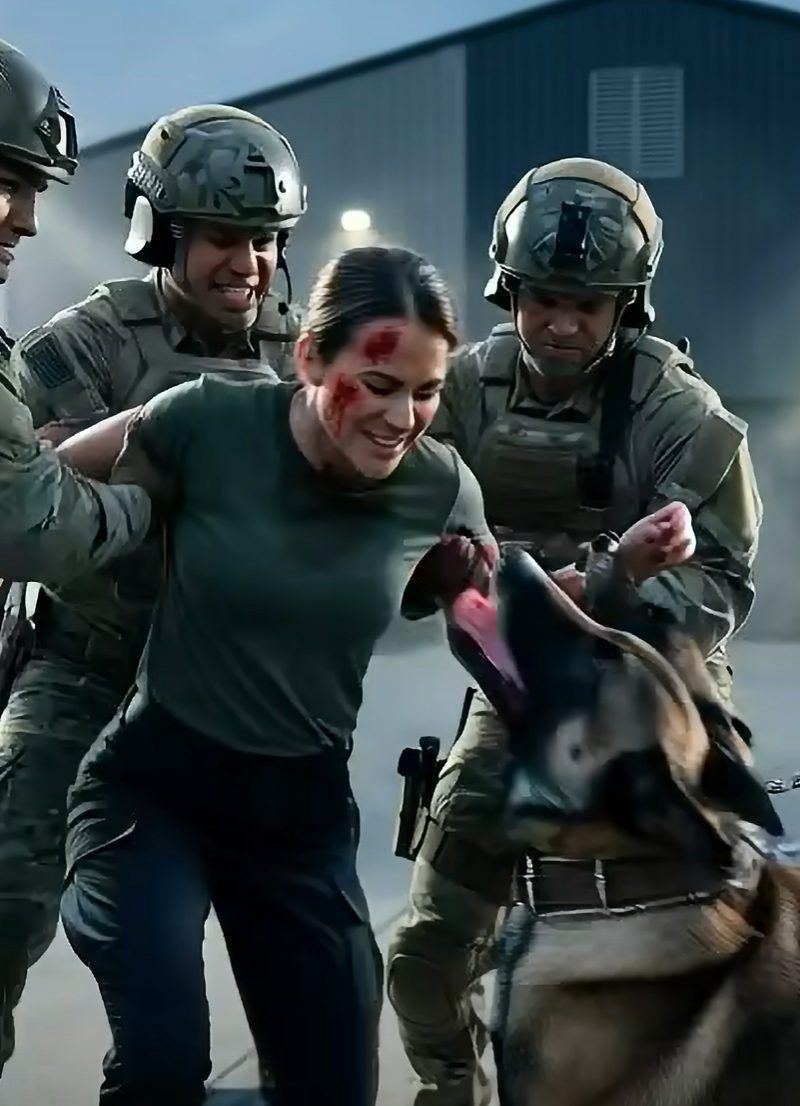
Those Dogs Weren’t Vicious – They Were Tortured!”: How One Woman Silenced the Kennel and Saved Three Military Malinois
At the K9 tactical training compound outside Norfolk, the heat sat low over the concrete runs, chain-link fencing, and dust-packed exercise yard. Men who had spent years around working dogs moved with the swagger of people convinced they had seen everything worth seeing. So when Commander Talia Mercer arrived in plain training gear, no insignia displayed, hair tied back, expression unreadable, the reception was exactly what she expected: polite at first, then dismissive, then quietly hostile.
Officially, she was there to evaluate handling standards and kennel readiness. Unofficially, several of the male trainers had already decided she was an outsider with a clipboard – someone who knew paperwork, not pressure. Their contempt sharpened the moment she questioned the condition of three Belgian Malinois held in an isolated enclosure at the far end of the compound. The dogs – Rexor, Vandal, and Kiro – were pacing in tight circles, ribs visible, eyes hot with agitation, their movements too sharp to be normal. Talia saw the signs immediately: prolonged hunger, excessive stimulation, sleep disruption, and the kind of rough conditioning that confuses fear with obedience.
The trainers called them dangerous.
Talia called them damaged.
That was when Chief Handler Brett Sawyer, a broad-shouldered instructor with too much confidence and too little patience, made the challenge everyone around him secretly wanted to see. If she thought she understood dogs better than the people working them every day, she could step into the enclosure herself. No bite sleeve. No baton. No tranquilizer. No sidearm. Just her and three half-starved Malinois who had been kept on edge for more than thirty-six hours.
The invitation was not professional. It was a trap dressed as a dare.
Everyone expected her to refuse.
Talia did not.
She removed her watch, handed over her radio, and walked toward the gate while a line of handlers gathered along the fence, some curious, some amused, some openly waiting for blood. Inside the enclosure, the dogs were already locked onto her movement. Rexor crouched first, head low. Vandal tested the angle from the left flank. Kiro held the center, tail stiff, reading her the way predators read weakness. Talia stepped through the gate without hurry and let it close behind her.
She did not stare them down.
She did not retreat.
She slowed her breathing, dropped her shoulders, angled her body slightly off-line, and let silence do what shouting never could. Every motion she made had meaning. No challenge. No fear. No false softness either. She communicated the way experienced handlers sometimes forget: through space, tension, posture, stillness.
The first lunge never came.
Instead, confusion rippled through the pack. The aggression they had been trained to amplify met something they could not categorize. Talia shifted once, barely. Rexor stopped pacing. Vandal’s ears twitched forward. Kiro, the most unstable of the three, gave a deep warning growl – then hesitated when she neither threatened nor submitted.
Minutes later, the impossible happened.
One by one, the dogs sat.
Not broken. Not exhausted. Calm.
The men at the fence stopped laughing.
And when an older kennel tech suddenly whispered that he knew exactly who Talia Mercer was – the combat K9 specialist once credited with saving an entire patrol in Helmand – the mood on the compound changed from mockery to shock.
Because if she had just done in four minutes what their whole system failed to do for months, then one question was about to tear the compound apart:
What Exactly Had Been Happening Here
The kennel tech’s name was Dennis Pruitt. He was fifty-three, had worked military dogs since Reagan was in office, and he had the kind of face that had stopped being surprised by things years ago. But his face was doing something now.
He didn’t say it loud. Just loud enough for the two handlers standing nearest to him. “That’s Mercer. The Mercer. She was in Helmand when Koda’s patrol walked into the ambush. She pulled that dog out of a burning vehicle and held the perimeter herself for eleven minutes.”
Nobody confirmed it. Nobody denied it.
Sawyer heard it from fifteen feet away and his jaw went tight.
Inside the enclosure, Talia was crouching now. Not rushing it. Just lowering her center of gravity the way you do when you want to stop being a threat and start being a presence. Rexor had moved two feet closer without seeming to decide to. Vandal was watching her hands. Kiro still had that hard stiffness in his haunches but the growling had stopped.
She reached into her left cargo pocket and came out with three strips of dried meat she’d had since that morning. Not treats. Protein. The difference mattered.
She set one on the ground in front of her. Didn’t hold it out. Didn’t coax. Just placed it and went still.
Rexor took four minutes to get there. He ate it without looking away from her face.
The men at the fence had stopped talking entirely.
The System That Made Them This Way
The evaluation report Talia had been handed before arriving was forty-one pages. She’d read it twice on the drive down from D.C. Most of it was metrics: bite force assessments, obstacle completion times, aggression ratings on a scale of one to ten. Rexor was an eight. Vandal a nine. Kiro was listed as a ten with a red flag notation: handler discretion required at all times.
What the report didn’t say, but what Talia had read between every clinical line: these dogs had been failed systematically.
The conditioning protocol used at the compound was old. Not old in the sense of traditional or proven. Old in the sense of stubborn. It had been designed in the late nineties by a retired trainer named Garfield Cobb who believed that combat dogs needed to operate at maximum arousal at all times, that calm was complacency, that a dog who could be soothed was a dog who could be distracted.
Cobb was long gone. His philosophy had stayed.
The result was what Talia was looking at: three dogs who had been kept in a state of chronic stress until their nervous systems had essentially locked. They weren’t vicious. They were running on cortisol and confusion. They had been taught that humans brought either threat or food, nothing else, and since food had been inconsistent, they defaulted to threat.
Every handler who had approached them with body armor and a baton had confirmed the only lesson they knew.
Talia had walked in with her hands open.
That was the whole difference.
The Thing Sawyer Said Next
He waited until she was back outside the enclosure. The gate clanged shut behind her and she was brushing dust off her knees when he walked over. He had the look of a man who had lost something but hadn’t decided yet whether to admit it.
“That’s a nice trick,” he said. “Doesn’t mean they’re deployable.”
Talia looked at him for a moment. Not long. “Didn’t say they were. Said they were damaged. Damaged things can be fixed.”
“Takes months. We don’t have months.”
“You had months. You spent them making it worse.”
Sawyer’s neck went red from the collar up. Two of his handlers shifted their weight. One of them, a younger guy named Marcus Webb, looked at the ground.
Webb was the tell. Talia had noticed him earlier, the way he’d stood slightly apart from the group, the way he’d watched the enclosure with something in his face that wasn’t amusement. He knew. Maybe not everything, but enough.
She made a note of that and said nothing more to Sawyer. There was no point. You don’t win arguments with men like Brett Sawyer by arguing. You win by making the argument irrelevant.
She pulled out her phone and started documenting. Photos of the enclosure dimensions. Photos of the food and water stations, both inadequate. Photos of the enrichment area, which was essentially nonexistent: bare concrete, one worn rubber toy, a length of chain attached to nothing.
Sawyer watched her do it.
“You’re going to report this,” he said. It wasn’t a question.
“I’m going to report everything,” she said. “That’s what evaluations are for.”
What Marcus Webb Told Her at 9 PM
She was in the temporary quarters they’d assigned her, a cinderblock room with a window unit that rattled every four minutes like clockwork, when someone knocked. She opened the door and Webb was standing there in civilian clothes, baseball cap pulled low, holding a folded piece of paper like he wasn’t sure he was going to hand it over.
She stepped back. He came in.
He was twenty-six, maybe twenty-seven. Had that look of someone who had been told to keep his head down so many times it had become a physical posture.
“I’ve been here fourteen months,” he said. He sat on the edge of the chair by the desk and looked at his hands. “The dogs were fine when I got here. Rexor especially. He was incredible. You could see it. The potential. He wanted to work.”
“What changed?”
“Sawyer got the new contract. The stress-conditioning protocol. He said it came down from above but I never saw paperwork on that.” He paused. “Maybe there was paperwork. I don’t know.”
He handed her the folded paper. It was a training log, handwritten, covering six weeks. Rexor’s weight had dropped eleven pounds in that period. The sleep disruption schedule was documented in Sawyer’s own handwriting, which was either arrogant or stupid. Probably both.
“Why are you giving me this?” Talia asked.
Webb looked up. “Because Kiro bit a handler last month and they’re talking about euthanizing him. And that’s not right. That’s not right at all.” His voice didn’t crack but it wanted to. “He bit someone because someone hurt him first. That’s not a dangerous dog. That’s a dog that ran out of other options.”
Talia looked at the log for a long time.
“You understand what happens if I use this,” she said.
“Yes.”
“Sawyer will know it came from you.”
“I know.”
She folded it back up and put it in the interior pocket of her jacket.
The Compound at 6 AM
She was up before anyone else. She walked the whole facility in the early gray light, before the heat came back, before the handlers arrived. She stopped at the enclosure.
Rexor was lying down. Actually lying down, which she suspected he hadn’t done voluntarily in weeks. He raised his head when she approached the fence. His eyes were still hot but there was something else in them now. Not trust. Not yet. Something earlier than trust. Recognition, maybe. The understanding that she existed.
Vandal was pressed against the far wall, asleep.
Kiro paced. Still paced. But slower.
She stood there for a while, not doing anything, just being present. The compound smelled like metal and dog and the particular flatness of ground that doesn’t drain well. Somewhere in the distance a truck was running.
She thought about Helmand. About a different dog, a different compound, a different kind of heat. About the eleven minutes Webb had mentioned, which had actually been closer to fourteen, and about how she’d been so focused on keeping the dog calm that she’d barely registered the fire until afterward.
She thought about what Koda’s handler had said to her when the patrol got out. He’d grabbed both her arms and said, “How did you do that? How did you keep him like that?”
She hadn’t had a good answer then. She still didn’t, not one that fit in a sentence. You just understood that the dog wasn’t the problem. The dog was never the problem. The dog was the result.
Fix the conditions. The dog fixes itself.
What the Report Said and What Happened After
The formal evaluation ran to sixty-three pages. Talia filed it eleven days after leaving the compound. It documented the conditioning protocol, the nutritional deficiencies, the inadequate rest periods, the absence of any enrichment or decompression structure, and the pattern of escalating stress that had produced three dogs who were now classified as behavioral emergencies.
It also documented, in a separate section, the training log Webb had provided, with his name redacted.
Sawyer’s contract was suspended pending review. That was the official language. In practice it meant he was done, though it would take three more months of institutional grinding before anyone said so directly.
Rexor, Vandal, and Kiro were transferred to a rehabilitation facility in Virginia run by a former Army veterinarian named Dr. Carol Stines, who had been doing this work since 2009 and had a success rate that made the compound’s numbers look embarrassing.
Rexor took four weeks to stop pacing at night.
Vandal was cleared for handler reassignment in three months. She was eventually paired with a young specialist out of Fort Campbell who had the patience for it and the right instincts, and by all accounts they were good together.
Kiro took longer. Kiro always was going to take longer. There were two steps forward and one step back for most of that first year, and there were two separate incidents that made Dr. Stines wonder whether the damage was too deep.
But Kiro was still there. Still working through it.
That was the thing about damaged, Talia had always believed. Damaged wasn’t the same as broken. Broken meant the structure was gone. Damaged meant it was still there, underneath, waiting for the conditions to change.
Webb requested a transfer the week after Talia filed her report. He was assigned to a facility in Colorado. She heard, through a mutual contact, that he was good at his work. That the dogs he handled came out steady.
She wasn’t surprised.
She left the compound the morning after she’d walked into the enclosure, before most of the handlers had arrived. No ceremony, no confrontation. She picked up her watch from the table where she’d left it, clipped it back on, and drove north with the windows down and the radio off.
She thought about Rexor lying down in the gray light.
The way he’d raised his head and looked at her.
Not trust. Something earlier than trust.
That was enough to start with.
—
If this one stayed with you, share it with someone who needs to hear it.
For more stories of unexpected turns and powerful moments, check out what happened when he humiliated me in front of fifty soldiers – then went pale the second he heard my last name or when they dragged me into court in chains and called me a traitor. And if you’re curious about a demonstration that took an unexpected turn, read about when I asked the General what kind of demonstration he wanted.



