
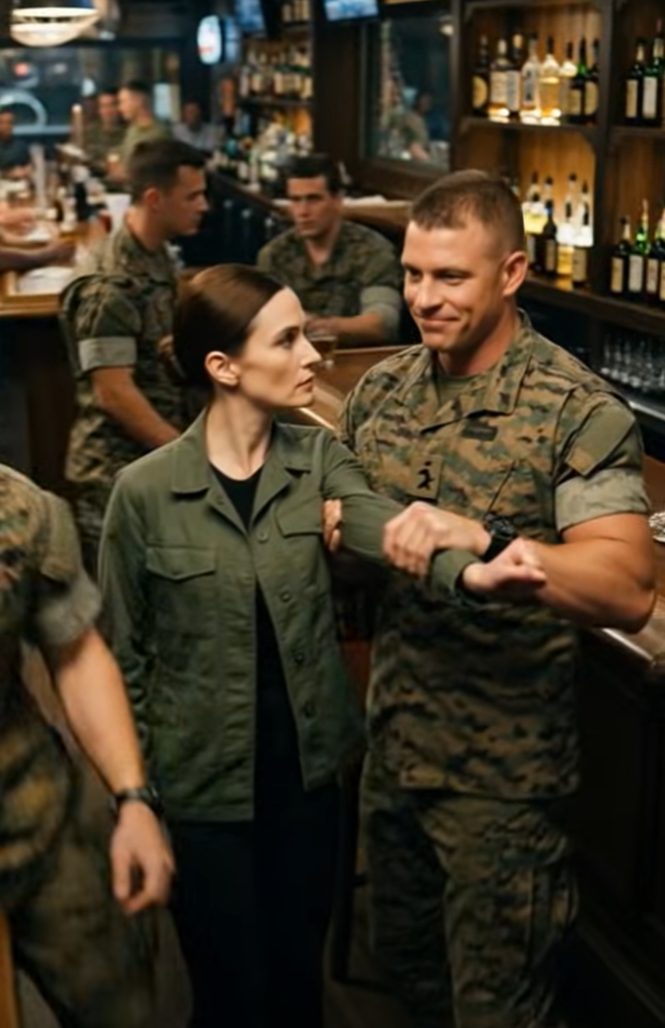
The first thing that moved across the room wasn’t a voice or a warning.
It was a sloppy spray of beer that cut through the dim yellow light, catching glints off scratched tabletops before landing across a plate of fries and spreading outward in a slow, sticky wave.
It reached the edge of the table, paused for the briefest moment, then dripped onto the worn wooden floor in a soft, steady rhythm that somehow sounded louder than it should have.
Elena Graves did not react.
She didn’t pull away, didn’t exhale sharply, didn’t even lift her gaze right away. She had spent twenty-two years learning exactly this – how to hold herself together when every nerve in her body wanted to respond, how to stay rooted when the easier thing would have been to move.
She had buried soldiers. She had stood at podiums and kept her voice level while reading names. She had sat across from generals who tried to rattle her and never once gave them the satisfaction.
One drunk Staff Sergeant with a beer bottle wasn’t going to be the thing that broke her composure.
Instead, she set her water glass down with quiet precision, took a napkin, and began dabbing the spill with small, deliberate motions.
Across the room, laughter erupted in a loose, unrestrained ripple.
To them, it was nothing more than entertainment – the kind that came easily after a few drinks and even easier when the target sat alone.
They saw a woman tucked into a corner booth.
They saw silence and read it as weakness.
They saw stillness and mistook it for surrender.
What they didn’t see – because they had never trained themselves to notice – was the posture that never slackened, the measured breathing, or the quiet awareness in the way she occupied space without ever appearing to claim it.
Because Elena hadn’t come to Anchor Point Tavern to relax.
She hadn’t come for conversation or distraction or even the illusion of a normal evening.
She had come because three weeks ago, a complaint landed on her desk. A formal grievance filed by a junior enlisted woman at Naval Station San Diego – harassment, intimidation, a pattern of behavior that had been dismissed twice already by the chain of command above her.
The woman had named names.
And one of those names was seated twenty feet away, boots propped up, laughing like he owned the room.
Elena needed to see it for herself. Not a report. Not a secondhand account filtered through someone else’s language. She needed to see exactly who these men were when they believed no one important was watching.
The four Marines who had just turned her into a joke had no idea they were already part of something far more consequential than the night they thought they were having.
The Kind of Place Where People Get Comfortable Too Quickly
Anchor Point Tavern sat just outside Naval Station San Diego, wedged between a tire shop that closed early and a pawn shop that always looked half-forgotten, as if it had stopped keeping track of time years ago.
Inside, the lighting never truly shifted – hovering in a permanent low glow that made everything feel slightly blurred around the edges.
The walls were layered with scratches and carved initials. Small attempts by strangers to leave a mark in a place that never remembered anyone for long.
The air carried the weight of years – beer, sweat, laughter, arguments – pressed deep into the wood and soaked into every grain.
It was exactly the kind of place where rules softened, voices grew louder, and people stopped noticing who might be watching.
Which was exactly why Elena had chosen it.
At a table near the center, the four Marines fed off their own energy, loud enough that their voices rolled over nearby conversations without resistance.
They were young in that specific way that comes after surviving early challenges – where confidence grows faster than perspective and strength begins to feel like certainty.
Staff Sergeant Jason Carter leaned back, boots hooked casually, his expression carrying that easy arrogance that often passed for leadership among peers.
“I’m telling you, she’s gonna break,” he said, nodding toward Elena’s booth with a smirk he didn’t bother hiding.
Lance Corporal Tyler Brooks let out a low laugh.
“They always do. Push them just enough, they fold.”
Private First Class Evan Cole swirled what remained in his glass, eyes narrowing slightly as he watched her without truly seeing her.
“Shouldn’t sit alone if she doesn’t want attention,” he added, as if that explained everything.
Across from them, Corporal Ryan Hale shifted in his seat, his gaze moving between his friends and the quiet figure in the corner.
“Guys… maybe just leave it,” he said, his tone softer, almost hesitant, as if he already understood something the others didn’t.
But the moment slipped away, swallowed by laughter that came too quickly and lasted too long.
Because in a place like that, hesitation almost never wins.
And in the corner booth, Elena reached into her jacket pocket and felt the four sealed envelopes she had prepared before walking through the door.
She hadn’t decided yet whether tonight would be the night she used them.
She was deciding now.
What the Envelopes Contained
She had typed them herself. No assistant, no admin staff, no one else in the loop.
Four sheets of paper. Four names at the top of four separate documents. Each one a summary – clean, specific, sourced – of the formal complaint filed by Corporal Denise Ruiz, age twenty-four, three years of service, one prior commendation, two prior attempts to report what had been done to her in the parking structure on base and in the break room of the motor pool and in a dozen smaller moments that never made it into any official record because no one had bothered to write them down.
Elena had written them down.
She’d spent eleven days reconstructing Denise Ruiz’s timeline from scratch – cross-referencing access logs, duty rosters, surveillance footage requests that took four phone calls to get approved. She’d interviewed six people who said they hadn’t seen anything and two who said they had but asked not to be named.
The envelopes weren’t subpoenas. They weren’t official notices of investigation.
They were something quieter than that, and in some ways worse.
Each one contained a single paragraph informing the recipient that a formal review had been opened, that their conduct during specific dates and times was under examination, and that they were expected to report to the Office of the Inspector General at 0800 on the following Monday.
That was four days away.
Elena had planned to mail them Friday morning.
But she’d come here first because she needed to know whether Carter was the kind of man who performed badly in front of witnesses or the kind who performed badly when he thought there weren’t any.
Now she knew.
The Second Move
Carter stood up.
Not aggressively – that came later. First he just stood, the way men do when they’ve had enough to drink that movement feels like an idea worth following through on. He said something to the others that Elena couldn’t hear from across the room, and then he started walking toward her booth with the particular loose-shouldered gait of someone who had never once been told to stop.
She kept her eyes on the table. Not because she was afraid. Because she wanted him to get close enough that there would be no question later about what he had said.
He stopped at the edge of her booth. Gripped the back of the seat across from her with one hand.
“You doing alright over here?”
His voice was the kind of friendly that isn’t.
Elena looked up. She met his eyes and held them with the same expression she used in rooms full of people who outranked her, which was no expression at all.
“I’m fine,” she said. Flat. Final.
He didn’t move.
“You sure? You’ve been sitting alone a while. My friends and I were thinking maybe you could use some company.”
Behind him, at the center table, Brooks said something and Cole laughed. Hale was looking at his drink.
Elena let three full seconds pass. She counted them.
“Staff Sergeant Carter,” she said.
His hand tightened on the seat back. Just slightly. The smirk didn’t fall off his face all at once – it took a moment, like something draining.
“I don’t think we’ve met,” he said.
“We haven’t.” She reached into her jacket and set one of the envelopes on the table between them. His name was typed across the front. “But you have an appointment Monday morning. I’d recommend getting some sleep this weekend.”
He stared at the envelope.
She watched his face go through four or five things in about two seconds – confusion, irritation, a flash of something that might have been fear, then the performance of not being afraid, which is never quite as convincing as the real thing.
“What is this?”
“It explains itself.”
What Hale Did Next
She expected Carter to pick up the envelope. Instead he left it on the table and walked back to his friends without another word. She watched him go. Watched him lean down and say something. Watched the easy confidence leave the table like air out of a tire – slowly, then all at once.
Brooks stood up and looked at her. She held his gaze until he sat back down.
Cole pulled out his phone.
But Hale – Corporal Ryan Hale, twenty-two years old, from Decatur, Illinois, eighteen months into his first posting – Hale got up from the table and walked toward her booth with his hands visible and his shoulders straight and stopped a respectful distance away.
“Ma’am,” he said. “I’m sorry. For the beer. For all of it. I should’ve said something earlier and I didn’t and I’m sorry.”
Elena looked at him for a long moment.
He didn’t fidget. Didn’t look back at his friends for reassurance. He just stood there and took the weight of her attention without flinching.
“Sit down, Corporal.”
He sat.
“You filed nothing,” she said. “You witnessed conduct that should have been reported and you stayed quiet. You understand that.”
“Yes, ma’am.”
“Is that a pattern for you or was tonight unusual?”
He thought about it. Actually thought about it, which she noticed.
“I’ve stayed quiet before,” he said. “More than I should have.”
She slid one of the remaining envelopes across the table. He looked at his name on the front and his jaw tightened.
“Monday, 0800,” she said. “But if you come in with a written account of what you’ve witnessed – specific, dated, signed – that changes the shape of the conversation considerably.”
Hale picked up the envelope. Turned it over once in his hands.
“Corporal Ruiz,” he said quietly. Not a question.
“I can’t confirm that.”
But he nodded like she had.
He stood, tucked the envelope under his arm, and walked back to the table. Said something to the others that Elena couldn’t hear. Picked up his jacket. Left.
The three remaining men watched him go. Then they looked at Elena. Then they looked at the envelopes she was still holding.
She set the last two on the table in front of her, side by side.
Waited.
Carter came back for his. Brooks took longer, but he came.
Cole was the last. He crossed the room with his hands in his pockets and his chin down and didn’t say anything when he picked it up. Just took it and turned and walked out the door without returning to the table.
Carter and Brooks left two minutes after that.
What the Bartender Said
The bartender’s name was Phil Donahue. Fifty-three, former Navy, forearms like dock rope, the kind of quiet that comes from having seen most things twice already.
He came over with a cloth and cleaned the table where the four of them had been sitting.
“You want anything?” he asked. “On the house.”
“Water’s fine.”
He refilled her glass without comment. Started to walk away.
“Phil.”
He turned.
“Did you see what happened over there tonight?”
He looked at her steadily. “I see most things in here.”
“If someone asked you to write down what you saw, would you?”
He considered that for a moment, the cloth folded over his forearm.
“Depends on who’s asking,” he said.
Elena set a card on the table. He picked it up and read it and his eyebrows moved, just barely.
“Monday’s fine,” she said. “If you’re willing.”
He put the card in his shirt pocket and went back behind the bar.
Elena sat alone in the corner booth for another twenty minutes. The room filled back in around her – other voices, other conversations, the normal noise of a Tuesday night bleeding toward closing time.
She finished her water.
Left the plate of fries, cold now, untouched.
On her way out she paused at the door and looked back at the room – the scratched tables, the low light, the walls full of initials from people who’d passed through and thought no one would remember them.
Phil was already watching her go.
She pushed through the door and walked to her car and sat in it for a minute in the dark, not thinking about anything in particular. Her hands were completely steady.
She drove back to base with the windows down, the night air off the bay coming in cold and flat and smelling of salt and diesel.
Monday was four days away.
—
If this one got under your skin, pass it to someone who needs to read it.
For another tale of mistaken identity and unexpected power, read about how She Had No Rank on Her Sleeve. The Monitor Knew Her Name, or discover why The Woman They Grabbed in the Parking Lot Wasn’t Who Anyone Thought She Was.



