
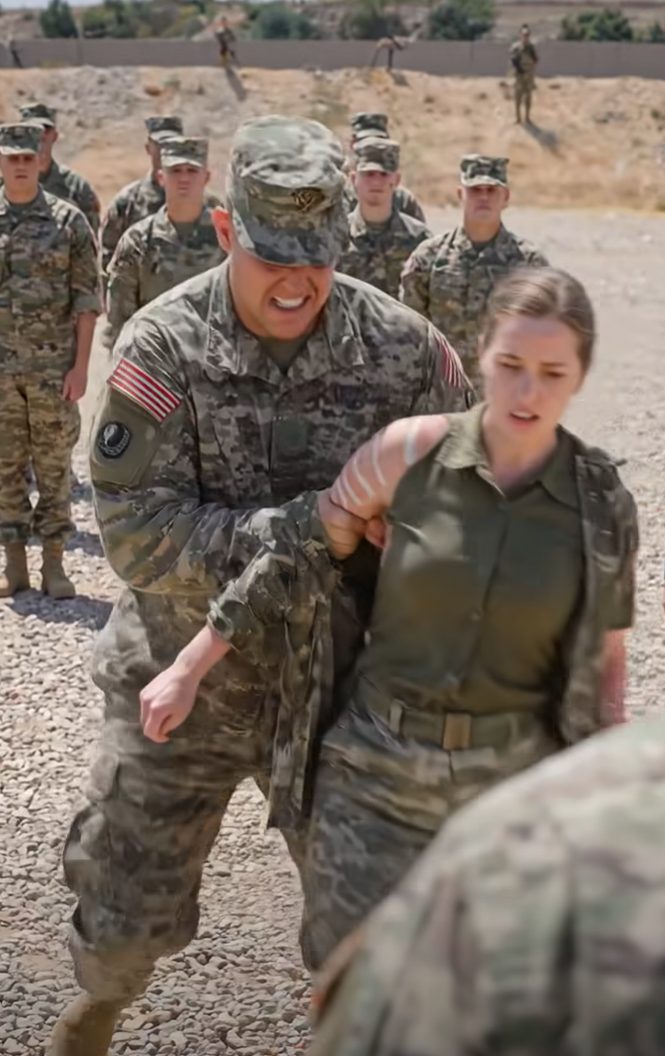
The Georgia clay didn’t just stain your boots; it seeped into your pores, heavily scented with pine, sweat, and the suffocating humidity of Fort Mercer. For the past six weeks, I had survived basic training by mastering the art of being invisible. At barely five-foot-two and weighing less than a standard-issue rucksack, I wasn’t a soldier they looked at twice. That was exactly how I wanted it.
Every morning, before the bugle even thought about waking the rest of the barracks, I meticulously rolled my right sleeve up exactly three inches above the elbow, but my left sleeve remained buttoned down to the wrist. I secured it with a small, rusted safety pin hidden perfectly beneath the seam. It was an obsessive ritual. That, and staring strictly at the third button of whoever stood in front of me during formation. If you never meet their eyes, they can never see the ghosts lingering in yours.
I thought I had cultivated a perfect, false sense of peace. I maxed out my physical fitness tests in the quietest way possible, never finishing first, never finishing last. I cleaned my M4 rifle until the bolt carrier group shined like a mirror, absorbing myself in the rhythmic, metallic clicking. But in an environment built to break you down, camouflage only works for so long.
Recruit Miller was a legacy. Standing six-foot-four with shoulders that blocked out the sun, he came from a long line of infantrymen and carried an arrogance that the drill sergeants mistook for leadership. To him, my silence wasn’t submission; it was defiance. And in Miller’s world, defiance from someone half his size was a personal insult.
He didn’t use his fists. The military had strict rules against that now. Instead, he used his mass, his shadow, and his suffocating presence. During chow, he would bump my tray just enough to spill scalding black coffee onto my knuckles, whispering, “Oops, didn’t see you down there, ghost.” During low-crawl exercises under the barbed wire, he would intentionally kick up storms of red dust directly into my face, choking me.
I took it all. Every insult, every “accidental” shove, every sabotaged bunk. I swallowed the humiliation because reacting meant drawing attention, and drawing attention meant questions I could never, ever answer. I let them think I was weak. I let them think I was a terrified little girl who had made a monumental mistake walking into a recruiter’s office. It was better they believed I was fragile than for them to know what I actually was.
But the phantom itch beneath my left sleeve was growing worse.
It always flared up when my heart rate spiked, a psychosomatic burn reminding me of a life I was desperately trying to outrun. A life built on the ashes of classified coordinates, shattered glass, and the smell of burning jet fuel. I had buried that version of myself deep underground, right along with the team I couldn’t save. Fort Mercer was supposed to be a fresh start. A blank slate disguised as a grunt.
Week six was the crucible. We had just finished a brutal twelve-mile ruck march through the sweltering backwoods. The air in the staging yard was heavy with exhaustion, the metallic tang of adrenaline, and frayed nerves. Platoon 3 stood in ragged columns, chests heaving, waiting for the command to drop our seventy-pound packs.
I was standing perfectly still, eyes locked on the third button of the recruit in front of me, breathing in slow, measured counts of four. My left hand instinctively twitched, my thumb brushing against the hidden safety pin at my wrist to ensure the cuff was secure.
Miller was pacing near the back, his face flushed with heat and irritability. He had struggled on the final hill, his massive frame a detriment in the suffocating humidity, while I had simply put one foot in front of the other, an unbothered metronome of endurance. He hated that. He hated that he was bent over gasping while the “tiny ghost” wasn’t even flushed.
“You think you’re something special, Vance?” his voice boomed across the dusty yard, shattering the exhausted silence.
I didn’t move. I didn’t blink.
“Hey!” he barked, closing the distance between us in three heavy, aggressive strides. The surrounding recruits subtly stepped back, wanting no part of the impending collision. “I’m talking to you, you little mute. Six weeks of this act. You don’t belong here. You’re a liability to this entire squad.”
He stepped squarely into my personal space, his chest practically against my face, trying to physically dominate me into looking up. I kept my gaze leveled at his chest rig.
“Look at me when I’m talking to you,” he snarled, the heat of his breath washing over my face.
Silence. Just the wind kicking up the red dirt.
Infuriated by my complete lack of reaction, Miller snapped. He didn’t punch me – he reached down with a massive, dirt-caked hand and aggressively grabbed my left wrist, intending to physically drag me out of the formation line.
“I said – “
He yanked fiercely.
My instinct, buried under months of suppression, flared faster than conscious thought. I planted my back foot and twisted my center of gravity to break his grip, a highly classified kinetic reflex. The sudden, violent torque was too much for the worn military fabric.
The rusted safety pin violently snapped.
There was a sharp, loud RIIIP that seemed to echo across the quiet staging yard. The entire left sleeve of my OCP uniform tore open from the cuff all the way up past the elbow, the fabric fluttering uselessly in the hot wind.
Miller stumbled back, a triumphant sneer starting to form on his lips – but it died instantly.
He looked down at my exposed arm.
The sneer evaporated, replaced by a sudden, visceral pallor. He dropped his hand as if he had just touched a hot stove. He took a stumbling step backward, his mouth opening and closing without a sound.
The recruit next to him looked over. He gasped, a sharp, choked sound of pure horror.
Within seconds, the exhausted murmurs of the platoon died completely. A suffocating, terrifying silence fell over the staging yard. Fifty recruits stood frozen, their eyes locked in absolute, unadulterated terror at my left arm.
It wasn’t just a scar. It was a horrifying, undeniable roadmap of unspeakable trauma. Deep, jagged keloid tissue wrapped around my forearm like brutalized barbed wire, weaving through the unmistakable, perfectly circular burn marks of a high-voltage interrogation matrix. But worse than the scars was what was permanently branded into the center of the ruined flesh – a jagged, pitch-black insignia of a scythe wrapped in chains.
It was the ghost mark. The branding of the Reaper Battalion, a black-ops unit so highly classified, so lethally infamous, that their very existence was considered an urban legend meant to terrify hardened war criminals. To have that mark meant you had survived the absolute worst hell on earth.
Nobody moved. The air itself seemed to turn to ice despite the ninety-degree heat. Miller was trembling, staring at the tiny, quiet female recruit he had been tormenting, suddenly realizing he had been repeatedly kicking a sleeping dragon.
I stood perfectly still, my breathing unchanged, the torn sleeve catching in the wind. The false peace was gone. The camouflage was destroyed.
Footsteps crunched heavily on the gravel.
The crowd of terrified recruits parted like the Red Sea. Stepping through the gap was Colonel Briggs, the legendary, silver-haired base commander of Fort Mercer. A man who rarely left his command post, a veteran with eyes as cold as steel who had seen three different wars.
He walked slowly into the center of the formation, his commanding presence immediately dominating the yard. He stopped three feet from me. His cold eyes drifted down from my face to the torn, fluttering fabric of my sleeve.
He looked at the jagged scars. He looked at the pitch-black scythe.
Briggs didn’t yell. He didn’t reprimand Miller. His eyes locked onto the jagged landscape of my forearm, all the blood draining from his weathered face, and what he did next sent a shockwave through the entire camp.
What Briggs Did With His Hands
He came to attention.
Full, rigid, by-the-book attention. Heels together, chin level, eyes forward. The base commander of Fort Mercer, a man who had shaken hands with two sitting presidents and buried soldiers in four different time zones, snapped to attention in front of a recruit.
Then he saluted me.
Not a casual acknowledgment. Not a half-gesture. A full, formal, held salute. His right hand locked at the brim of his cover, his arm rigid, his face stripped of everything except something I can only describe as recognition. Like a man who had just found something he thought was lost for good.
Nobody breathed.
I held his gaze for the first time in six weeks. Didn’t look at his third button. Looked directly into those steel-grey eyes that had seen Fallujah and Kandahar and things he’d never once put in a report.
I returned the salute.
The yard stayed dead silent for another three seconds. Then Briggs dropped his hand, turned slightly, and looked at Miller the way you’d look at something you’d scraped off your boot.
He didn’t say a word to him either.
He just looked. And Miller, six-foot-four Miller with the infantry bloodline and the suffocating arrogance, seemed to shrink about eight inches in real time.
Briggs turned back to me. “Vance.”
“Sir.”
“Walk with me.”
The Walk Nobody Talked About Afterward
We left the formation behind. Fifty recruits standing in Georgia clay, not one of them making a sound.
I fell into step beside him, my torn sleeve still flapping. He didn’t offer to get me a replacement uniform. He didn’t look at the arm again. He walked with his hands clasped behind his back, his pace measured, heading toward the far tree line where the gravel path curved behind the motor pool and out of earshot of everything.
When we were clear, he stopped.
He stared at the middle distance for a moment. A crow was doing something loud and irritating in a pine tree about forty yards out. That was the only sound.
“Reaper Seven,” he said. Not a question.
My chest did something. Not dramatic. Just a small, tight compression, like a fist closing around something fragile.
“That unit doesn’t exist,” I said.
“No,” he agreed. “It doesn’t.”
He was quiet again. The crow left. Somewhere back in the yard, a drill sergeant was finally barking at somebody about something, the world resuming its ordinary noise.
“I knew your team leader,” Briggs said. “Donovan.”
The name hit me in the back of the throat.
“He was a good man,” I said.
“He was the best man I ever served with.” Briggs turned and looked at me directly. “I got the casualty report fourteen months ago. It listed the entire team KIA. All seven.”
I didn’t say anything.
“You weren’t on that list,” he said.
“No. I wasn’t.”
He looked at my arm. Just briefly. His jaw moved once, like he was chewing something he couldn’t swallow. “How long were you held?”
“Classified.”
A pause. “Vance.”
“Eleven weeks,” I said.
He closed his eyes for two seconds. Opened them. Looked back at the tree line.
“And then you walked into a recruiting office.”
“I needed somewhere to put myself,” I said. It came out flat, honest, slightly embarrassing. “Somewhere with a schedule.”
What He Said About Miller
We walked back after maybe ten minutes. Neither of us said much else. There wasn’t much else to say. He knew what the scythe meant. He knew what the burn marks meant. He knew what eleven weeks in a black site did to a person’s nervous system, their sleep, their relationship with any room that locked from the outside.
He didn’t need me to explain any of it, and that was the first time in fourteen months I hadn’t felt like I was supposed to explain any of it.
At the edge of the motor pool, he stopped again.
“Miller,” he said.
“Don’t,” I said.
He looked at me.
“I’m not a victim,” I said. “If you pull him out of the platoon, every recruit in that yard draws a line between what they saw and why he’s gone. I become a problem. I become a story.” I kept my voice level. “I just need to finish training. That’s all.”
Briggs studied me for a long moment. The calculation behind his eyes was visible, the kind of thinking that had kept a lot of people alive over a long career.
“He touches you again,” Briggs said, “and it stops being your call.”
“Understood, sir.”
We walked back.
What Changed and What Didn’t
Miller never spoke to me again. Not a word, not a bump, not a shadow thrown across my tray at chow. He moved through the remaining weeks of training like a man trying very hard to be invisible, which I found quietly funny in a way I never shared with anyone.
The other recruits were different about it too, but not in the way I’d feared. Not pitying. Not scared exactly. More like they’d all agreed, without discussing it, to simply give me space. To stop testing the edges of me.
I finished basic training on a Thursday in October. The clay was still red. The pine smell was still there. I rolled both sleeves to the elbow for the ceremony because it was regulation and because I was done hiding it, at least in this yard, from these people.
Briggs stood at the front during the graduation formation. He didn’t look at me any differently than he looked at anyone else. He shook hands down the line, firm and quick, the same grip for every new soldier.
When he got to me, he paused for half a second.
He pressed something small into my palm as he shook it. Closed my fingers around it before moving on.
I didn’t look until I was back in the barracks, sitting on my bunk with my new kit spread out around me.
It was a challenge coin. Old, worn smooth on one side from handling. The insignia on the back was a scythe.
Not wrapped in chains.
Just the scythe. Clean. The way it looked before everything that came after.
I held it for a while. Then I put it in the chest pocket of my jacket, right over the sternum, where I’d feel it when I breathed.
I didn’t sleep great that night. I never did. But I slept.
—
If this one got into your chest, pass it to someone who needs it.
For more tales of unexpected twists and hidden strengths, you might enjoy how she built the jet he couldn’t fly, or the story of how they stripped her rank in front of 5,000 sailors, but she made one phone call first, and don’t miss the time he told her to fetch his coffee, but had no idea who she was.



