
The bar wasn’t crowded, but it was loud enough that Maya heard the laughter before she saw where it was coming from.
Three guys at the high-top near the window. Mid-twenties, collared shirts, the particular confidence of men who’d never been told to quiet down. One of them had his phone out, and for a moment she thought he was showing the others something on the screen.
Then she followed his gaze to the woman sitting alone at the bar.
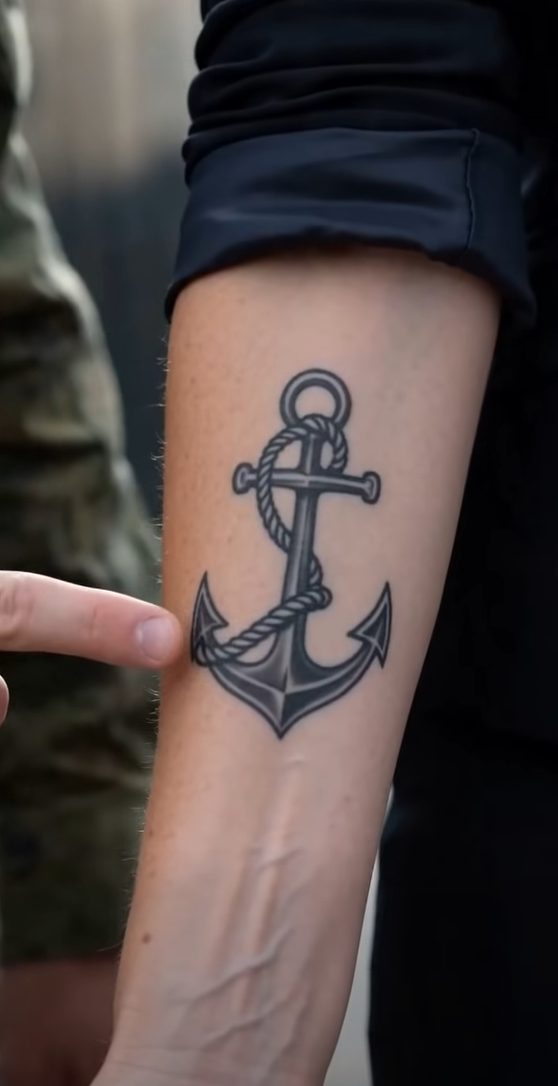
She was maybe sixty, silver-haired, nursing a glass of red wine with both hands wrapped around the stem. Her left forearm rested on the bar top, sleeve pushed up against the heat of the room. The tattoo was small – a date, and beneath it, a single set of wings. Nothing ornate. The kind of ink that doesn’t announce itself.
“What is that even supposed to mean?” one of the guys said, loud enough to carry. His friends grinned into their drinks.
The woman didn’t turn around. Just set her glass down slowly, the way people do when they’ve decided not to react.
“Probably means she lost a bet,” another one said, and the laughter came harder this time.
Maya watched the woman’s shoulders. They didn’t rise. They didn’t tighten. She just sat there, both hands still wrapped around the wine glass, and Maya thought she understood something then – that this wasn’t the first time, and the woman had learned long ago how to make herself a still, quiet thing until it passed.
But it didn’t pass.
“Ma’am.” The loudest one leaned sideways off his stool, craning toward her. “Hey. What’s the occasion?”
The woman turned then. Not sharply. Just a slow pivot on the barstool, the kind of movement that belongs to someone with nothing left to prove. She looked at the three of them for a moment without speaking, and in that silence Maya felt something shift in the room’s atmosphere, though she couldn’t have said why.
The woman set her forearm flat on the bar between them so the tattoo faced up, clear under the light.
She said a name. A rank. And then the date inked into her skin.
—
One of the guys put his drink down.
Another one looked at the floor.
The third opened his mouth, and then closed it, and didn’t try again.
What Maya Did Next
She’d been holding her own drink the whole time. A gin and soda she’d barely touched.
She set it down now, slid off her stool, and walked the twelve feet between them without thinking too hard about it. She sat down one seat over from the woman. Not right next to her. Just close enough.
The bartender, a guy named Dennis who Maya had seen work this room on Friday nights for two years, had gone very still at the end of the bar. His hand was on a pint glass he’d stopped pretending to dry.
“Can I buy you another?” Maya asked.
The woman looked at her. Her eyes were pale, the kind of gray that reads blue in some lights. There were lines at the corners of them, the sort that come from squinting into sun or wind, not from laughing. She considered Maya for a second.
“Sure,” she said. “Thank you.”
That was it. No performance. No gracious little speech. Just sure and thank you, like she’d accepted a kindness a thousand times and knew not to make it bigger than it was.
Dennis poured without being asked. He put it down in front of her and didn’t charge Maya for it either. She found that out later when she got her tab.
Her Name Was Carol
Not Caroline. Carol. She said it flat, the way people do when they’ve had to correct the assumption before.
Carol Hatch. She’d driven up from Bridgeport that afternoon for reasons she didn’t explain right away, and she was waiting for her daughter, who was forty minutes late and had texted three times with updates that kept pushing the arrival back.
“She’s always late,” Carol said, without apparent irritation. “Since she was sixteen.”
Maya laughed. Carol almost did.
The three guys at the high-top had rearranged themselves somehow. Two of them were facing the window now. The loud one, the one who’d leaned off his stool, was on his phone with his back mostly turned. None of them were laughing.
Maya didn’t look at them long enough to make it a thing.
“The tattoo,” she said, because she wanted to ask and didn’t know a cleaner way in. “If you don’t mind.”
Carol didn’t mind.
She turned her forearm up again, more for herself than for Maya, and looked at it the way you look at something you’ve memorized but still need to see.
The name was Daniel. The rank was Specialist. The date was in March, eleven years back.
“My son,” Carol said.
Eleven Years
He’d been twenty-two. Deployed eight months into a four-year enlistment, which she’d spent equal parts proud and sick about, the way she explained it. You don’t get to feel just one thing. She said that without drama, like it was a fact about weather.
Daniel had been funny. That was the first thing she said about him, not brave or good or any of the other words people reach for. Funny. He did voices. He could do their neighbor’s laugh so exactly that Carol had answered the phone once thinking it was the neighbor, and he’d kept it going for four full minutes before she caught on.
She found out on a Tuesday. The men came to the door in the early afternoon, and she’d known before she opened it, she said. She’d known from the car in the driveway.
She got the tattoo eight months later, after she’d stopped thinking it would feel like giving up. A woman in New Haven did it. Small parlor, cash only, a photo of Daniel propped against the lamp so the artist could see his face while she worked, which Carol hadn’t asked for. The artist had just done it.
“I never went back to say thank you,” Carol said. “I should have.”
She looked at the wine glass.
“I kept meaning to.”
The Thing About That Silence
Maya had been in bars when things went wrong. She’d seen the kind of noise that a room makes when someone gets loud and the tension spills over, that collective intake, the way everyone becomes suddenly interested in their own conversation. She knew that sound.
This had been different.
When Carol said the name and the rank and the date, the silence had come from somewhere else. Not from shock. From something landing correctly. Like a key in a lock, the specific sound of a thing fitting where it belongs.
The guys at the high-top hadn’t gone quiet because they were embarrassed, though they were. They’d gone quiet because there was nothing left to say that wasn’t going to make it worse, and even they understood that. Even with the drinks and the collared shirts and the particular confidence.
Some things are just bigger than the room you’re in.
Carol knew that. She’d known it for eleven years. She carried it on her left forearm, right there, small and clear, not for other people but because she’d needed somewhere to put it that she could always find.
Her Daughter Arrived at 8:47
Maya knew the time because she’d looked at her phone when the door opened and Carol’s posture changed, just slightly, the way a person’s does when they spot someone they’ve been waiting for.
The daughter was maybe thirty-five. Dark-haired where Carol was silver. She came in still unwrapping a scarf and apologizing before she’d fully cleared the entrance, the specific guilt of someone who is always late and has never fully made peace with it.
“I know, I know, I’m sorry, there was an accident on 95 and my phone was – “
She stopped.
Looked at her mother. Looked at Maya.
“Hi,” she said, uncertain.
“This is Maya,” Carol said. “She kept me company.”
The daughter’s name was Renee. She sat down on Carol’s other side and ordered a club soda because she was still driving, and within four minutes she was telling a story about Daniel that Maya hadn’t expected, something from before the deployment, a Thanksgiving where he’d burned the rolls so completely that the smoke detector went off twice and he’d tried to serve them anyway, insisting they had character.
Carol laughed at that one. A real laugh, short and sudden, gone almost before it arrived.
Renee looked at her mother when it happened. Just for a second. The look of someone cataloguing something they don’t take for granted.
Before Maya Left
She stayed another twenty minutes. She didn’t need to, and Carol hadn’t asked her to, but the conversation had found its own rhythm and she didn’t want to break it badly by leaving at the wrong moment.
When she finally got up, Carol touched her arm once, briefly, on the back of the hand.
“Thank you,” she said again. Same two words as before. Same flat, practiced delivery. But this time Maya heard something else in it, or thought she did. The difference between thanking someone for a glass of wine and thanking them for sitting down at all.
She walked out past the high-top. The three guys were still there. The loud one was looking at his phone, but he wasn’t really looking at it. His thumb wasn’t moving.
Maya didn’t say anything to them. There was nothing to say that Carol hadn’t already said better, with less effort, without even raising her voice.
Outside it was cold, the particular cold of a Friday in November in Connecticut, the kind that finds the back of your neck first. She stood on the sidewalk for a second and looked through the window.
Carol and Renee were leaning toward each other now, heads close, Renee’s hand over her mother’s on the bar. Talking about something Maya couldn’t hear.
She stood there longer than she meant to.
Then she turned up her collar and walked to her car.
—
If this one stayed with you, pass it on to someone who’d get it.
For more amazing natural remedies, discover how onion can be a natural remedy for leg & joint pain or the secret doctors won’t tell you about castor oil with baking soda. You might also be interested in this powerful recipe for hair growth using potato.



