
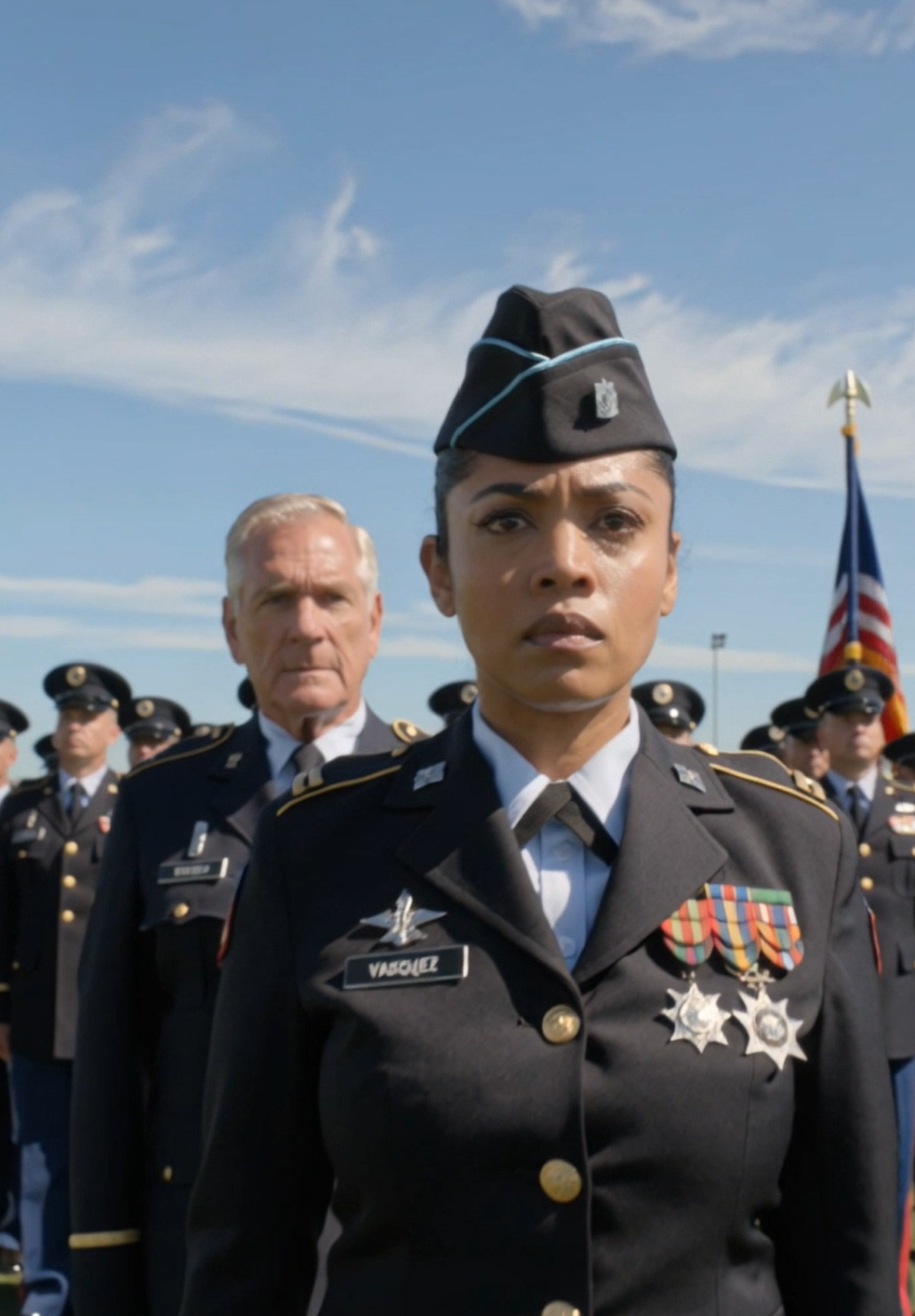
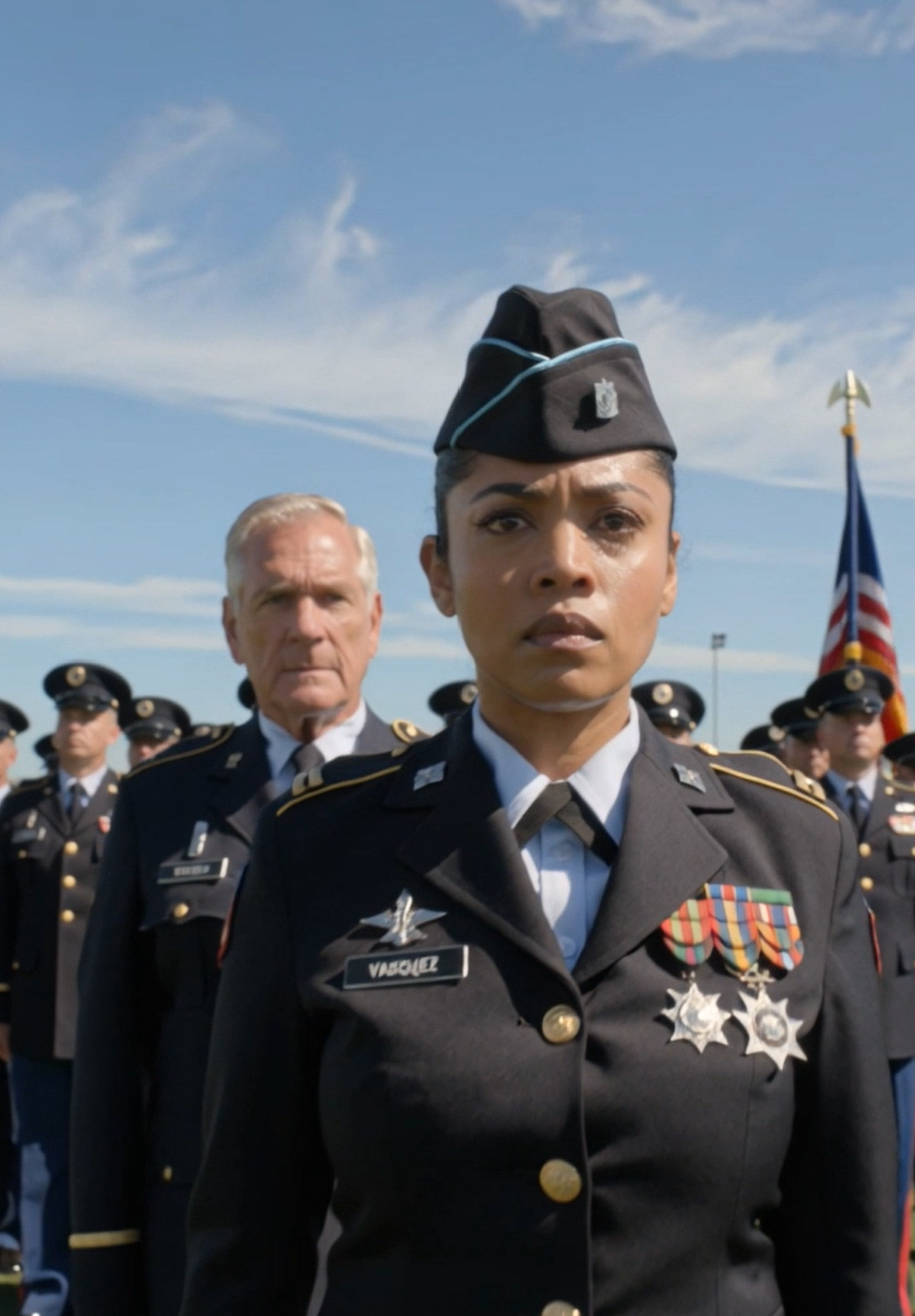
The entire parade field went silent the moment Captain Marcia Delgado refused to salute.
Rows of soldiers stood frozen beneath the brutal afternoon sun, boots planted against scorched pavement, uniforms stiff with heat and discipline. Flags snapped above the reviewing stand. Officers watched from the sidelines, expecting another routine ceremony to unfold exactly as planned.
Then General Victor Hale stopped in front of her.
Decorated. Respected. Untouchable.
A man who had spent three decades commanding obedience with a single glance. And directly in front of him stood one captain who refused to move.
“Then salute,” Hale ordered coldly.
His voice carried across the field with the kind of authority that had broken men far stronger than her.
Every soldier nearby felt the tension at once. Sharp. Immediate. Like lightning racing through metal.
Because nobody ignored a direct command from a general.
Nobody.
But Marcia remained perfectly still.
Her posture never changed. Her expression never shifted. And most chilling of all – she did not look frightened.
Finally, she answered.
“No, sir.”
The words cracked through the parade ground like a gunshot. A shudder moved through the ranks. Stunned glances flickered from the corners of soldiers’ eyes, quick and terrified, careful not to become a second offense.
Even the officers near the reviewing platform went rigid.
General Hale stared at her, and for one strange second it was not anger that crossed his face.
It was disbelief.
As if his mind could not accept what had just happened in front of an entire battalion.
“What did you say?” he asked, quieter now.
Marcia held his gaze without blinking. “I said no, sir.”
The silence that followed turned heavy enough to choke on.
This was no longer simple insubordination. Something darker had stepped onto that field. Something no one else fully understood yet – but everyone could feel.
Hale moved closer, the medals on his chest flashing under the hard afternoon light.
“You understand,” he said carefully, each word sharpened to a point, “that refusing a direct order in front of active ranks carries consequences.”
“I understand perfectly.”
That calmness shook people more than shouting ever could. Marcia Delgado did not look reckless. She looked certain.
Around them, the battalion stood locked in place while tension spread through the formation like fire beneath dry grass. Nobody knew what this was anymore. Only that it had moved far beyond a ceremony.
Then Marcia took one slow step forward.
Just one.
Enough to close the distance between them. Enough that only Hale could clearly hear what came next.
“You really don’t remember me, do you?”
Something flickered across the General’s face then. Small. Quick. But real.
Confusion.
He studied her more carefully now, as though forcing open a locked room in his memory.
“Should I?” he asked.
Marcia’s eyes hardened.
“My father remembered you,” she said softly. “Right up until the day they buried him.”
The change in Hale was instant. His jaw tightened. The lines around his mouth went rigid. Nearby officers noticed it too, and the air shifted again.
Because suddenly this was no longer about military protocol.
This was personal.
“You’re out of line, Captain,” Hale warned. But the edge in his voice no longer sounded like certainty.
It sounded like pressure.
Marcia did not move back. Instead, she opened the folder tucked beneath her arm and pulled out a sealed document. The motion alone made nearby military police tense – hands ready, eyes sharp.
Then she spoke, and the entire field seemed to stop breathing.
“I’ve already contacted military investigators.”
No one moved.
Not the soldiers. Not the officers. Not even the colonel at the sidelines who opened his mouth as if to stop her and then thought better of it.
“The charges were sealed fourteen years ago under executive classification,” Marcia said, her voice steady, controlled, terrifying in its calm. “Until this morning.”
Color drained from Hale’s face so slowly it was worse than panic. It was the visible collapse of a man who had spent decades believing the dead stayed buried.
“What are you doing?” he asked. And now his voice had changed too. Lower. Thinner.
Marcia looked directly into his eyes.
“Finishing what my father died trying to expose.”
A ripple of whispers threatened to break through the formation despite every ounce of discipline holding it together. Officers exchanged alarmed looks. Soldiers stared forward but listened with everything they had.
Then something happened in Hale’s expression that turned the moment from shocking to unbearable.
Recognition.
Slow. Awful. Complete.
His eyes locked onto her fully now. No longer seeing a captain in dress uniform. No longer seeing a subordinate.
He was seeing the past.
“Delgado…” he whispered.
The name left his mouth like a ghost.
And everyone standing on that blazing field could see it now – the fear rising behind the eyes of a man who had once seemed untouchable.
Because at last he understood exactly who was standing in front of him.
Not just Captain Marcia Delgado.
She was the daughter of the officer who vanished fourteen years ago after threatening to expose something buried beneath Hale’s command. The officer declared dead in a transport ambush that never had a body. The officer Hale himself had testified against before the entire investigation quietly disappeared.
The parade field stayed frozen in absolute silence.
Then Marcia lifted the sealed document higher for the whole battalion to see – and what was written on the front cover made General Hale take one slow step back, and then another.
It read: Operation Nightingale: Final Testimony of Major Samuel Delgado.
The name of the operation hung in the air, an invisible poison that only Hale seemed to feel. Two military policemen began to move towards Marcia, their expressions grim, their duty clear.
But a new voice cut through the tension. “Stand down.”
The voice belonged to General Robert Wallace, a man with more years and more stars on his shoulder than Hale. He stepped down from the reviewing stand, his face a mask of stone. He ignored Hale completely. His eyes were fixed only on Marcia.
“Captain Delgado, you will come with me,” he stated, not as an order, but as a lifeline.
The Military Police froze, caught between two generals. Wallace gave them a sharp nod, and they stepped back. He then turned to Hale.
“Victor,” he said, his voice dropping to a low, dangerous tone. “You are relieved of duty pending a formal inquiry. You will be escorted to your quarters.”
The parade was over.
As Wallace led Marcia away from the silent chaos, the world felt like it was moving in slow motion. The rigid soldiers, the shocked officers, the snapping flags — they all blurred into the background.
She remembered her father, Samuel, not as a Major, but as a dad. She remembered him teaching her how to ride a bike on this very base, his large, steady hands on the handlebars. He’d always say, “Look where you want to go, Marci, not at your feet.”
That’s what she was doing now. Looking where she wanted to go.
They entered a sterile, quiet office. General Wallace closed the door, and the hard lines on his face softened into an expression of deep exhaustion and sorrow.
“I knew your father, Marcia,” he said softly. “He was a good man. The best of us.”
Marcia finally allowed herself to take a deep breath. “He said the same about you, sir.”
Wallace gestured to a chair. “I’ve been waiting for this day for fourteen years. Samuel gave me a copy of his evidence before he…left. But it wasn’t enough. We needed more. We needed someone on the inside to connect the final dots.”
“That’s why I joined,” Marcia admitted, her voice barely a whisper. “I spent years in military intelligence, working my way up, searching for anything related to Operation Nightingale.”
The operation, as her father’s files revealed, was not just about bribery or stolen funds. It was far worse.
Fourteen years ago, in a dusty, forgotten corner of the world, then-Colonel Hale had authorized an illegal weapons transfer. He sold advanced American weaponry to a local militia in exchange for battlefield intelligence.
But the intel was bad, and the militia turned on a nearby American patrol.
Twelve soldiers walked into an ambush. They were outgunned, slaughtered by the very weapons Hale had provided. The incident was classified as a tragic but unavoidable consequence of war.
Major Samuel Delgado, Hale’s executive officer, discovered the truth. He found the signed transfer orders Hale had tried to bury. He compiled a detailed file, ready to expose a crime that had cost American lives.
Then his transport was ambushed. No survivors. No body. Case closed.
“They couldn’t let it come out,” Wallace said, his gaze distant. “Not just Hale. The people above him. Hale took the fall for them, and in return, they protected him. They promoted him. They made him a hero to ensure his silence.”
The next few days were a blur of secure rooms and sworn statements. General Hale was held in isolation, his decades of power stripped away in a single afternoon.
Marcia finally sat across from him in a bare, white interrogation room. He looked smaller now, older, without the crisp uniform and the weight of his medals.
He just looked like a tired old man.
“You built your entire career on the graves of those twelve soldiers,” Marcia said, her voice devoid of heat. It was a simple statement of fact.
Hale looked up, his eyes bloodshot. “It was a mistake. A terrible, split-second decision from an officer who wanted to win, who believed bad intel.”
“You didn’t just make a mistake,” Marcia countered. “You covered it up. You let my father take the blame. You let him be declared a traitor who died in a dishonorable ambush.”
For the first time, a flash of the old Hale appeared. “I never called him a traitor! I testified that he was a good officer who got in over his head.”
“You lied,” she shot back. “You stood by while his name was tarnished, while my mother grieved for a man she was told had gone rogue. You let a lie become the truth.”
The fight went out of him. He slumped in his chair, the weight of fourteen years finally crushing him. He was silent for a long time.
Then, he spoke, his voice so low she had to lean in to hear it.
“I didn’t kill him,” he whispered.
Marcia stared at him, unblinking. “What did you say?”
“Your father,” Hale croaked, looking her in the eye. “I didn’t kill him. I couldn’t do it. He was my friend.”
This was a twist she had never considered. All her plans, all her anger, had been built on the certainty of her father’s murder.
“The ambush…” she began.
“It was staged,” Hale confessed, the words tumbling out now, a dam of lies finally breaking. “The people above me… they wanted him gone. Permanently. They gave me the order.”
He explained that he had arranged for the transport to be hit, but his men had orders to fire into the air. He pulled Samuel from the vehicle himself.
“I told him they would come after you and your mother if he ever surfaced,” Hale continued, his voice thick with shame. “I told him the only way to protect his family was to disappear. To die, on paper.”
He said he gave Samuel a new identity, a new life, funded from his own pocket. He sent him away, to a place so remote no one would ever think to look.
“He’s alive?” Marcia asked, the ground shifting beneath her feet. The entire world she had built around her father’s memory was threatening to collapse.
Hale nodded. “I haven’t had contact since that day, but I check once a year, through an intermediary. He’s alive.”
He then wrote down an address on a piece of paper. A small town in rural Oregon she had never heard of. “This is where he is. This is the truth, Captain. For whatever it’s worth now.”
The revelation was a second, more profound shock. Her father wasn’t a ghost. He was a man in exile. Her righteous crusade for a dead hero was suddenly a rescue mission for a living man.
With General Wallace’s discreet assistance, Marcia took leave. She drove for two days, her mind a storm of hope and fear. What if Hale was lying? What if he was already gone?
The town was little more than a main street and a handful of houses nestled between enormous pine trees. The address led to a small, simple cabin with a wisp of smoke curling from its chimney.
She parked the car and walked up the gravel path, her heart pounding in her chest. She raised her hand to knock, but the door opened before she could.
An older man stood there. His hair was gray, his face was lined with the years, but his eyes… she knew those eyes.
It was him.
Samuel Delgado stared at his daughter, a ghost from a life he had been forced to leave behind. He looked older, tired, but he was real. He was breathing.
“Marci?” he whispered, his voice rusty from disuse.
Tears she hadn’t shed in fourteen years finally fell. She couldn’t speak. She just ran into his arms, burying her face in his shoulder, holding on to the father she thought she had lost forever.
He held her back just as tightly, a lifetime of sorrow and regret pouring out in a single, desperate embrace.
Later, they sat by the fire as he explained everything. He confirmed Hale’s story. He had chosen exile to keep her and her mother safe, watching from afar as his little girl grew up and joined the very institution that had betrayed him.
“I saw your graduation photo,” he said, his voice thick with emotion. “You looked so strong. So much like your mother.” He confessed it was the hardest day of his life, not being there.
With Samuel’s testimony, the entire conspiracy unraveled. High-ranking officials, long retired but still powerful, were indicted. The truth of Operation Nightingale, and the deaths of the twelve soldiers, was finally made public. Their families, after fourteen years, finally knew what had happened.
General Victor Hale faced a court-martial. He accepted his sentence without contest: a dishonorable discharge and a lengthy prison sentence. In a strange way, his confession had been his own form of salvation, a final act of a man trying to right a terrible wrong.
Months later, Marcia stood with her father on a windswept bluff overlooking the ocean. Samuel Delgado’s name had been officially cleared. He was no longer a ghost or a traitor, but a man of honor who had been returned to the world.
The path to justice had been long and filled with anger. But in the end, it wasn’t about revenge. It was about truth.
It was about bringing a good man home.
The deepest wounds, she realized, aren’t healed by punishment, but by restoration. The truth doesn’t just expose the guilty; it frees the innocent. And courage isn’t the absence of fear, but the refusal to let it have the final word.



