
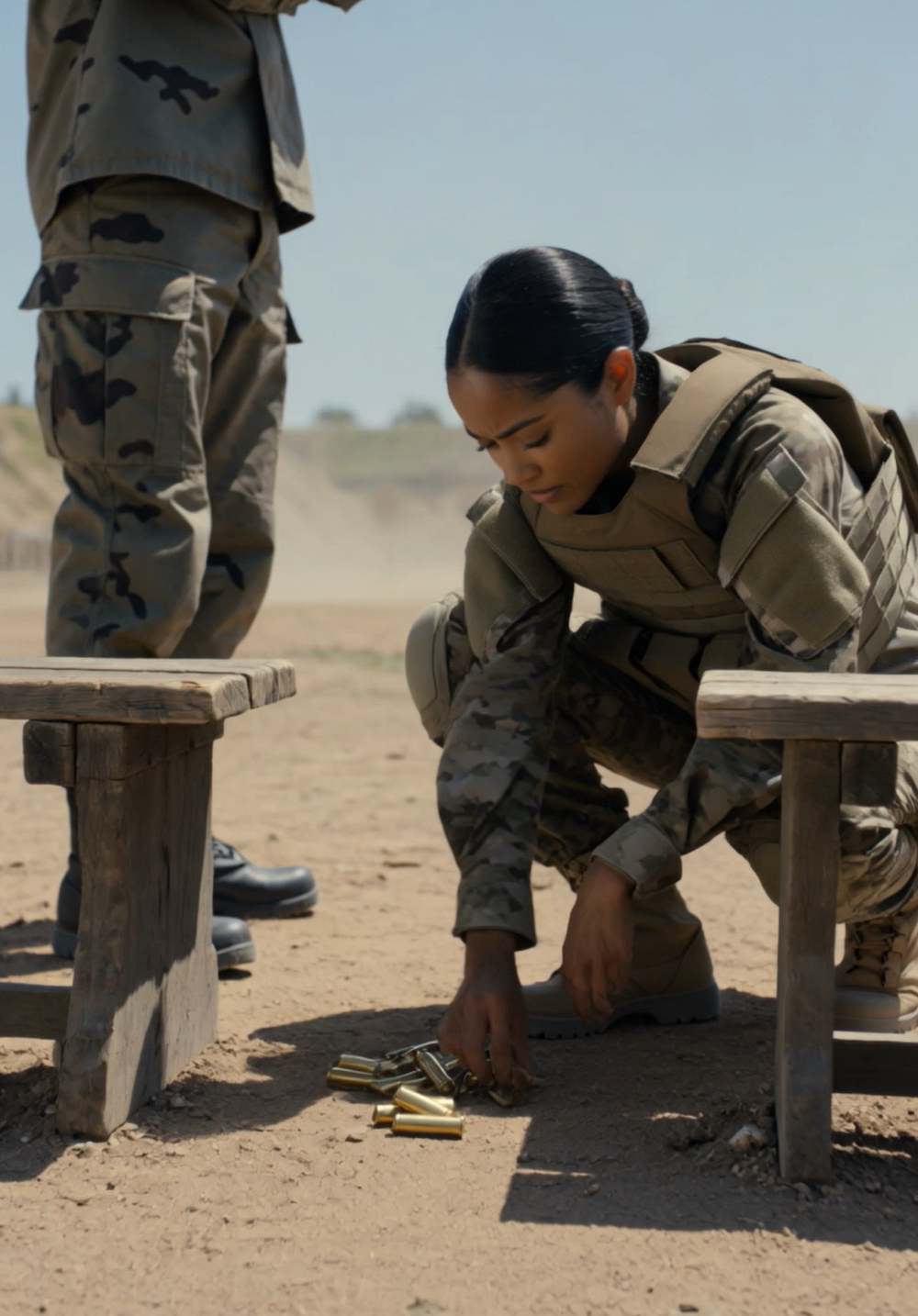
“You’re in my lane.”
She looked up from the ground. She’d been crouched at the edge of the firing lane, collecting spent casings in a canvas bag. The kind of task that gets done because someone has to do it, and no one of consequence notices who.
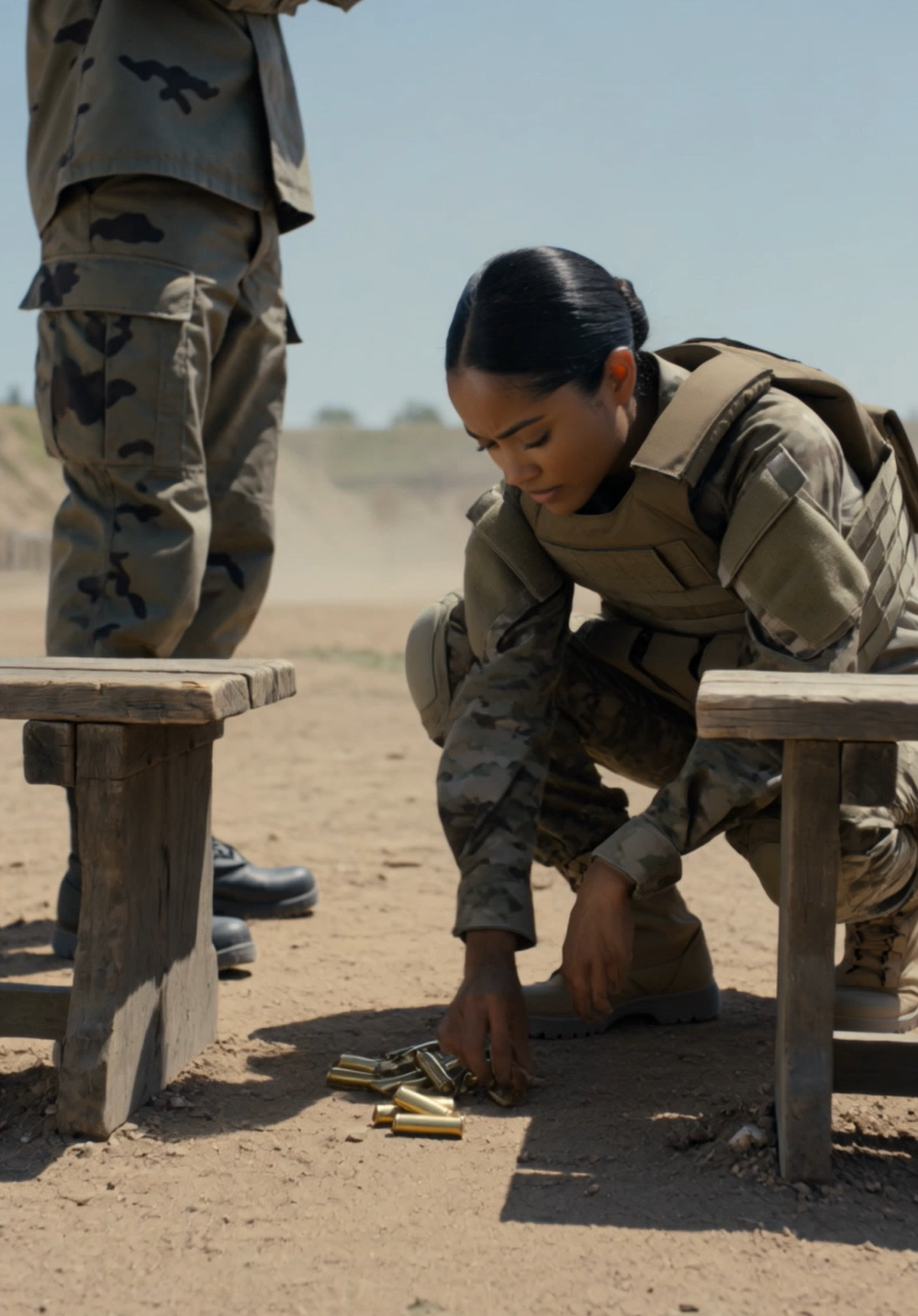
The man speaking was Staff Sergeant Brennan – Marine Scout Sniper, three tours, the kind of professional confidence that fills a room before the person does. His spotter stood beside him, rifle slung, wearing the patient irritation of a man whose precision work had just been interrupted by a woman with no unit patch on her sleeve.
“I’ll be out of your way in a minute,” she said.
“You’re out of your way right now,” he shot back. “This is a restricted lane. What are you even doing here?”
She held up the canvas bag. The logic was self-evident. He wasn’t asking because he didn’t understand – he was asking because he wanted her to acknowledge the hierarchy implied by the question.
She didn’t.
She just kept collecting brass.
Brennan exchanged a look with his spotter – the kind of look men share when they’re deciding how far to push something, and who’s watching.
“Tell you what,” Brennan said. “You want to stay on this range? Fine. But there’s a target at four thousand meters. End of the valley, behind the ridge cut. Nobody here has hit it – not with this wind, not at this elevation, not with standard ballistic tables.” He crossed his arms. “You want to try?”
She stood up slowly. She looked at him. Then she looked downrange, toward the ridge where, somewhere in the shimmer of heat, the target waited.
“What’s the wind?” she asked.
Brennan blinked. “Excuse me?”
“What’s the current wind reading? Mid-range and terminal.”
He stared. “Fourteen knots mid-range. Unknown at terminal – the valley creates a funnel effect that changes the read.”
“Elevation change?”
“Two hundred twelve feet of descent, then a forty-foot rise at the final two hundred meters.”
“What round are you running?”
“What are you—”
“What round.”
He told her.
She nodded once. Set down the canvas bag. Then she turned her head — slowly — toward the rifle case lying along the wall of the range shelter. The one that had been sitting there all morning. The one everyone had assumed belonged to a transiting soldier, or was waiting on a pickup.
“That’s yours?” Brennan said, his voice changing.
“It is.”
She walked over and opened the case.
The rifle inside was custom — long suppressor, modified bipod, optics that cost more than most people’s vehicles. And the worn finish of a tool that had been used in the field. Not maintained for inspection. Used.
She lay prone. Settled into position the way a person settles into something deeply known. Adjusted her scope. Pulled a small worn notebook from her chest pocket — the kind engineers carry, the kind researchers fill — and did math in the margins. Calm. Rapid. Small numbers in tight handwriting.
The range went quiet.
Word spreads on a range the way it spreads anywhere — fast, without announcement, through the specific frequency of people who sense that something worth watching is happening.
By the time she was ready, there were eleven men at the observation scope.
She breathed. She waited. She didn’t rush the wind — she read it, the way someone reads a face. Not just for what’s there, but for what’s about to change.
The shot, when it came, was a single event.
At the observation scope, someone whispered: “Hit.”
Nobody moved.
Brennan stood behind her. He looked downrange. He looked at the custom rifle. He looked at her — still prone, still composed, already beginning to disassemble her scope with unhurried hands. The work was done. The moment had already passed for her.
“What is your rate?” he said. Not sarcastic. Genuinely.
“Sorry?”
“Your rate. Your MOS. What do you do?”
She picked up the canvas bag she’d set down earlier. Resumed collecting brass.
“Right now?” she said. “This.”
And that was all she said.
Brennan stood in the lane long after she walked off. His spotter didn’t say anything either. The remaining brass on the ground caught the afternoon light — small, golden, spent.
Later, when they pulled the target data and ran the numbers, the ballistic solution she had used didn’t match any standard table in any manual any of them had ever trained from. It worked. It worked perfectly — accounting for variables that weren’t in any field guide they knew of.
Someone, somewhere, had trained her for this.
The question was where. The question was when.
That night, Brennan couldn’t sleep. He pulled up the range’s sign-in log, looking for her name. There was no name. No badge number. No vehicle plate.
But there was one entry, stamped by the base commander himself at 0500 that morning. Three words next to a clearance code Brennan had only ever seen once before, in a briefing he wasn’t supposed to remember.
And when he read what those three words said, his hands went cold.
“Conducting field audit.”
Field audit. The words echoed in his head, sterile and cold. It wasn’t a job title. It was a purpose. Audits weren’t for training. They were for finding flaws. For finding weaknesses.
The next morning, the sting of his own arrogance felt like a fresh burn. He went to the base commander’s office. Colonel Matthews was an older man, weathered by decades of service, with eyes that saw more than they let on.
Brennan stood at parade rest. “Sir, about the visitor on Range 7 yesterday.”
The Colonel didn’t look up from his paperwork. “What about her, Staff Sergeant?”
“The log entry, sir. The field audit.”
Matthews finally looked up. His face was a closed door. “Your team’s performance data was exemplary yesterday, Brennan. Focus on that. Your next deployment schedule is being moved up.”
It was a dismissal. More than that, it was a warning.
Brennan persisted, his voice quieter now. “With respect, sir, she made a shot nobody on this base could make. I need to understand her methods. For my team.”
“Some methods aren’t in a book,” the Colonel said, his gaze sharp. “They’re in the person. You saw a demonstration of that. Learn from it. Now get out of my office.”
Brennan left, but the Colonel’s words didn’t settle the matter. They twisted it tighter. He didn’t just want to know how she made the shot anymore. He wanted to know who she was.
He spent the next two days looking for her. Discreetly. He checked with the motor pool, the mess hall, the barracks assignment desk. Nothing. It was like she had vanished.
On the third day, he found her in the one place he hadn’t thought to look. The base library.
She was sitting at a small table in the back, surrounded by stacks of books on metallurgy and atmospheric science. Her canvas bag was on the floor beside her. It wasn’t full of random brass casings. They were sorted into small, labeled plastic bags.
She looked up as he approached, her expression calm, unsurprised.
He stopped at her table, feeling like a recruit on his first day. “Ma’am.”
She gave a slight, acknowledging nod.
“I wanted to apologize,” Brennan said. “For my conduct on the range. There was no excuse for it.”
“You were protecting your lane,” she replied, her tone neutral. “And asserting your authority. Standard procedure.”
The way she said ‘standard procedure’ made it sound less like a justification and more like a diagnosis.
“It was unprofessional,” he insisted. “I was unprofessional.”
She studied him for a long moment. “Your apology is accepted, Staff Sergeant.”
He opened his mouth to say more, to ask the questions burning in his mind, but then he looked at the books on her table. They weren’t military manuals. They were dense, academic textbooks.
“What are you really doing here?” he asked, the question slipping out more bluntly than he intended.
She picked up a casing from one of the bags. She turned it over in her fingers. “Brass is a story,” she said. “The alloy tells you about the manufacturer. The primer strike tells you about the firing pin. The expansion tells you about the chamber pressure.”
She pointed to a nearly invisible hairline fracture near the case mouth. “And this tells you that lot number 7B of this ammunition has a microscopic structural flaw. It won’t fail nine hundred and ninety-nine times out of a thousand. But on that one time, under the right stress, it will cause a catastrophic jam.”
Brennan stared at the tiny piece of metal. He’d seen thousands of casings. To him, they were just trash to be swept up. To her, they were data.
“You’re not a sniper,” he said, the realization dawning on him.
“Not in the way you mean,” she said. Her name, he learned, was Sarah Kenway. She wasn’t military, not exactly. She worked for a small, obscure office in the Department of Defense. They were the people who came in after the fact, the ones who figured out why a helicopter blade failed, or why a new armor system didn’t perform as advertised.
They were professional skeptics. Institutional ghosts who looked for the hairline fractures in the system itself.
“The shot,” he said. “Why did you take the shot?”
“You presented a unique opportunity,” she explained, her voice still quiet. “The wind conditions in that valley are notoriously difficult to model. I had a new predictive algorithm. You gave me a chance to test it with your ammunition, from your weapon’s operational environment. It was valuable data.”
The whole thing—his challenge, his pride, the audience of watching Marines—had just been a data point for her. The thought should have been humiliating. Instead, Brennan felt a strange sense of clarity.
“You’re auditing us,” he said. “The whole base.”
“I am evaluating readiness,” she corrected him softly. “Equipment, doctrine, personnel. It’s all connected.”
She then looked him straight in the eye. “Your team moves as a unit. Your sight picture is clean. But you have a blind spot.”
He braced himself.
“Your bipod placement. On uneven ground, your spotter defaults to placing the left leg slightly lower. It’s a millimeter difference. It compensates for the natural cant of a right-handed shooter. It’s what you were taught. But it also creates a subtle point of instability. In high winds, over two thousand meters, it can throw your shot by half a meter.”
He thought back to a dozen training exercises. Misses he had blamed on the wind, on bad dope, on a dirty barrel. Half a meter. Enough to matter.
“Nobody’s ever noticed that,” he said, his voice barely a whisper.
“My job is to notice,” she said, before turning back to her books. The conversation was over.
Brennan walked away from the library a different man. The world suddenly seemed full of details he had been blind to. He went back to his team and, without explaining why, he changed their bipod doctrine. He made them practice on rocky, uneven terrain for hours, focusing on perfect, level placement every single time.
His spotter complained. “This is nuts, Staff Sergeant. It’s not in the manual.”
“The manual is getting a new chapter,” Brennan replied.
Two months later, Brennan’s unit was deployed to a mountainous region overseas. They were providing overwatch for another team moving through a narrow valley, a near-perfect replica of the terrain back home.
An enemy sniper pinned them down from a high ridge. The range was extreme, over twenty-five hundred meters. The wind was howling, unpredictable, just like on the range that day.
Brennan set up. He remembered Sarah’s words. He paid agonizing attention to his bipod, ensuring it was perfectly level on the shifting shale. His spotter called the wind, but there was a doubt in his voice. The variables were off the charts.
“It’s an impossible shot,” the spotter muttered.
Brennan thought of Sarah’s quiet confidence. He thought of the hairline fracture in the brass. He thought of the tiny detail he had overlooked for a decade. He controlled his breathing, read the currents in the air, and trusted the new foundation he was built on.
He fired.
The shot was true. The threat was neutralized. The other team was able to move to safety.
Back at the forward operating base, the debrief was a blur. The engagement was hailed as a textbook example of long-range precision under impossible conditions. Brennan was commended, but he knew the credit wasn’t his alone.
He owed it to the quiet woman who collected brass.
A year passed. Brennan, now a Gunnery Sergeant, was offered a post as a lead instructor at the scout sniper school in Quantico. It was a prestigious assignment, one he never thought he’d get.
On his first day, he met with the school’s commanding officer. The Colonel was a legend, a man who had written half the manuals Brennan had studied.
At the end of the meeting, the Colonel slid a file across the desk. “You should know how you got here, Gunny.”
Brennan opened it. It was a field audit report. The author’s name was redacted, but he knew who had written it. It detailed the ammunition flaw, doctrinal inefficiencies, and readiness levels across his old base.
He scrolled through the technical data until he reached the personnel section. He found his own name. He expected a scathing review of his initial arrogance.
Instead, the report noted his behavior on the range. But it didn’t end there.
It went on to praise his “capacity to immediately internalize critique and implement doctrinal improvements without ego.” It mentioned his apology at the library. It noted his successful engagement overseas, citing it as direct evidence of his “superior adaptability and commitment to learning.”
The report concluded with a single line: “Staff Sergeant Brennan represents the precise combination of experience and humility required to train the next generation of warfighters. Recommend for instructor duty at the highest level.”
Sarah Kenway hadn’t just audited him. She had seen through his flawed exterior and found something worth endorsing. The challenge on the range wasn’t a test of his skill; it was a test of his character. And by admitting he was wrong, he had passed.
Brennan closed the file. He thought of her picking up those small, golden casings, finding the stories they held. He had been just another piece of brass to her, another part of the system to be analyzed. But she hadn’t just reported the flaw she found. She had also noted the polish.
On his desk in his new office, he placed a single, spent casing. It wasn’t there as a trophy. It was a reminder. A reminder that the most important lessons often come from the quietest corners, and that true strength isn’t about never being wrong. It’s about having the grace to learn when you are.



