
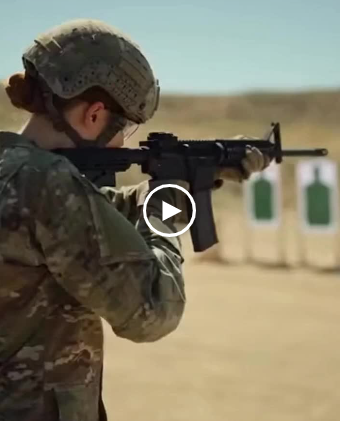
A morning on the range that changed everything
Five clean impacts sat tight as a quarter on the far wall, right where a human chest would be if the world marked aim with honesty instead of guesses. The sound that followed was not applause. It was silence—the kind that makes people stand up a little straighter and take stock of what they missed. In that hush, one young trainee realized he had been laughing at the one person in the room who never needed anyone’s approval to hit what mattered.
There are days in any life when the lesson you expect flips upside down. This was one of those days. The colonel’s demonstration had begun like a hundred others. Then it inverted in an instant, and you could feel the room learning in real time. Who asked which question, who rushed to make excuses, and who finally understood the difference between noise and precision—that is the part worth remembering. Because what came next quietly rewrote the order of things.
The colonel stepped forward with his jaw set, boots ringing against concrete like a metronome for authority. He stared at the tight cluster of holes, then turned toward Nicole Harper. She had already lowered her weapon. Her face gave nothing away. She looked like someone who had seen this misunderstanding before and knew how to let the facts speak for themselves.
The question no one expected to ask
“Private Harper,” the colonel said, voice hard but thinner than before.
“Sir?” Her tone was calm, almost restful.
“You want to tell me how the hell that happened?”
“I aimed,” she said. It was not a quip. There was no bravado in it. Just the simple truth stated like a steady hand.
The colonel scoffed and looked to Foster at the bench. “Was the sight off? Any malfunction?”
Foster’s mouth nearly curled into a smile but didn’t. “No problem with the rifle. Sights are set the way they left the factory. She just didn’t shoot where you were looking.”
Behind the firing line, a murmur ran through the ranks. Nicole heard the fragments without turning her head. Spec ops? Some unit from overseas? Was she part of a group with a name people whispered? She did not flinch. Being noticed late, or for the wrong reason, was not new to her.
“Private, what’s your background?” the colonel pressed. “Before the paperwork put you in supply.”
Nicole met his eyes. “I grew up with rifles. My father trained hunters in Montana. I also worked with a volunteer search and rescue group. It’s all in the file, sir.”
“That doesn’t explain a group that tight,” someone muttered from the back.
Nicole shrugged gently. “I didn’t say it would.”
The colonel stared as if the riddle had the answer written on the cover and he’d still forgotten to read it. Then something changed behind his eyes. The amusement faded. The calculation began. Before he could speak, Foster stepped a little closer.
“She’s not just good, Colonel. She’s very good. That group is tighter than what I’ve seen from half the instructors.”
“Not possible,” a trainee blurted out, louder than he meant to be.
Nicole turned slightly toward the voice. “Would you like me to repeat it?” Her voice was soft and entirely even. “You choose the weapon.”
That silence returned, but heavier now, like snowfall that dampens every careless sound. No one volunteered.
Foster tilted her head toward the colonel. “We are wasting her behind a desk.”
That was the moment something larger began to shift.
A doorway appears where a wall used to be
Within an hour, Nicole was called out of logistics and into a gray office deep in the training wing, a place that smelled like recycled air and decision-making. A man in civilian clothes waited, posture military even out of uniform, tablet in hand, small talk left at the door.
“You ever been offered a shadow track?” he asked.
Nicole blinked once. “I thought those weren’t official.”
“They aren’t, not on paper,” he said. “Sometimes we let the paperwork catch up to common sense.”
She let the quiet do the working for her.
“You’re not just precise,” he continued. “You’re calm. You move as if you’re using only the energy the job requires. That usually comes from training, or from life handing you hard lessons. Often, it’s both.”
Nicole stayed silent. The way she kept still made him nod as if she had answered anyway.
“We have a program. Cross-training. You’d learn more marksmanship, reconnaissance, and a slice of intelligence work. No transfer to a new unit yet. You would train under blackout orders. Not a secret to you, but a quiet line on our side.”
“Why now?” she asked, not defiant, simply practical.
“Because you just embarrassed a colonel with steady hands and no bravado. That kind of discipline is rare. The Army runs on noise. You seem to run on aim.”
He slid the tablet across. The header read like a locked door: Shadow Evaluation Program—Tier 3 Authorization Required.
“What if I say no?”
“Then you go back to inventory and morning runs. Maybe someone promotes you out of habit. Maybe you make sergeant by the time this war is a paragraph in a book.”
“And if I say yes?”
He let a small smile show. “Then people learn your name before they laugh.”
Nicole did not rattle the moment with a speech. She signed.
The quiet work of getting ready
Three weeks later, Nicole ran a timed live-fire course blindfolded. Her instructor, an ex-Ranger named Cates, watched with his arms folded and a stopwatch firm in his hand. Twenty seconds later, the room was clear. Four targets. Four clean strikes. Not a mark on the walls.
Cates shook his head like he was adjusting a picture frame that finally hung true. “You’re not just talented. You’re surgical. Who were you before you got here?”
Nicole removed an empty magazine, slid the next one in, and said nothing. For her, the reload was the answer.
Training hardened, then smoothed. Night runs sharpened the senses. Wilderness escape drills taught her to move quiet and think two steps ahead. Hostage scenarios used real actors and blanks, so the mind could practice staying still while the heart tried to rush. She learned and relearned the same movements until they were less like chores and more like breathing.
There is a shape to this kind of growth that doesn’t require shouting. Some people collect praise. Nicole collected repetitions. She didn’t brag. She didn’t bark. She did the work the way a craftsman sands wood: patient strokes, the surface improving each time, the dust swept away without ceremony.
Within a month, she began to pull ahead of most of the cohort. Respect followed, not because she asked for it, but because she left no room for doubt. The loudest thing about her was what she could do on command, and what she declined to explain.
The second meeting with the colonel
When the colonel saw her again, it was not on the range but at a joint-exercise briefing with brass in the room and quiet decisions being made three steps above everyone’s head. Nicole stood in full kit, visor tucked, unit patch unmarked. The colonel looked up, did a double-take, and found his words the way a man finds his footing after a misstep.
“Private Harper?”
She nodded once.
“I heard you changed tracks,” he said, the sentence both an admission and a compliment.
“Didn’t change, sir. Just caught up.”
He opened his mouth, maybe reaching for an apology, maybe for a tidy story to tell himself about that morning. But the briefing moved on without asking for his version. Nicole turned to the mission board. Her name sat beside the overwatch assignment, the role for the pair of eyes who sees danger traveling in from the edges.
She had been a clerk. Now she was the view from the high window.
Before dawn, a test that mattered
The operation kicked off at 0400. It was a training takedown in an urban setting, but the stakes were as real as inked signatures and remembered names. Senior observers were present. Drones watched. Evaluations waited like blank report cards.
Nicole set up on a second-story perch with limited cover and plenty of sightlines. She called distance and wind shift to her spotter. She did not correct his numbers out loud. She already knew her own.
Three hostiles moved through the space below. Two slipped into a building. A third lingered in the blind angle, trying to be the problem no one would see in time. Nicole settled her breath. Her pulse slowed. The rifle bucked against her shoulder like a whisper into a sleeve.
Target down.
Minutes later, the assault team cleared the building without a single injury. The capture was clean. Her single shot had removed the only threat tucked out of sight—even the drone feed had missed it. Command noticed the result because results are hard to argue with.
After extraction, Cates approached while she stripped her gear with the quiet satisfaction of a job done without drama. “They’re putting you in for something,” he said.
Nicole rolled a shoulder free of a strap. “Doesn’t matter.”
“Why not?”
She looked up, the hint of a smile nowhere on her face but somewhere near the steadiness in her voice. “I don’t do this for decorations.”
A summons from higher—and quieter
That night, a coded message reached her. It was not from her unit. It was from above the places with names on the doors.
Your performance has been reviewed. Report to Hangar 3 at 0600. No questions.
She didn’t pack much. A duffel. The service pistol she had tuned to her hand in week two. At Hangar 3, a black tiltrotor already idled, rotors turning the air into purpose. Two men in suits waited inside. No insignia. No introductions. She boarded. No one filled the silence with small talk. The flight lasted hours and said nothing.
They did not land at a base. They touched down at a compound whose purpose lived in the space between words. Inside, a single table waited with a sealed folder on it.
“Open it,” the taller man said.
Inside, the profile had lines where a name should be and shadows where a face should sit. The mission code was simple, almost too on the nose to be real: WRAITH.
“You’re being activated,” the man said, not unkindly. “You proved what we needed to know. You’re not just precise. You can be invisible until the moment not being invisible is the point. That is what we need.”
Nicole leaned back and studied both men the way a careful person looks at a map before taking the first step. “What’s the target?”
The man’s answer curved into something like a smile. “Don’t worry. We already know you’ll hit it.”
And just like that, the woman they once dismissed as a clerk became the quiet presence in the places that shape outcomes. The laughter that had greeted her on a range now lived only as a lesson in someone else’s mind.
The marks that remain, and the ones that matter
Back at Fort Ironwood, a new class of trainees stepped up to the line, hands a little shaky the way hands are when a new chapter starts. One of them pointed at the rear wall, where five faint circles still lived in the concrete.
“What are those from?” a fresh recruit asked, not mocking, just curious.
Foster, now running the session, paused. The hint of a smile touched her, the kind that reaches the eyes when memory and pride meet halfway. “Story for another time,” she said.
As she said it, she glanced up toward the big open sky over the range. It was a small thing, a reflex of respect, like straightening a picture before guests arrive. Somewhere out there, Nicole Harper was still doing the work. Watching. Waiting for the next shot that mattered. Keeping it all quiet until the moment called for clarity.
And this time, nobody laughed. What they did instead was learn. The room had discovered the difference between being loud and being right, between activity and aim. That is a lesson that lasts. It changes how you stand, how you listen, and when you speak.
A simple truth for anyone who’s ever been underestimated
For anyone who has been told to stay small, or to keep busy while others handle the real work, Nicole’s story carries a gentle promise. Sometimes the most important talent doesn’t wear a label. Sometimes the best moment to begin is the moment you are noticed for the wrong reason, and you let your steady hand correct the record. There’s wisdom in moving with purpose, in spending energy where it counts, and in refusing to explain away what you can show with results.
Nicole did not argue. She didn’t perform for praise or live for headlines. She practiced. She learned the safety, the patience, and the judgment that come from a lifetime of careful instruction, from hunting seasons where a bad shot meant going home empty, from volunteer rescue work where staying calm could save a stranger’s life. Then she brought that discipline into a world that often mistakes volume for value. She showed that a clear eye and a quiet breath can change a mission, a room, and in small, steady ways, a culture.
In time, medals may or may not find their way into a drawer. Names may or may not make their way into stories told after the fact. But the lesson remains, even after the marks on the wall fade. There is a strength in being exact. There is dignity in doing the job without fanfare. And there is power in choosing when to be seen.
On that first day, five small circles carried a bigger message than anyone expected. They said that skill and humility can sit in the same person, that work done well does not need a witness to be real, and that laughter at the wrong moment can become a footnote while the person you doubted writes the rest of the page.
Somewhere far from Fort Ironwood, a quiet aircraft may lift into the dawn with no markings and no announcements. Somewhere, someone calm will measure the wind and the distance, not for recognition, but simply to do the task well. If you listen, you will not hear much. That is the point. Precision makes less noise than pride. And in the space where the two part ways, careers are made, rooms are rewritten, and on rare days, even colonels stop laughing.



