
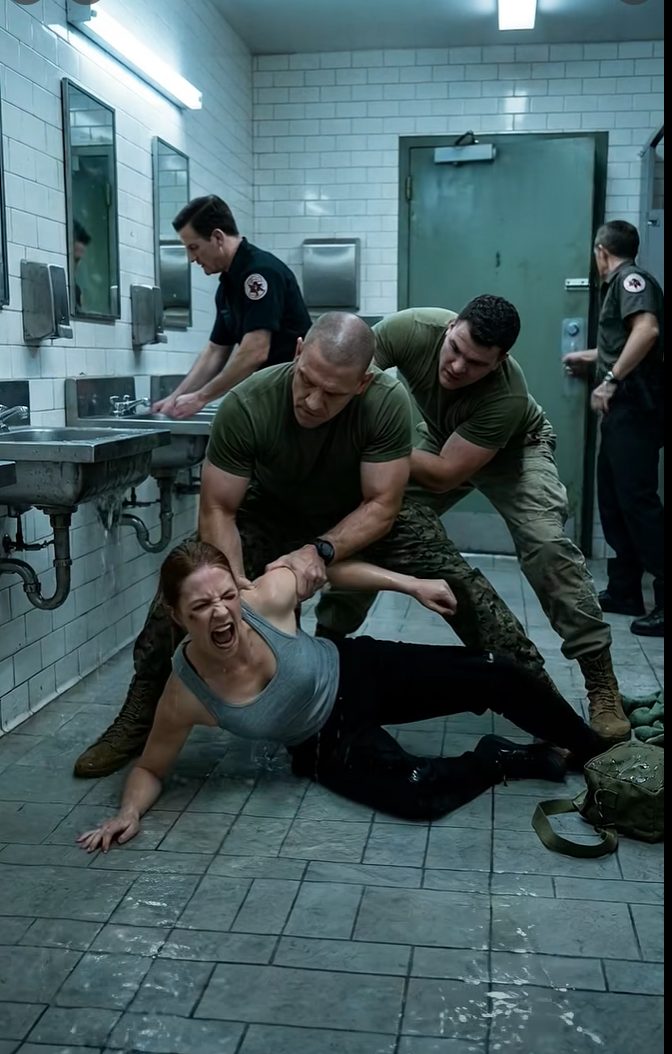
“LOCK THE DOOR SO NO ONE HEARS IT!” They Pulled Her Into The Bathroom – 2s Later, Only One Navy SEAL Came Out!
“Lock it.”
The order snaps across the tiled walls, sharp enough to feel like it could slice skin. A deadbolt slides into place with a hard metallic click that sounds like a coffin lid shutting.
Four men. One woman.
Eleven minutes from now, only one person will leave this bathroom alive enough to count.
But that is still eleven minutes away.
Three weeks earlier, the air in the room tastes of ozone and buried secrets. Fluorescent lights buzz at a pitch you don’t notice until it becomes the only sound in your head. The room does not officially exist, hidden inside a building the Pentagon denies, tucked behind a corridor that never shows up on any map.
Commander Katherine Sullivan sits in a steel chair bolted into the concrete floor. She is thirty-three, auburn hair pulled back tight, posture straight as if a metal rod runs through her spine. Her green eyes are calm in a way that makes men who depend on intimidation suddenly question themselves.
Across the table sits Admiral Lawrence Donnelly, sixty-two, shoulders still squared as though he is standing at attention despite being seated. His hands rest on a manila folder marked with a red stripe, the kind that means people have died to keep what it contains buried. His wedding band is worn thin. His knuckles are scarred.
“Fort Davidson,” he says.
Two words, flat and heavy, like he is naming an illness.
Kate does not blink. Donnelly opens the folder. The first page shows a satellite image: Nevada desert, beige buildings, firing ranges, obstacle courses, and mountains wavering through a heat mirage.
“Seventeen assault reports in two years,” Donnelly says. “Zero prosecutions. Zero convictions. Zero consequences.”
He flips to the next page.
The photograph there does not belong inside a classified file. It belongs on a refrigerator. A young woman in Navy blues, twenty-four, blonde hair cut to regulation, blue eyes glowing with the kind of hope that comes from believing the uniform still means something.
Jessica Sullivan.
Kate’s baby sister.
The little girl who once stole Kate’s combat boots at five years old and marched around the backyard like she owned the planet. The teenager who cried when Kate shipped out. The young woman who joined the Navy after her because she wanted to become just like her.
Dead.
April 3rd, 2021.
Donnelly pushes the official report across the table. The language is neat and lifeless.
Training accident. Fatal fall from fourth-floor administrative building. Catastrophic injuries consistent with impact. No witnesses. Case closed.
Kate’s jaw tightens, only slightly. Donnelly sees it. He is a man who has spent his whole career studying what grief looks like in people trained never to reveal it.
“That’s the official story,” he says softly.
He turns another page.
A preliminary medical examiner’s report, written before someone above decided it should no longer exist.
Bruising inconsistent with a simple fall. Defensive wounds. Torn clothing. Evidence of a struggle.
Kate’s breathing remains steady, but something behind her eyes becomes very still.
“The unofficial story,” Donnelly says, “is that Jessica attempted to report an assault. She followed proper channels. Filed paperwork. Asked for an investigation.”
He turns the page again. A witness statement that never reached the final report. A female corporal saw several men leaving the building shortly before Jessica was found.
“Transferred to Okinawa before anyone followed up,” Donnelly adds. “The statement vanished. She was warned she’d face court-martial for making false accusations if she kept speaking.”
Kate’s hands lie flat against her thighs, unmoving as stone.
“How many others?” she asks.
Donnelly closes the folder as if he is shutting a coffin. “Forty-seven that we know about,” he says. “Women who reported assaults at different installations. Moved to bases already flagged for systemic misconduct. Marked as disciplinary problems. Isolated. Discredited. Or – “
He does not finish.
He does not have to.
Kate reaches into her jacket pocket and removes an old photograph. Two little girls in a backyard. The younger one wearing a Marine dress cover three sizes too large. The older one standing at attention beside her. Both smiling like the whole world belongs to them.
Their father, Colonel Patrick Sullivan, died in Mogadishu. Kate was eight. Jessica was five. The picture was taken two weeks before notification officers appeared at their front door.
Kate slips it back into place, directly over her heart.
“Tell me about Corsair,” she says.
Donnelly leans back. A second folder comes out of a locked briefcase, thicker than the first, stamped with a classification level that makes the red stripe look almost ordinary.
“Black program,” Donnelly says. “It doesn’t exist on paper. It never will.”
Kate’s eyes do not move.
“We place female Tier One operators inside installations flagged for systemic misconduct,” he continues. “Strip their identity. Remove their rank. Make them appear to be the perfect target.”
Kate’s mouth tightens. “Bait.”
“Catalyst,” Donnelly corrects. “Predators do not reveal themselves to strength. They go after what looks weak. We manufacture vulnerability. When they strike, we collect evidence so clean even Pentagon attorneys can’t bury it.”
He flips through pages, showing operational summaries, most stamped mission failure in block letters.
“Twelve operators before you,” he says. “Three dead. Four permanently injured. Five failed to trigger an attack or gather enough evidence to break the protection network.”
Kate’s eyes move over the casualty list. She reads each name as if carving it into memory.
“Success rate?” she asks.
“Zero,” Donnelly says.
The silence inside the room grows dense, heavy as water flooding a sealed compartment.
“You would be number thirteen,” Donnelly adds.
Kate looks down at Jessica’s photograph in the other folder. That trusting smile. That bright, foolish hope.
“When do I leave?” she asks.
Donnelly does not praise her. He does not call her brave. He only nods, like a judge delivering a sentence.
“Seventy-two hours,” he says. “New identity. Private Jane Miller. E-1. Disciplinary transfer. Insubordination. Failure to adapt. The paperwork will make you look disposable.”
He opens a small case. Inside rests a capsule smaller than a grain of rice.
“Swallow it,” he says. “Biocompatible nano-recorder. Activates when your heart rate passes one-forty. Records forty-eight hours of audio. Transmits once you reach open air.”
Kate lifts the capsule toward the light.
So tiny.
So heavy.
“If I die,” she says, “what happens?”
Donnelly’s expression does not shift. “Training accident,” he says. “Full honors. Folded flag. Letter of regret. Your name on a wall no one visits.”
Kate places the capsule on the table and asks the only question that matters.
“Do you think I can do this?”
Donnelly meets her stare with the kind of respect that is not handed out, only earned.
“You graduated BUD/S,” he says. “You deployed. You are the most qualified person we have ever sent.”
He pauses.
“But being qualified does not mean surviving.”
Kate gives one small nod.
“My sister tried to do it the right way,” Kate says quietly. “The system failed her.”
“The system protected predators,” Donnelly says. “So the system has to be exposed.”
Kate picks up the capsule and closes her fist around it.
“When I walk out of that base,” she says, her voice steady, “it won’t be inside a body bag.”
Donnelly extends his hand. Kate takes it.
The agreement is sealed with something stronger than ink.
Three weeks later, inside a Nevada bathroom, the deadbolt clicks.
And Kate Sullivan is exactly where she meant to be.
Private Jane Miller, Reporting for Duty
The drive to Fort Davidson takes four hours through country that looks like a painting someone gave up on. Flat. Brown. Heat coming off the asphalt in visible waves. Kate sits in the back of a government sedan with a duffel bag containing everything Private Jane Miller owns: two changes of clothes, a paperback novel with the spine cracked, and a toiletry bag that holds a secondary recording device disguised as a lip balm tube.
She’s been Jane for six days already. Six days of drilling herself on the backstory until it comes out without thinking.
Grew up in Tulsa. Father was a mechanic. Mother left when she was nine. Dropped out of community college. Joined the Navy because there was nothing else. Got into trouble at her last posting for mouthing off to a senior petty officer. Transferred here as a last chance before discharge.
Disposable.
That’s the word Donnelly used. The paperwork will make you look disposable.
She watches the base gate approach. Two sentries. Standard checkpoint. One of them waves the sedan through without more than a glance.
Nobody looks twice at a disciplinary transfer.
That’s the whole point.
Her bunk is in a barracks block at the far east end of the installation, away from the main administrative buildings, away from the officers’ quarters. The women’s block. Twelve bunks, seven occupied. The women who are already there look at Jane the way people look at a new dog in a shelter: sizing up the threat level, deciding whether to bother.
One of them, a compact woman named Petty Officer Donna Reyes, does not look away as fast as the others.
“Transfer?” Donna asks.
“Yeah.”
“From where?”
“Lemoore.”
Donna nods slowly. Something careful in her expression. “Word of advice,” she says, voice low enough that it doesn’t carry past the two of them. “Stay out of the rec room after twenty-one hundred. Don’t walk to the mess hall alone after dark. And if anyone named Chief Kowalski offers to show you around the base, tell him you’ve already seen it.”
Kate files each word in a precise internal drawer.
“Thanks,” she says.
Donna’s eyes hold hers for a beat. Then she goes back to her book.
The Network
It takes four days to map it.
Kate does not rush. Rushing is what number three did, according to the operational summaries Donnelly showed her, and number three ended up in a Nevada hospital with three broken ribs and a fractured orbital bone and a cover story about a training fall that nobody questioned.
She goes to mess. She does her assigned work detail, motor pool maintenance, hands dirty by 0700 every morning. She keeps her head down in exactly the way a woman who is slightly broken would keep her head down. Not submissive. Not invisible. Just tired. The kind of tired that says she’s had enough fights and lost enough of them.
Chief Petty Officer Dale Kowalski is forty-one. Broad across the chest. A jaw like a cinder block. The kind of man who learned early that his size did most of his talking for him and never bothered developing much else. He runs the administrative support division and has, by Kate’s count, four men in his immediate orbit who move with the particular ease of people who have never faced consequences.
Petty Officer Second Class Gary Pruitt. Twenty-six. Quick eyes. Nervous laugh that appears and disappears too fast.
Petty Officer First Class Ron Hatch. Thirty-three. Former MP, transferred here eighteen months ago. Quiet in a way that is not peace.
Seaman Marcus Webb. Twenty-two. The youngest. Follows the other three with the desperate energy of someone still auditioning for membership.
Kate watches them for three days before she understands the structure. Kowalski decides. Hatch executes. Pruitt covers the paperwork trail. Webb does whatever the other three need him to do and is grateful for the privilege.
On the fifth day, Kowalski notices her.
She feels it before she sees it. The shift in the air when a specific kind of attention turns your way. She’s catalogued it before, in other contexts, in other theaters. It has a texture. Like barometric pressure dropping before a storm.
She keeps eating her lunch and does not look up.
The Setup
Day eight.
Donna Reyes finds Kate at the motor pool at 1630, ostensibly to borrow a torque wrench. She hands it over without looking at Kate directly.
“They’ve been asking about you,” Donna says. “Kowalski’s crew.”
“What kind of asking?”
“The kind where they already know the answers.” Donna sets the wrench down and picks up a different one, like she’s still shopping. “Your paperwork. Your disciplinary record. They pulled it.”
Kate keeps her hands on the engine block in front of her.
“Pruitt does admin,” Donna continues. “He can access transfer files. They do this with every new woman who comes in flagged as a problem case. They build a profile. Figure out who’s going to be believed if something happens and who isn’t.”
Kate looks at her now. Donna’s jaw is set tight.
“You’ve seen this before,” Kate says.
“I’ve seen what comes after,” Donna says.
She leaves with the wrong torque wrench and neither of them mentions it.
That night, Kate lies on her bunk and stares at the ceiling and counts the acoustic tiles. Sixty-three. She does this sometimes, counts arbitrary things, when she needs to keep her hands from doing something that would blow the operation.
Sixty-three tiles.
Jessica would have been twenty-seven in September.
She swallows the thought back down.
Eleven Minutes
Day eleven.
Kowalski makes his move at 2107.
Kate is in the corridor outside the rec room, alone, which she has been engineering for two days. Pruitt appears first, which means Hatch is already positioned somewhere behind her. She clocks Webb in her peripheral vision near the exterior door, shifting his weight from foot to foot.
Kowalski comes out of the rec room like he just happened to be heading the same direction.
“Miller,” he says. Friendly. The specific friendliness of a man who has done this before and gotten away with it before. “Haven’t had a chance to introduce myself properly.”
“Chief Kowalski,” Kate says. Flat. Not hostile enough to escalate, not warm enough to invite.
“Heard you’ve had a rough go of it,” he says. “Lemoore, then here. That’s a tough break.”
“I manage,” she says.
He smiles. “Come on. I’ll show you the break room on the admin side. Better coffee than this side of the base.”
Hatch has closed the gap behind her. Not touching. Just there.
Kate does the math in under a second. Four men. One corridor. The exterior door is twenty feet away but Webb is covering it. The rec room is empty at this hour, she’s verified that twice this week. The admin corridor is a dead end with a bathroom halfway down.
She lets herself be walked.
This is the part that requires something she does not have a name for. Not courage. Courage is the wrong word. Courage implies the option of turning back. This is more like walking into a burning building because the only person who can put out the fire is already inside.
The bathroom door. Kowalski opens it. The gesture of a host.
Kate walks in.
Pruitt follows. Then Hatch. Then Webb, pulling the door shut behind him.
“Lock it,” Kowalski says.
The deadbolt slides home.
Kate counts two seconds.
Her heart rate is at one hundred and forty-three beats per minute. She knows this not because she can feel it but because she can feel the capsule activating, a sensation like a single warm pulse behind her sternum. The recorder is running.
Everything from this point forward is evidence.
Kowalski takes a step toward her. He is still wearing the friendly expression, but it has changed quality, the way stage lighting changes when the scene shifts. His hands come up.
Kate moves.
What happens in the next forty seconds does not look like a movie fight. It is not elegant. There is no music. Hatch’s elbow connects with the side of her head on his way down and her ear rings for the next three hours. She splits the skin of her left knuckle on Pruitt’s teeth. She hits the floor once, knee first, hard enough that she feels it for a week.
But she has trained for this specific geometry, four men, confined space, no room to run, in a facility in Virginia for eleven days straight before she swallowed that capsule.
Forty seconds.
Then it is quiet.
Kowalski is on the floor with his wrist at an angle that wrists do not naturally achieve. Hatch is not conscious. Pruitt is sitting against the wall holding his face with both hands. Webb is in the corner, unharmed, which was a choice Kate made deliberately. He is nineteen. His hands are shaking. He is crying without making any sound.
Kate straightens up. Her knee is screaming. Her ear is still ringing.
She looks at Webb for a moment.
“You’re going to tell them everything,” she says. “Every name. Every incident. Everything Pruitt documented and everything Kowalski told you to forget.”
Webb nods so fast it looks involuntary.
Kate slides the deadbolt back.
She walks out into the corridor, then out through the exterior door into the Nevada night air. The sky is enormous out here, black and full of stars that don’t care about any of this.
She stands in the open air for exactly four seconds.
The capsule transmits.
Forty-seven women.
Including one who wore combat boots three sizes too big and marched around a backyard like she owned the whole planet.
Kate reaches up and touches the photograph through her jacket, just once, just briefly.
Then she takes out her phone and dials Donnelly’s number.
He answers on the second ring.
“It’s done,” she says.
—
If this one got to you, pass it along to someone who needs to read it.
If you’re eager for more intense stories, you won’t want to miss when The Admiral Laughed at Her on the Firing Line – Then He Saw the Tattoo or how She’d Been “The New Girl” for Months. Then Six Marines Walked In at 3 A.M.. And for a tale of quiet defiance, check out when My Sergeant Shoved My Face Into The Dirt. He Had No Idea What I Was Already Building Against Him..



