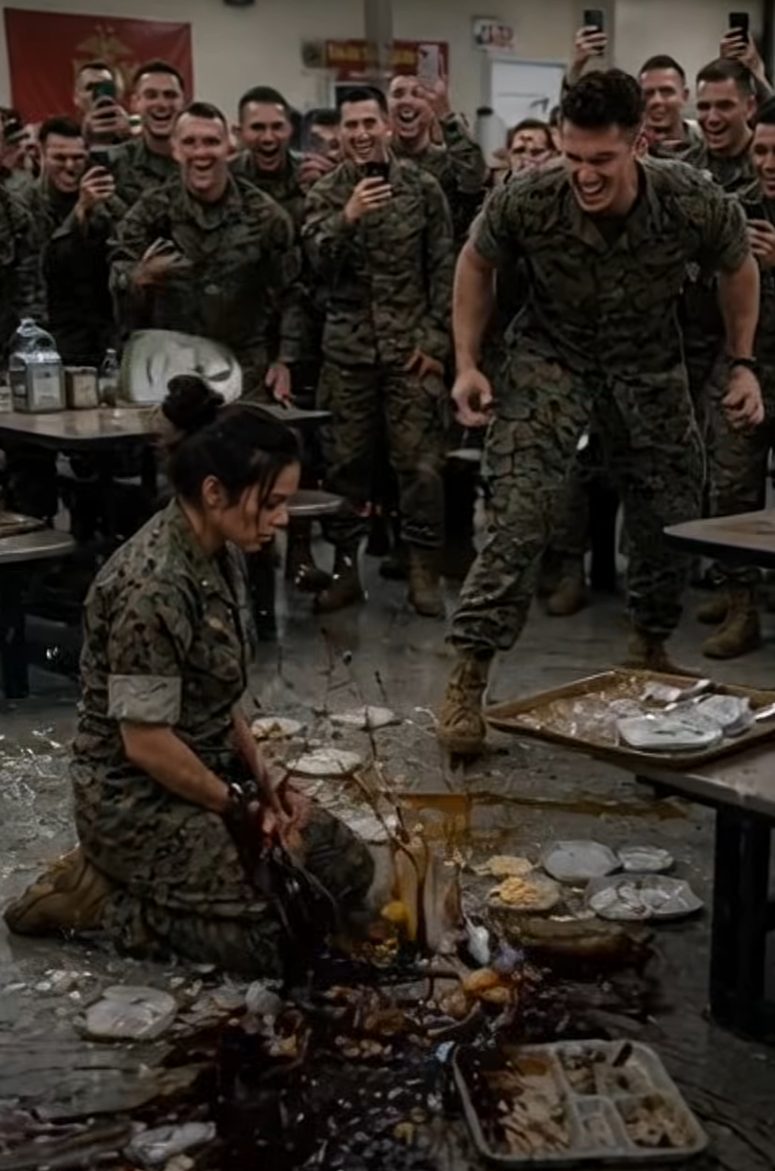
“On your knees,” the lieutenant barked, slamming his boot onto the table as phones rose around the cafeteria. But the young recruit did not lower her head. She looked him straight in the eyes, and everything changed.
—
The young woman stepped onto the Marine base just before sunrise, while cold gray fog still drifted across the cracked concrete like smoke from a dying fire. Massive steel hangars loomed in the distance, their walls rattling with the growl of machinery and the sharp clang of metal tools. Marines rushed across the training grounds with heavy boots pounding against wet pavement, while the bitter scent of motor oil mixed with damp concrete and burnt cafeteria coffee filled the freezing morning air. A heavy duffel bag rested over the young recruit’s shoulder, but her posture never wavered. She walked through the center of the base with calm, steady confidence, ignoring the dozens of eyes immediately locking onto her.
No one looked pleased to see her there. A few Marines exchanged amused smirks. Others openly laughed without bothering to lower their voices. One man muttered that women never lasted long in units like this. Another joked that someone must have sent her to the wrong address. The comments spread through the yard like sparks across dry grass. This place respected toughness above everything else. Strength mattered. Discipline mattered. Weakness was devoured without mercy. To many of them, a young female recruit entering their world looked less like a soldier and more like an invitation for ridicule.
First Lieutenant Derek Manning hated the sight immediately. He stood near the training yard with his arms folded tightly across his chest, a full head above the Marines beside him, built wide across the shoulders like a man who had spent decades making himself difficult to move. He had scarred knuckles and sharp features hardened by years of command. His cold stare followed the recruit from the moment she crossed the gate. He noticed the others watching him closely. That mattered. A man like Derek built authority carefully, piece by piece, and he knew reputation inside a Marine unit could disappear overnight if weakness appeared. The arrival of the young recruit threatened the balance he controlled. He decided instantly that she needed to understand her place.
He found her in the cafeteria at noon. She was seated alone at the far end of a long metal table, eating without hurry, her back straight, her eyes forward. The room was full. Conversation dropped the moment Manning walked in. He crossed the floor slowly, letting every boot strike land hard against the concrete, letting the silence build ahead of him like a wall.
He stopped directly beside her table. She did not look up.
He wants me to flinch, she thought. That’s the whole point.
She kept eating.
Manning let the silence stretch another few seconds. Then he lifted his boot and slammed it onto the table beside her tray. The metal surface rang like a struck bell. Every head in the room turned. Phones rose. Someone near the back held their breath loud enough to hear.
“On your knees, recruit,” he said.
The cafeteria went completely still.
She set her fork down slowly. She turned her head and looked up at him, not with anger, not with fear, but with something steadier than either. Her eyes met his and held there, flat and certain, the way a load-bearing wall holds when everything around it is shaking.
She did not move.
She did not lower her head.
And in that silence, with every eye in the room fixed on the two of them, something shifted. Manning could feel it. The room that had always bent toward him was no longer bending.
Her Name Was Carla Burke
Carla Burke had grown up in Beaumont, Texas, third of four kids, daughter of a man who drove trucks for thirty years and a mother who worked double shifts at a hospital laundry facility until her hands cracked every winter. Nobody in her family had ever commissioned. Nobody had gone to officer school. But she had tested into the top three percent of her intake class, and the Corps had placed her here, at Camp Ridgeline, a base that had been all-male for the first nineteen years of its existence and had never quite adjusted to the change.
She was twenty-two. She had been at Ridgeline for six weeks.
In those six weeks she had been called things she didn’t bother repeating. She’d had her bunk searched twice without cause. Someone had poured motor oil on her training gear the second Thursday she was there. She had cleaned it up herself, said nothing, filed nothing, because she understood what filing would cost her. Not in the official sense. In the daily-life sense. The kind of cost that shows up in a hundred small ways, a hundred small moments, until the accumulation of it buries you.
So she had kept her head down.
Not today, though.
She looked at Manning’s boot on the table beside her tray. Scuffed black leather. Size twelve, maybe thirteen. The kind of boot that expected the floor to apologize for being in its way.
She looked back at his face.
“Sir,” she said. “There’s no regulation requiring that.”
The Thing That Happens When Nobody Blinks
Manning had done this before. Not often, but enough to know the formula. You find the weak point, you press it publicly, you give the person a way out that costs them something visible. They take it. They sit down smaller than they stood up. The room learns the lesson without you having to teach it twice.
It had always worked.
He stared at her now. She was still looking at him. Not defiant, exactly. Not performing anything. She just hadn’t moved. Her hands were flat on the table. Her food was getting cold. She looked like someone who had already decided the outcome of this conversation and was simply waiting for the rest of the room to catch up.
“You questioning me, recruit?”
“I’m asking for the regulation, sir.”
Somebody near the middle of the room shifted in their seat. Manning heard it. He heard the phones still up, too. That was the part he hadn’t anticipated. Usually when he walked into a room, people put their phones away. They didn’t want to be associated with whatever came next. Today they were recording.
That meant they weren’t afraid of him.
Or they were, and they were recording anyway.
He wasn’t sure which was worse.
What Sergeant Dora Hensley Did Next
Sergeant Dora Hensley had been at Ridgeline for eleven years. She was forty-one, built like someone who had run a thousand miles and intended to run a thousand more. She sat four tables away, and she had watched Manning’s performance with the particular stillness of someone who had been waiting for something without knowing exactly what.
She stood up.
She didn’t say anything. She just stood up, picked up her tray, walked to Carla’s table, and sat down across from her.
That was it. That was the whole thing.
But the room understood it immediately, the way rooms understand things that don’t need to be explained. Hensley had eleven years on this base. She had run training cycles that broke men twice Carla’s size. Nobody questioned Hensley’s toughness. Nobody had ever found a reason to.
And she had just sat down next to the recruit who wouldn’t kneel.
A corporal named Terry Gould, twenty-six years old, from Akron, Ohio, who had laughed when Carla walked through the gate that first morning, stood up next. He carried his tray to the table and sat down without making eye contact with anyone.
Then two more.
Then three.
Manning’s boot was still on the table.
The Regulation He Couldn’t Name
He knew there wasn’t one. He had known it when he said it. The command was theater, not order. That was the whole mechanism of it. You gave an instruction that humiliated, and the humiliation itself was the point. The person who complied understood they had no real protection here. The person who didn’t comply got crushed by the weight of the room.
Except the room had moved.
He took his boot off the table. He did it slowly, like it was his idea, like he had somewhere better to be. He straightened his jacket. He looked at Carla one more time.
She was eating again.
He walked out of the cafeteria.
What Happened the Following Week
The footage was on three different phones. By evening it had reached the base commander’s desk through a channel Manning had not anticipated, which was a sergeant major named Phil Crockett who had served with Carla’s father’s unit in the nineties and had known her by name before she arrived. Crockett watched the video twice. He sent one message to the base commander. The message was four words.
We need to talk.
Manning was called in Thursday morning. The conversation lasted forty minutes. Nobody present described it afterward as pleasant.
He was reassigned within the month. Not discharged, not publicly disciplined in any way that made the news. Just moved. Transferred to a logistics post three states away, the kind of assignment that happens when the Corps wants to solve a problem quietly and permanently. His name disappeared from Ridgeline’s roster like a smudge wiped off a whiteboard.
Carla heard about the transfer secondhand, from Hensley, who mentioned it the way you mention weather.
“Manning’s gone,” Hensley said, lacing up her boots in the equipment room.
Carla looked up.
“Logistics,” Hensley said. “Somewhere cold.”
She went back to lacing her boots. Carla went back to checking her gear.
That was the whole conversation.
What Carla Did After That
She stayed. That part mattered. She didn’t leave, didn’t request a transfer, didn’t accept the quiet suggestion from one well-meaning officer that she might be more comfortable at a different installation. She ran her training cycles. She qualified. She kept her bunk squared and her scores high and her head exactly where it had always been: level, forward, unbothered.
She was not universally liked. That was never the point.
Terry Gould, the corporal from Akron who had laughed the first morning and then carried his tray to her table, became something like a friend. Not a close one. A base friend, the kind you eat with and complain about the coffee with and don’t see again once assignments change. He told her once, about four months in, that he’d felt sick watching Manning that day in the cafeteria. That he’d laughed that first morning because everyone else was laughing and he hadn’t thought about it.
“I know,” she said.
“That’s not an excuse,” he said.
“I know that too.”
He nodded. She ate. They didn’t talk about it again.
Hensley made staff sergeant before the year was out. Carla finished her initial cycle and tested into advanced training. The base moved on the way bases move on, grinding forward, absorbing the next round of recruits, producing the next round of Marines.
Nobody put their boot on her table again.
Not because she had made a speech. Not because she had filed a complaint or given an interview or demanded anything from anyone. Because she had sat there, in a room full of people deciding who she was, and she had stayed exactly herself.
Fork down. Eyes up. Not moving.
—
If this one stayed with you, pass it on. Someone out there needs to read it.
For more incredible stories of standing your ground, check out how one general’s joke about a kill count went sideways or read about what happened when a woman walked into a cage with three “vicious” military dogs. And if you’re curious about surprising turnarounds, you won’t want to miss the officer who went pale the second he heard her last name.